Faerdom: Now, As Ever
Exhibition audio description guide with transcripts
Section 2 – Faerdom
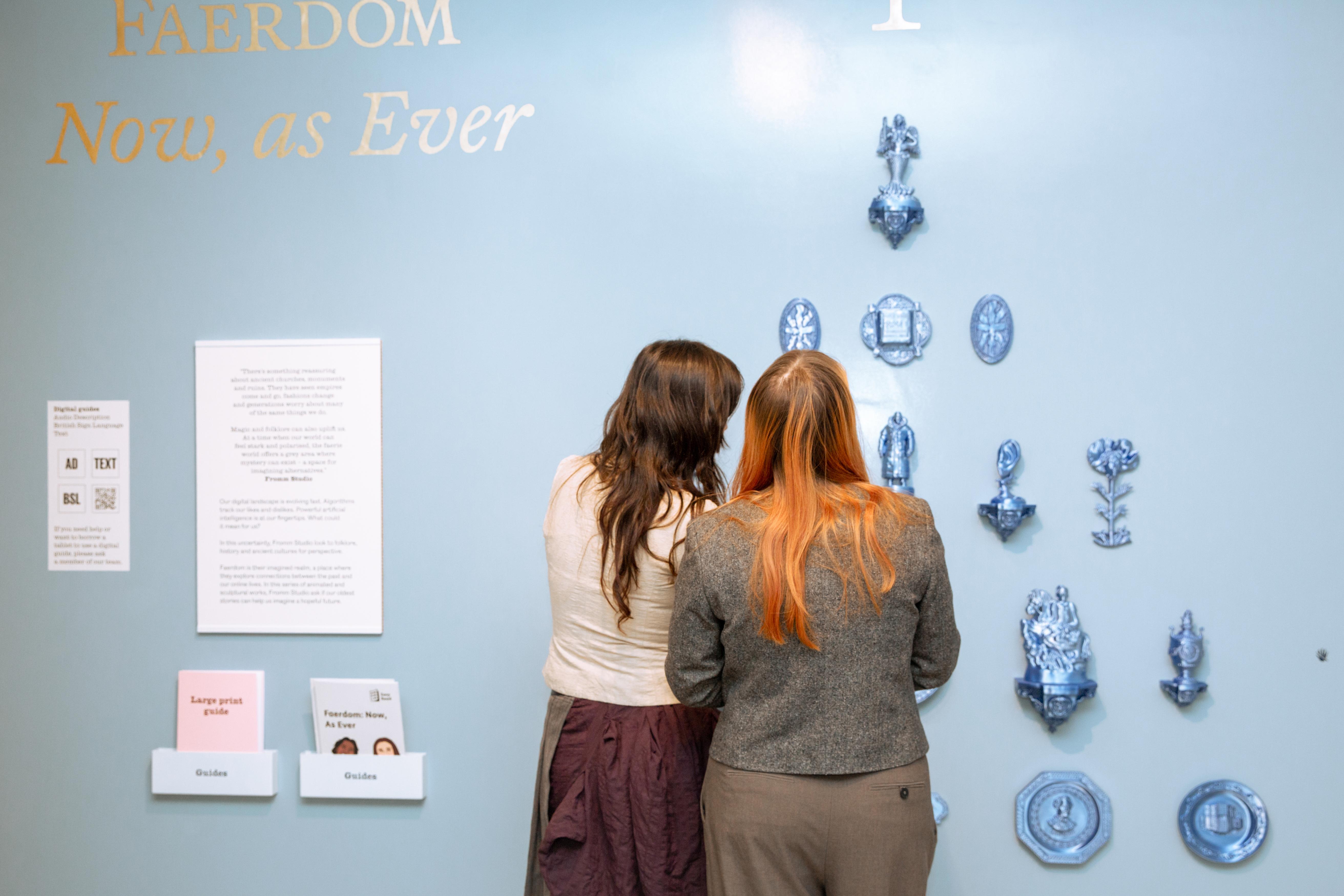
This second section of the exhibition is in a curved part of the gallery. There is one wall painted in a glossy off-white. At both ends of the curve are archways with decorative openings. One leads to the previous exhibition section; one leads to the next section.
This section is called Faerdom. There are three artworks in different media mounted in a row on the curved walls, each one with a large roman numeral above, applied to the wall with gold leaf.
The name Faerdom combines two meanings: the faerie kingdom of folklore and the fair kingdom the early internet promised to be. The works in this section contrast the initial hope that the World Wide Web would be a free and borderless landscape that would bring people together, and the reality of online spaces where our data is monetised and conflict occurs.
Faerdom artwork - Part 1
This is the first of two recordings about the sculptural work titled Faerdom, in the exhibition section also called Faerdom. It describes the overall structure of the work.
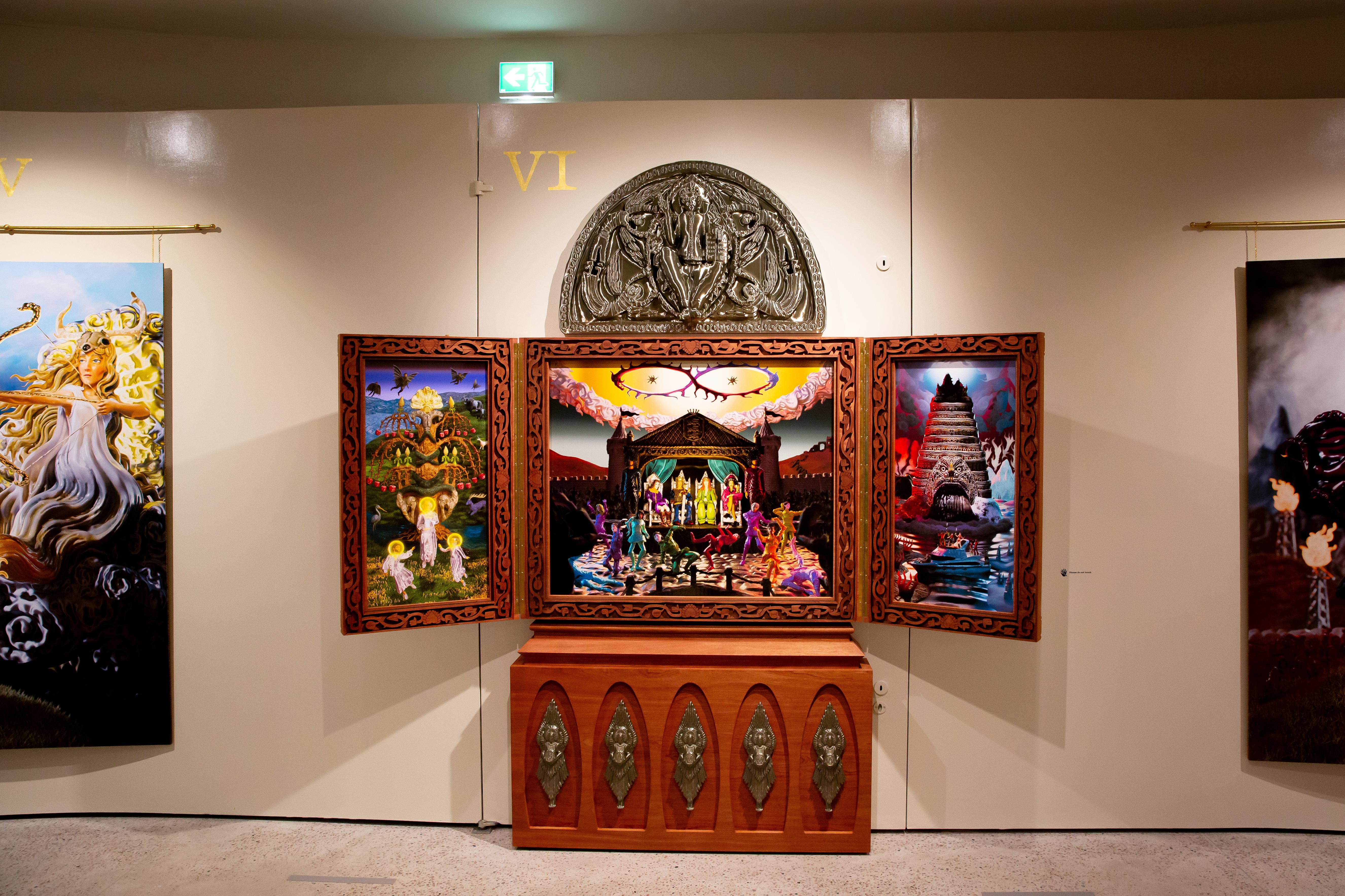
The work stands in the centre of the curved wall and is attached to the wall at the back. Taller than a standard doorway, it resembles an altarpiece. There are three main elements: a semicircular plaque at the top, three framed prints beneath it, and a shallow wooden plinth standing on the floor.
The plaque at the top is made from shiny silver plastic that looks like formed metal. Its relief shows four angels holding an oval-shaped form with a figure in the centre. This figure raises a hand with two fingers extended in a traditional gesture of Christian blessing. The figure wears a zip-through gilet and represents the stereotype of the ‘tech bro’. A tablet held by the figure references the terms and conditions we agree to when using apps and online platforms. Beneath the plaque, three wooden frames containing prints form a triptych. The supporting plinth is a little lower than a dining table. Across its front face are five evenly spaced arches, each containing an angel made from shiny silver 3D printed plastic. Each angel holds a letter representing an influential tech company. Together, the letters spell ‘GAMMA’: G, A, M, M, A.
The triptych has one large rectangular frame in the centre at landscape orientation. The left and right frames are half the size of the central frame and are attached with hinges so they can be closed like a cabinet or traditional altarpiece. Both sides are held open at an angle so that all the fprints are displayed.
The frame around each of the three prints has a decorative border made up of a thorny vine with hearts, hands with thumbs up and down, triangles and circles with ellipses. These symbols are versions of the icons that represent interactions on social media: likes, dislikes, bookmarks comments and shares.
Faerdom artwork - Part 2
This is the second of two recordings about the sculptural work titled Faerdom, in the exhibition section also called Faerdom. It describes the three prints held in the frames at the centre of the work.
Each print is high gloss with an image of a three-dimensional digital landscape made up of glossy elements. These three scenes represent the internet’s transformation from hoped-for utopian paradise to fragmentation.
I’ll describe the three prints from left to right. Their titles are Pangaea, Faerdom and Babel.
Pangea. The left print is a scene representing a digital Eden. In the centre is a symmetrical tree with a snake curled up its trunk. Hanging from the branches are clusters of red apples with human faces. Their eyes are closed.
In the background is a green landscape with a heron, a purple deer with gold antlers, a unicorn and two bison-like creatures. Further in the distance is a rolling blue sea. The sky above is a purple ombre, with four people with batwings in the sky. These people and the creatures in the landscape are a reference to the Great Moon Hoax of 1835, a series of articles that claimed there was life on the moon. For Fromm Studio, this incident represents a long history of misinformation, and connects the past to online misinformation today.
Beneath the tree are three figures wearing silver robes and halo-like glowing yellow helmets. The central figure is showing the other two a smartphone: two figures carved into the tree are whispering in his ear.
Faerdom. The central print shows a scene resembling a medieval court, with an outdoor stage in the grounds of a castle and dancers in the foreground. Four legendary figures sit on gold thrones on the stage: Guinevere, King Arthur, Merlin and Morgan le Fay. They have pale skin and wear elaborate medieval clothes. They look towards the dancers below with stern faces. Each dancer is in a different pose. They each have different hairstyles and skin tones. Each wears medieval clothes in one metallic colour: magenta, bright red, forest green, mint green or gold. For Fromm Studio, the dancers represent the ‘performances’ people give on social media for likes and engagement.
Above the court, a band of white cloud curves down from both upper corners and meets behind the roof of the outdoor stage. The cloud looks solid and iridescent, like mother-of-pearl, with swirls resembling waves or fire. It divides the sky into two areas: dark grey outside the curve and bright yellow inside. In the yellow area floats a serpent-like dragon with two heads, forming a figure of eight like an infinity symbol.
Babel. The print on the right is named after the Tower of Babel that appears in the Bible and the Torah, a structure build by people to reach the heavens. Their language is confused by God and they no longer understand each other.
For Fromm Studio, the Tower of Babel is a metaphor for the internet: a structure built upon an ideal of unity that is now divided into competing realities. In the image, the tower stands centrally in water. It tapers towards the top through seven horizontal layers, each smaller than the one beneath. The brown and white layers resemble rows of stylised faces, each with two circular eyes and a wide-open mouth. At the bottom of the tower is a larger, more ornate face, four layers high. Its eyes stare forwards and dark water gushes from its wide-open mouth.
On the left of the tower is a lump of red lava, and a volcano with smoke coming out in the background. On the right of the tower is a lump of ice, and what look like glaciers or mountains in the background.In the foreground there is a piece of land on the left with bursts of fire, and a piece of land on the right with icicles. Between them is a body of dark water. Floating on top is a superyacht with people on the deck and roof wearing swimwear and holding fireworks and bottles of champagne. They represent online influencers and the connection between online attention, wealth and status.
Luddites is a large print of a digital image. It’s a portrait-orientation rectangle about the height of an average doorway. The print has a glossy finish, and is hung on two gold chains that hang down from a brass pole. The image is of a digitally-made scene that has the appearance of a diorama of three-dimensional objects. In the foreground is a large person whose body dominates the image. They are standing with their body turned to face the right and their right arm reached forward, but looking back to the left. They wear a knee-length black tunic with red polka dots, a deep red cape and a red fabric band with two loose ends tied around their head. Their clothes and chin-length black hair are billowing out to the left as though blown by the wind. They have olive skin with pink flushed cheeks. Their mouth is closed and they have a look of determination on their face. The sky above them is a dark grey, that fades to a pale grey around them, making it appear like clouds have cleared directly above them.
The person stands on a mound of grass. Behind them, two crowds stand to the left and right, looking towards them. The people appear to be sculpted from the same orangey-brown clay, and some have their arms raised. Further back are three silver towers, each with a fire on top. Beyond them, grey snow-capped mountains rise above clouds on the horizon.
This image is a reworking of an 1812 engraving called The Leader of the Luddites, depicting the legendary weaver Ned Ludd with a burning mill in the background. Ned Ludd was said to have smashed knitting machines in a fit of rage and in the 1810s, groups of textile workers who sabotaged factory machinery called themselves ‘the Luddites’. Their actions were a form of protest against the poor pay and working conditions that came with mechanised textile production.
Today ‘Luddite’ is a word used to describe someone who doesn’t like technology. In this image, the burning mill of the original engraving is replaced with burning 5G towers. With their reworking, Fromm Studio are asking why people who question the impact of technology on our lives are dismissed as ‘luddites’.