Collage
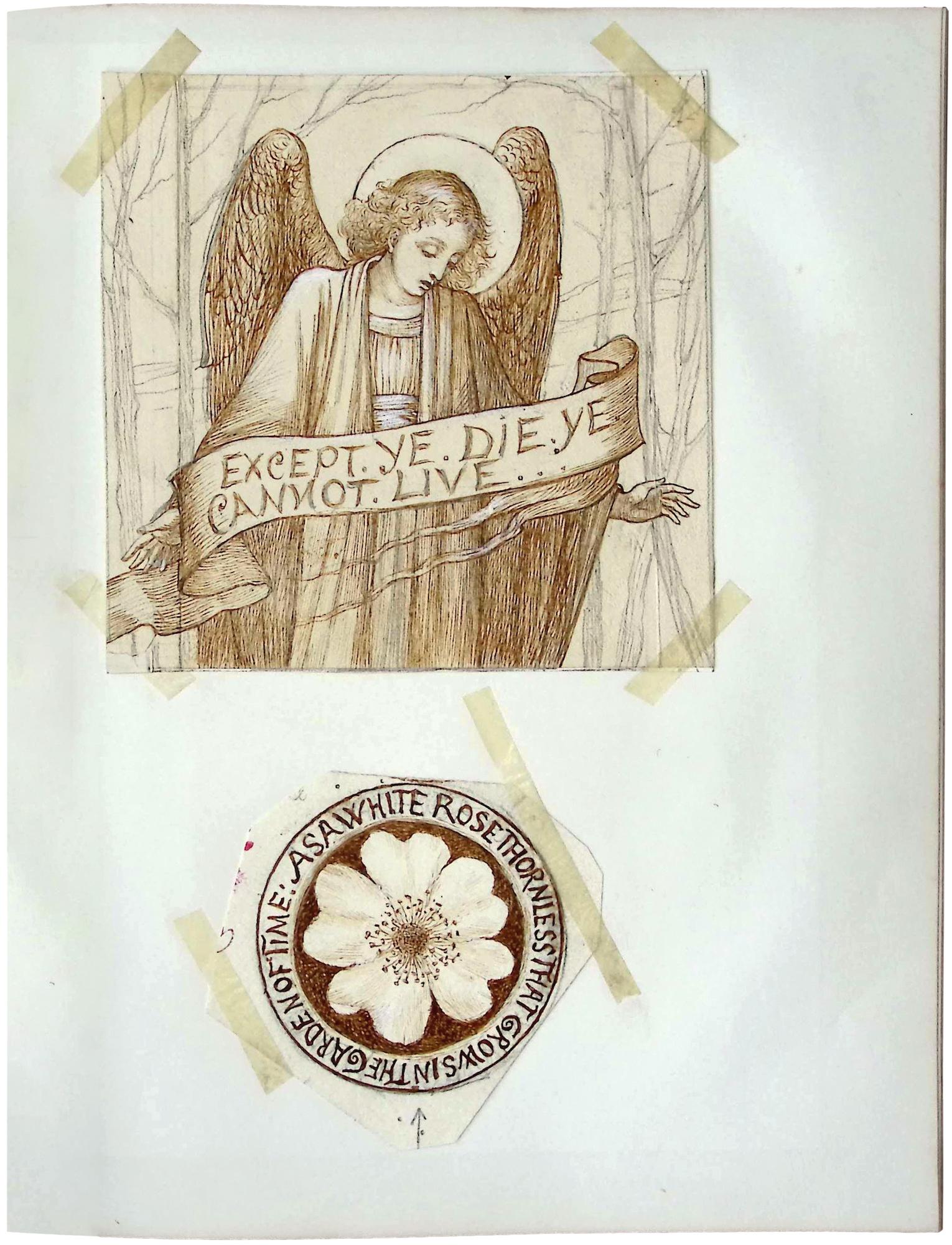
Untitled (illustrations for A Book of Heavenly Birthdays), c. 1893
Eleanor Vere Boyle (1825 – 1916) illustrated poetry and prose by some of the most popular authors of her time. She regularly drew and painted using ink and watercolour, sketching landscapes, animals and her children from life. She also made drawings from her imagination, often reflecting spiritual themes. These drawings were used as some of the final illustrations printed in the artists' publication A Book of Heavenly Birthdays (1893, London Elliot Stock)
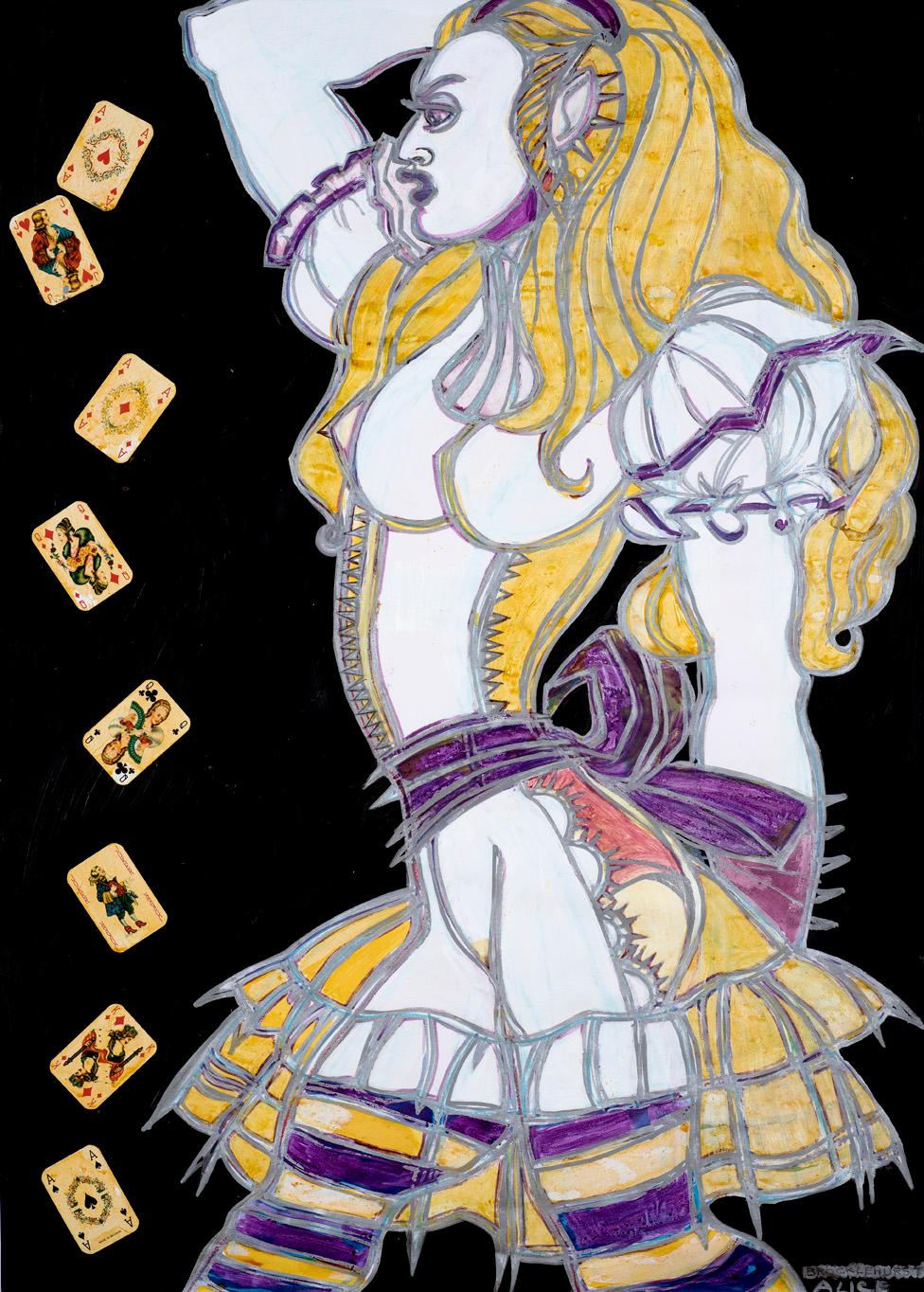
Jo Brocklehurst, Untitled (Alice from Brocklehurst Through the Looking-Glass), 2000s
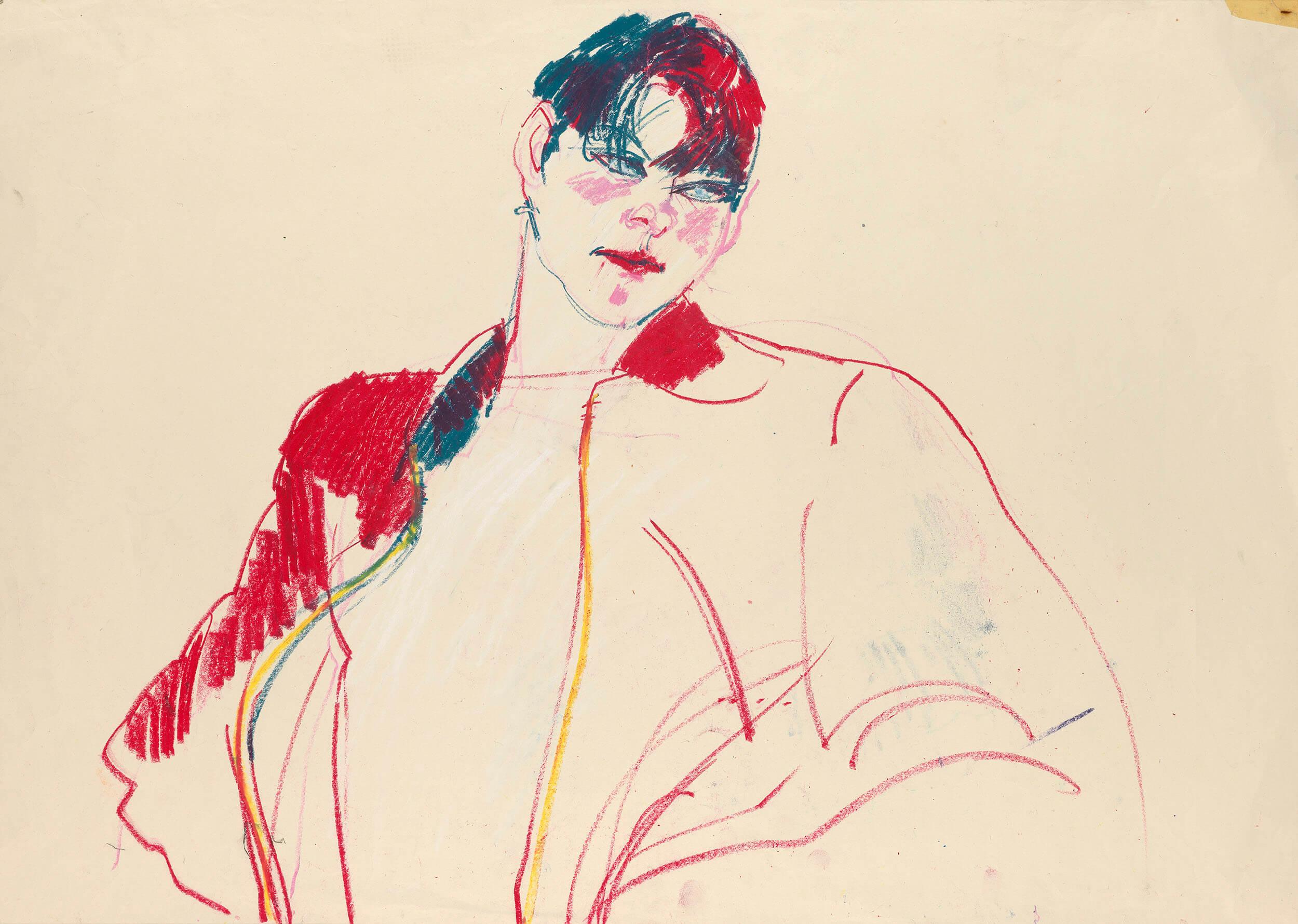
Jo (Josephine) Brocklehurst (1935 - 2006) studied at Central Saint Martins and began her career as a fashion illustrator. She later focused on portraiture, drawing directly from models at her studio in West Hampstead and in nightclubs and theatres in Berlin, London and New York. Her work documents the alternative subcultures of the 1970s, 80s and 90s that went on to shape mainstream fashion and performance scenes. This work is from Brocklehurst Through the Looking-Glass, Brocklehurst’s final series. With an image of herself as a child as the centrepiece, Brocklehurst made hundreds of drawings that re-imagined characters from Lewis Carroll’s Alice novels. Her models were friends and dedicated club-goers who designed and made their own clothes. Works from the series were framed with bright plastic gemstones and hung on every available space at Brocklehurst’s home studio. She used metallic and neon inks that transformed under ultraviolet lights that she switched on for her guests in the evenings.
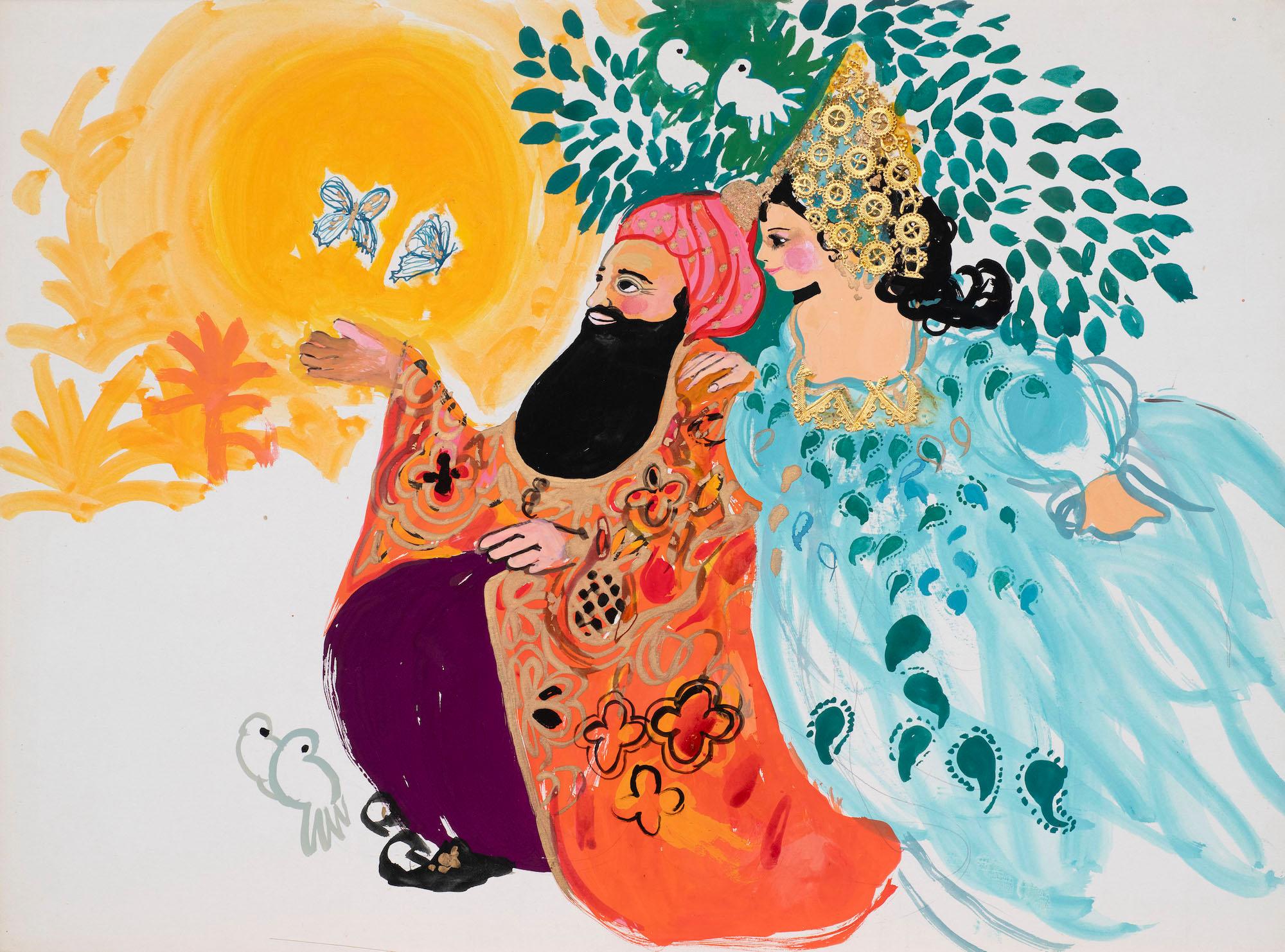
Untitled illustration for Jackanory (Just So Stories: The Butterfly who Stamped) , 1973
Janina Ede (1937-2018) created covers and illustrations for over 100 books in the 1960s, 70s and 80s. Many of her illustrations feature animals, which she drew from life. In the 1970s, Ede was commissioned to create large colourful illustrations for the BBC children’s television series, Jackanory. Each episode was dedicated to a story read by an actor, while specially commissioned illustrations were shown on screen during each programme. Some of these illustrations were for programmes featuring stories by author Rudyard Kipling. His ‘Just So’ stories were short tales that imagined how various animals attained their distinguishing features. Kipling set the stories in parts of India, West Asia and Africa. His descriptions of places and people included racist and exoticised stereotypes. Ede’s illustrations draw extensively on Kipling’s descriptions, and therefore reflect the racism in his work, as well as the prevailing stereotypical views that existed in 1970s Britain. Her own personal views are not documented. This storyboard illustration was produced by Janina Ede for Jackanory episode #1453, 'Just So Stories - The Butterfly that Stamped'. It aired on 4 January 1973.
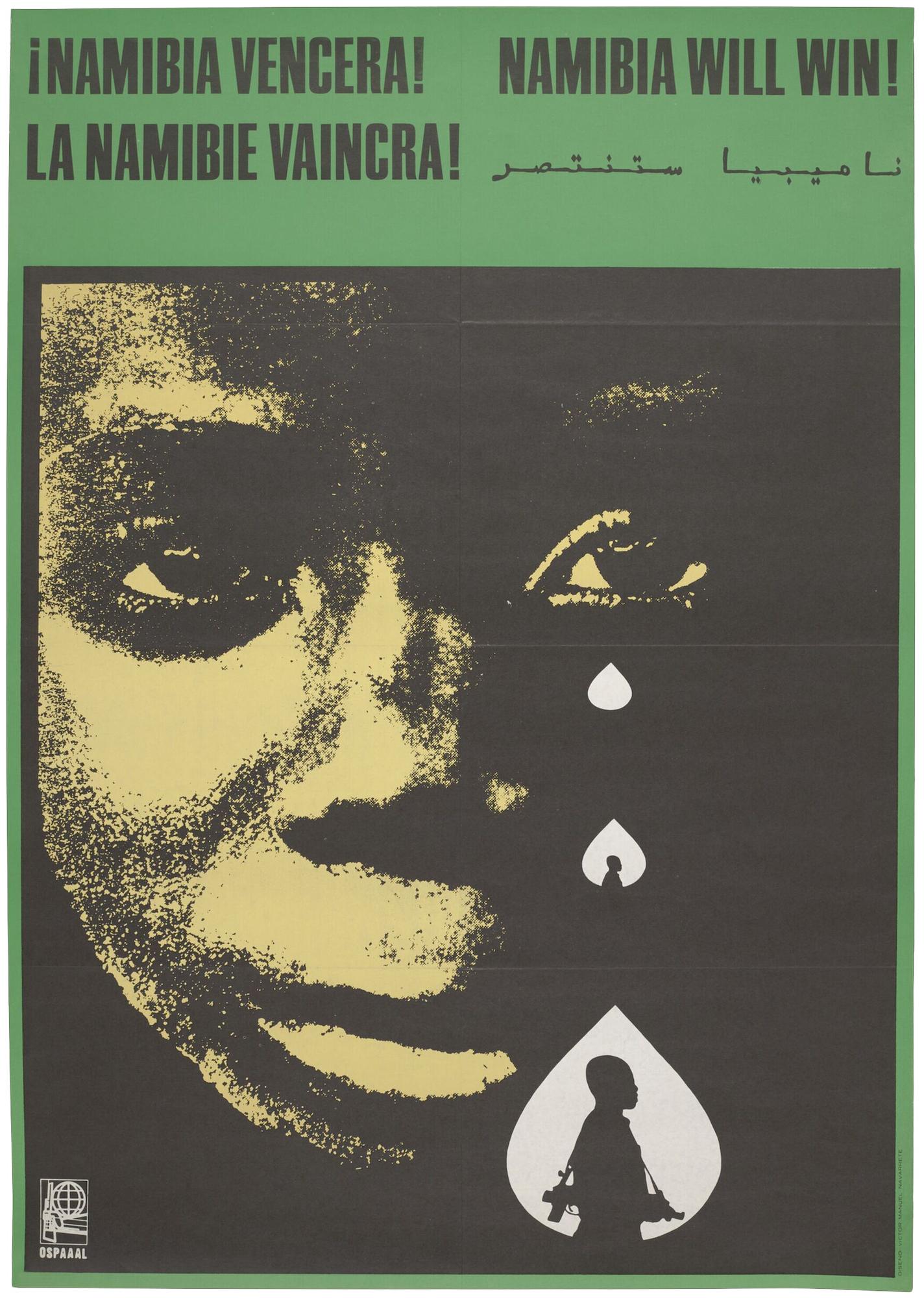
NAMIBIA WILL WIN!, 1977
Between the 1960s and 1990s, more than fifty designers worked at OSPAAAL (the Organisation of Solidarity with the People of Africa, Asia and Latin America). Based in Cuba, they made magazines and posters that were sent around the world. Their aim was to promote radical political ideas. Many of their posters celebrate socialist revolutions and liberation movements from the Global South. This poster was made in support of Namibia’s movement for independence from South African rule. OSPAAAL’s designers regularly used adapted photographs from the organisation’s news desk. Photographs were sometimes used out of context, with the same photographs appearing in posters and magazine illustrations to represent different themes. The identity of the child in this poster is not known.
Content warning: weaponry
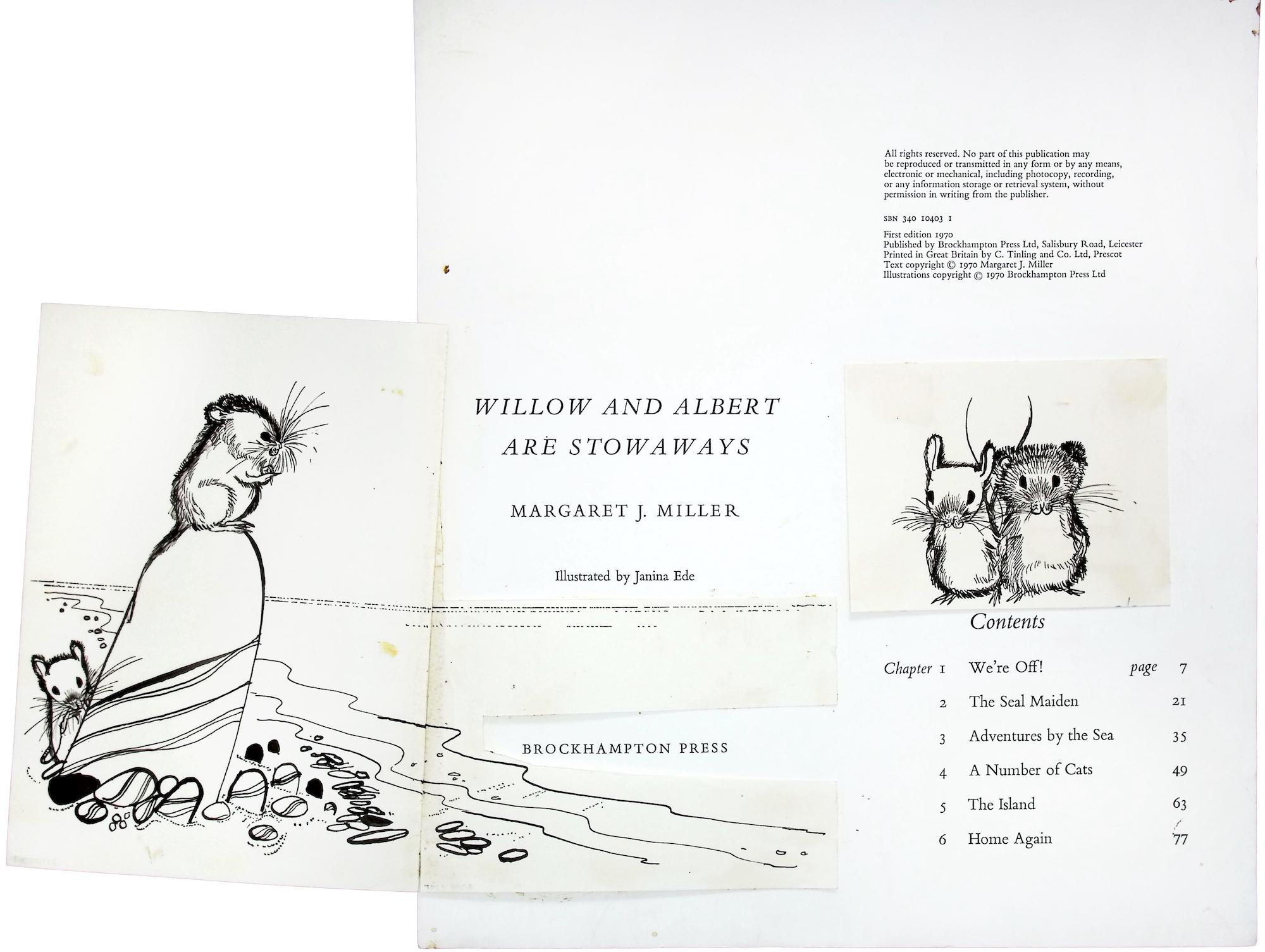
Layout proof for Willow and Albert are Stowaways, c. 1970
British illustrator Janina Ede (1937-2018) created covers and illustrations for over 100 books from the 1950s to the 1980s. Many of her illustrations feature animals, which she drew from life.
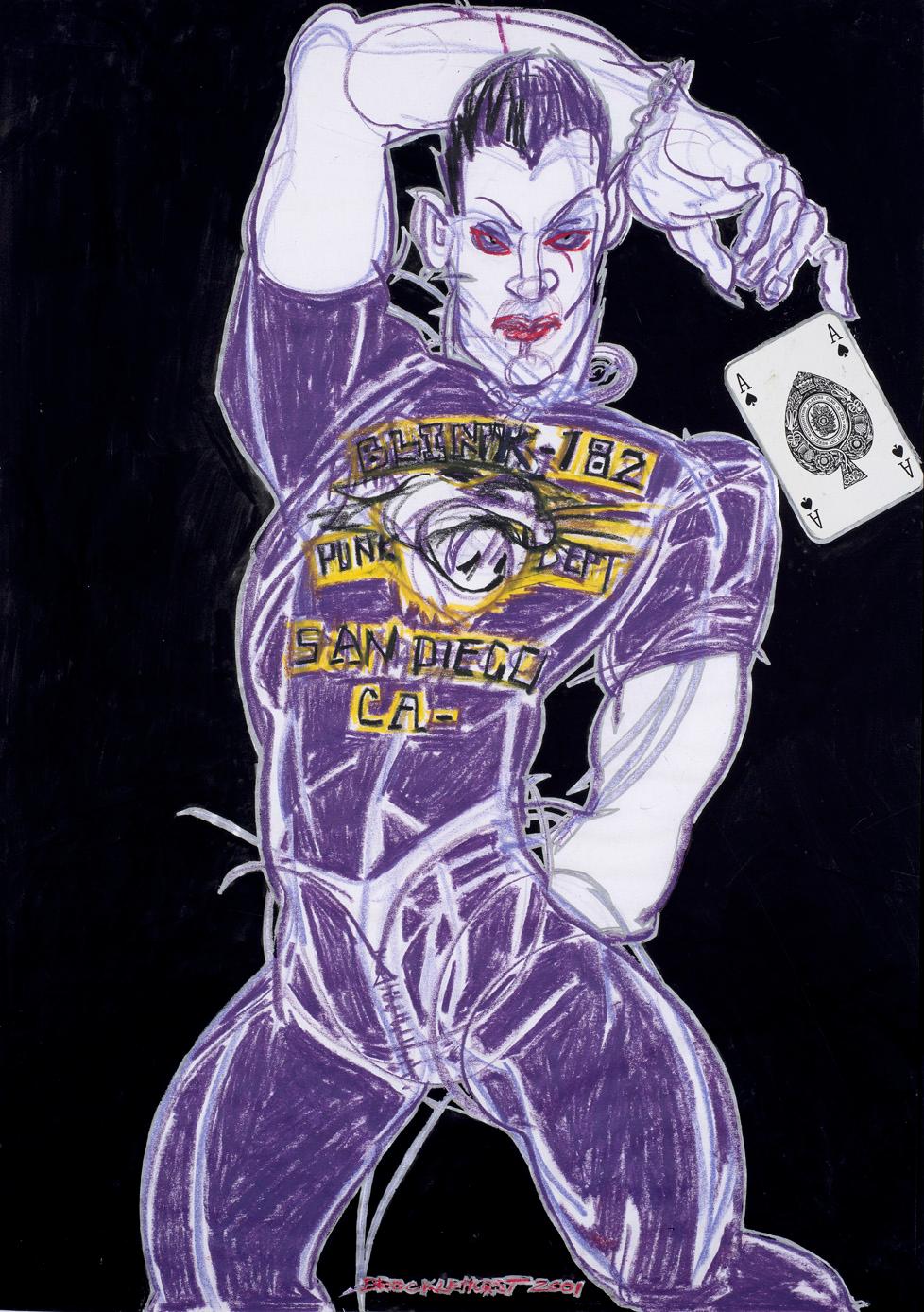
Jo Brocklehurst, Untitled (from Brocklehurst Through the Looking-Glass), 2001
Jo (Josephine) Brocklehurst (1935 - 2006) studied at Central Saint Martins and began her career as a fashion illustrator. She later focused on portraiture, drawing directly from models at her studio in West Hampstead and in nightclubs and theatres in Berlin, London and New York. Her work documents the alternative subcultures of the 1970s, 80s and 90s that went on to shape mainstream fashion and performance scenes. This work is from Brocklehurst Through the Looking-Glass, Brocklehurst’s final series. With an image of herself as a child as the centrepiece, Brocklehurst made hundreds of drawings that re-imagined characters from Lewis Carroll’s Alice novels. Her models were friends and dedicated club-goers who designed and made their own clothes. Works from the series were framed with bright plastic gemstones and hung on every available space at Brocklehurst’s home studio. She used metallic and neon inks that transformed under ultraviolet lights that she switched on for her guests in the evenings.
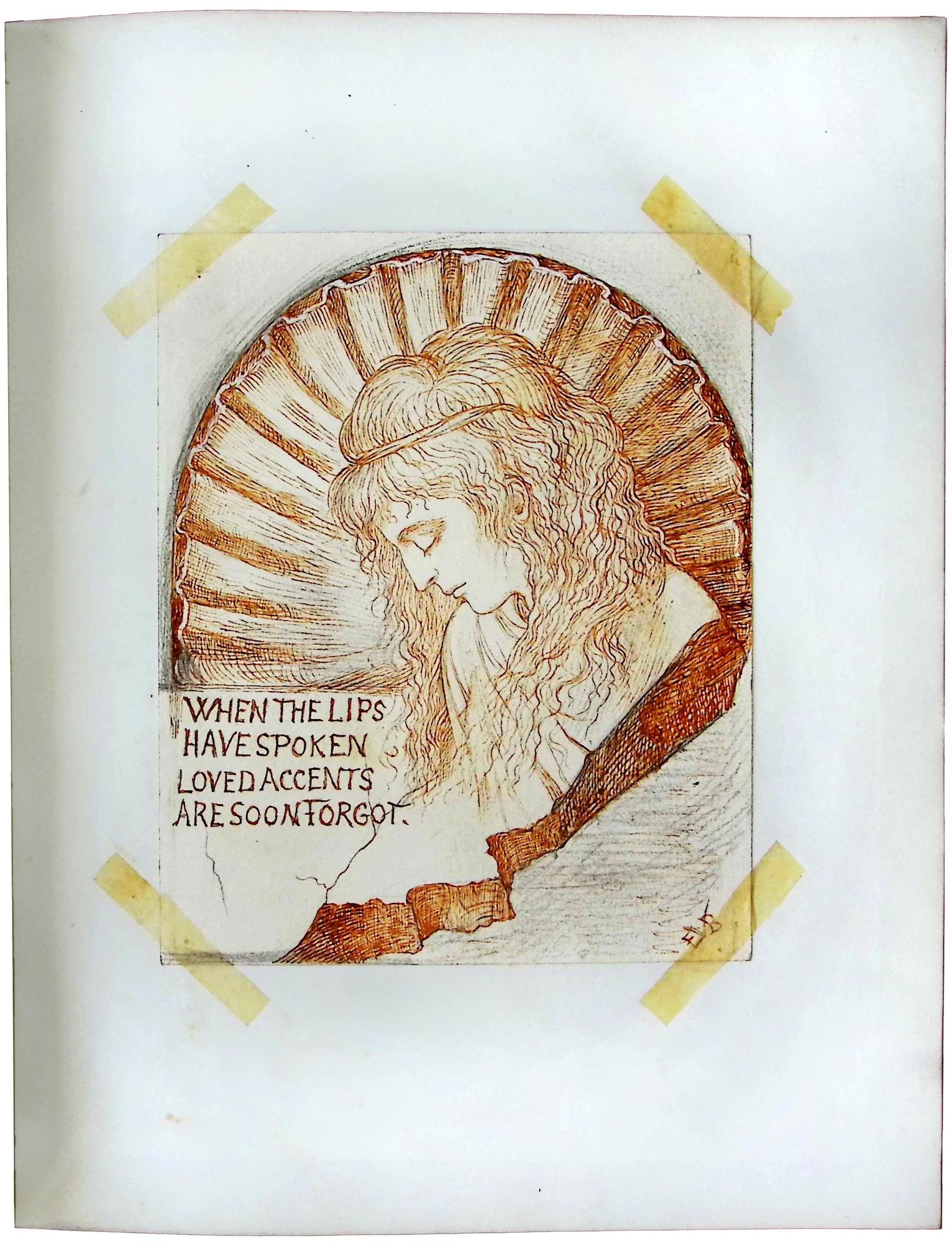
Untitled (illustration for A Book of Heavenly Birthdays), c. 1893
Eleanor Vere Boyle (1825 – 1916) illustrated poetry and prose by some of the most popular authors of her time. She regularly drew and painted using ink and watercolour, sketching landscapes, animals and her children from life. She also made drawings from her imagination, often reflecting spiritual themes. This drawing was used as some of the final illustrations printed in the artists' publication A Book of Heavenly Birthdays (1893, London Elliot Stock)
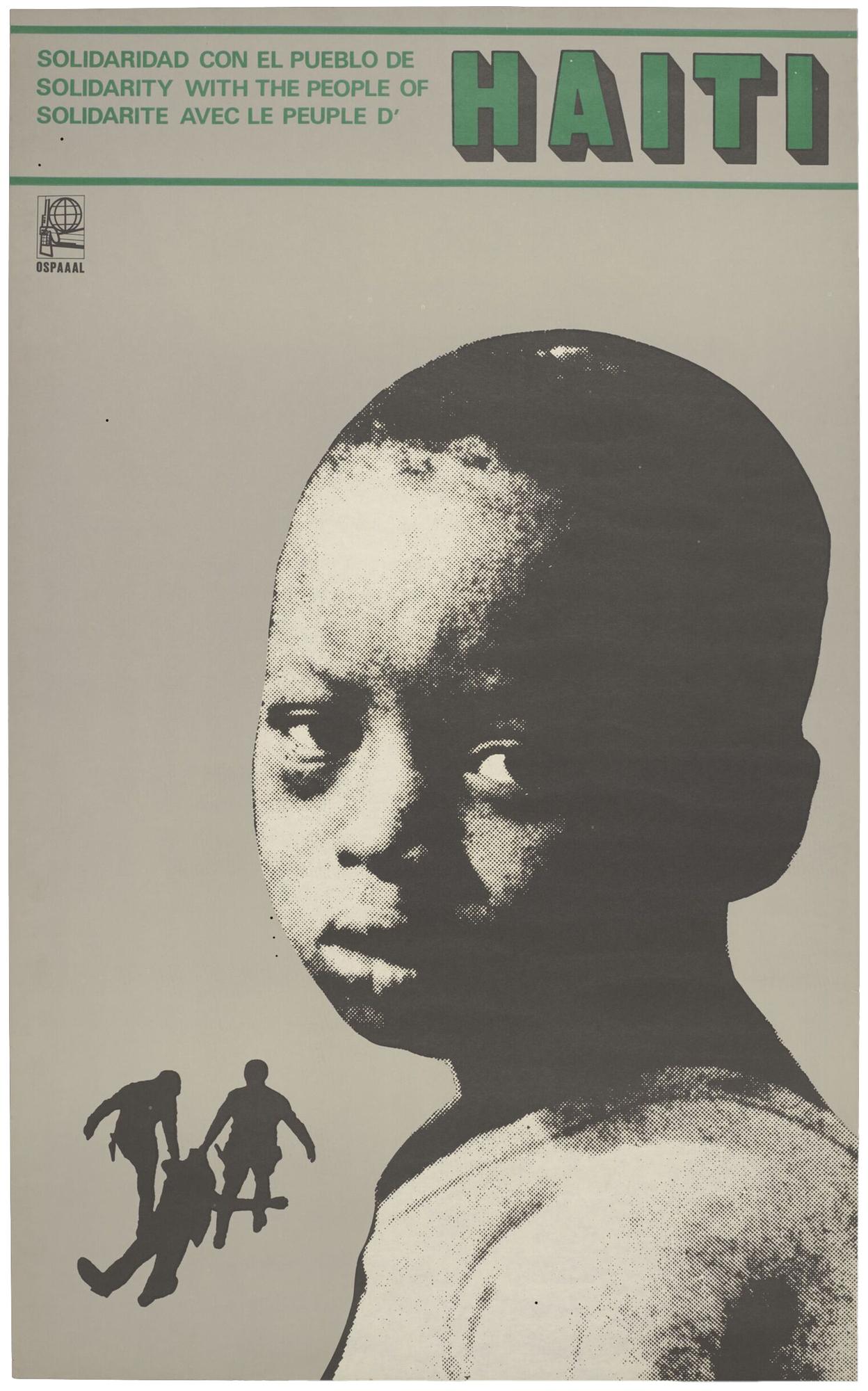
SOLIDARITY WITH THE PEOPLE OF HAITI, 1980
Between the 1960s and 1990s, more than fifty designers worked at OSPAAAL. Based in Cuba, they made magazines and posters that were sent around the world. Their aim was to promote radical political ideas. Many of their posters celebrate socialist revolutions and liberation movements from the Global South. To show support for people in Haiti experiencing state-sponsored violence, Rafael Enríquez Vega contrasted a silhouette of a limp body being dragged away with a photograph of a child by fellow designer Víctor Manuel Navarrete. The identity of the child is not recorded as part of the design.
Content warning: violence
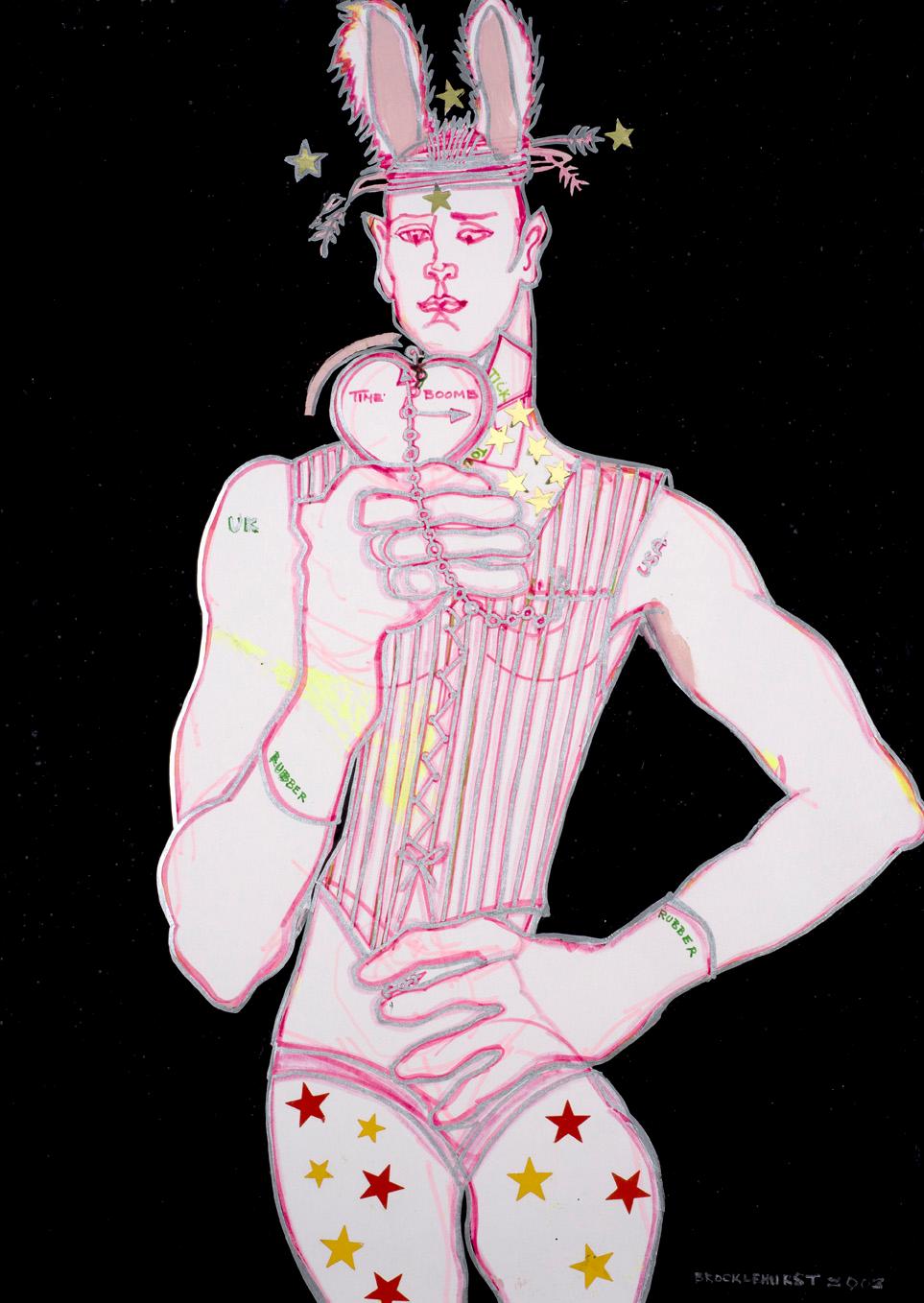
Jo Brocklehurst, Untitled (White Rabbit from Brocklehurst Through the Looking-Glass), 2003
Jo (Josephine) Brocklehurst (1935 - 2006) studied at Central Saint Martins and began her career as a fashion illustrator. She later focused on portraiture, drawing directly from models at her studio in West Hampstead and in nightclubs and theatres in Berlin, London and New York. Her work documents the alternative subcultures of the 1970s, 80s and 90s that went on to shape mainstream fashion and performance scenes. This work is from Brocklehurst Through the Looking-Glass, Brocklehurst’s final series. With an image of herself as a child as the centrepiece, Brocklehurst made hundreds of drawings that re-imagined characters from Lewis Carroll’s Alice novels. Her models were friends and dedicated club-goers who designed and made their own clothes. Works from the series were framed with bright plastic gemstones and hung on every available space at Brocklehurst’s home studio. She used metallic and neon inks that transformed under ultraviolet lights that she switched on for her guests in the evenings.
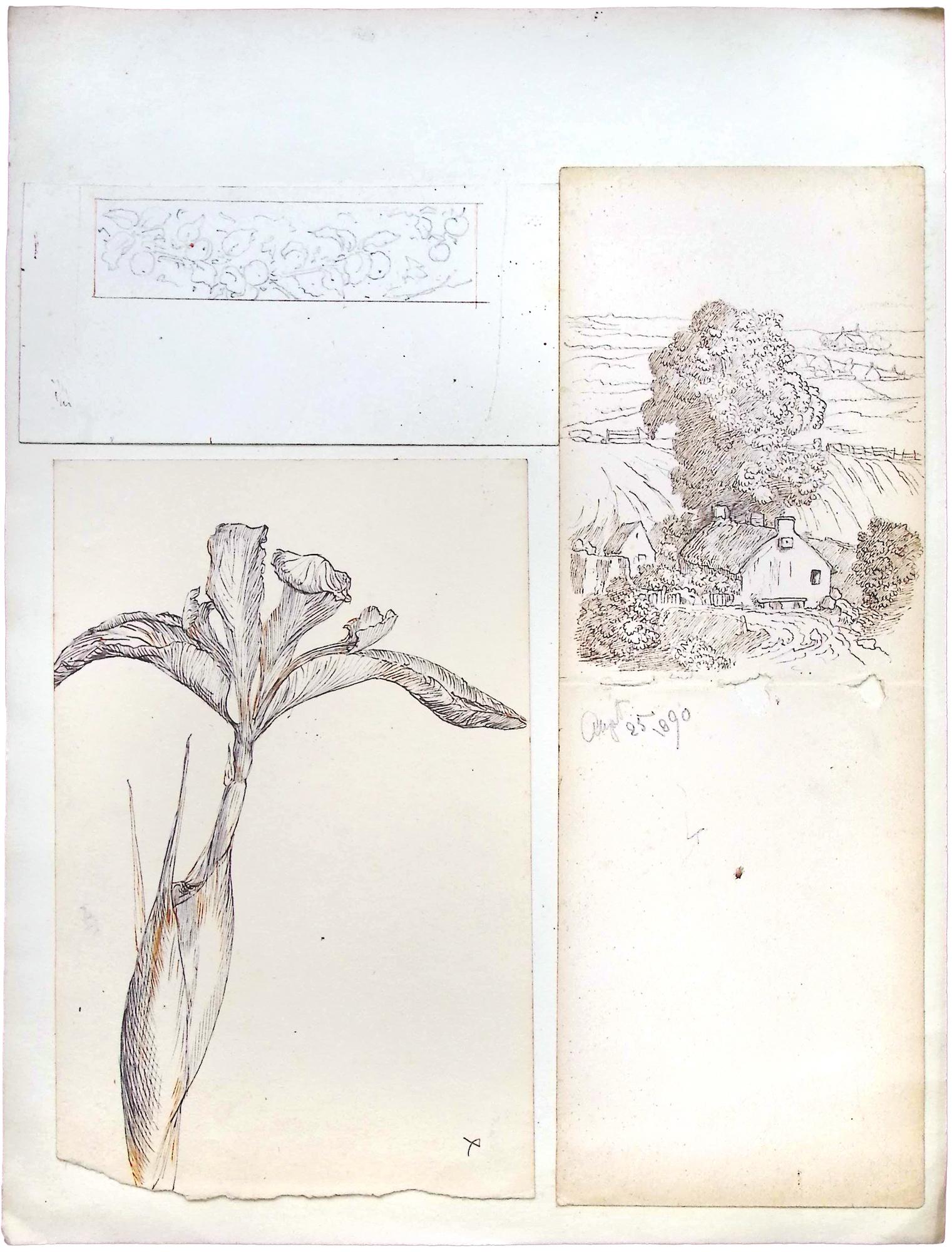
Untitled, Unknown date and 1890
Eleanor Vere Boyle (1825 – 1916) illustrated poetry and prose by some of the most popular authors of her time. She regularly drew and painted using ink and watercolour, sketching landscapes, animals and her children from life. She also made drawings from her imagination, often reflecting spiritual themes.
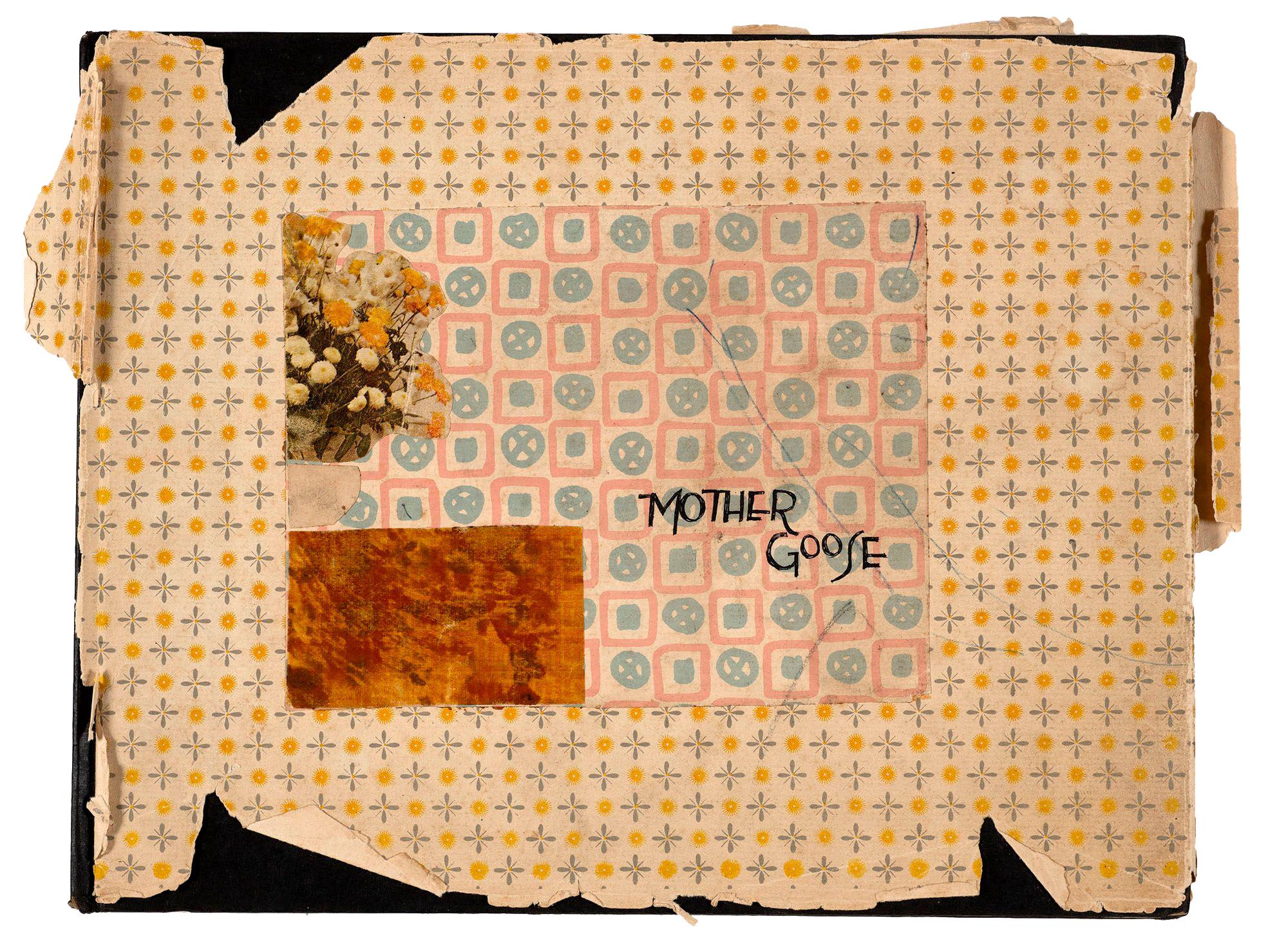
Jacqueline Ayer, Untitled (Handmade book for Margot), 1960
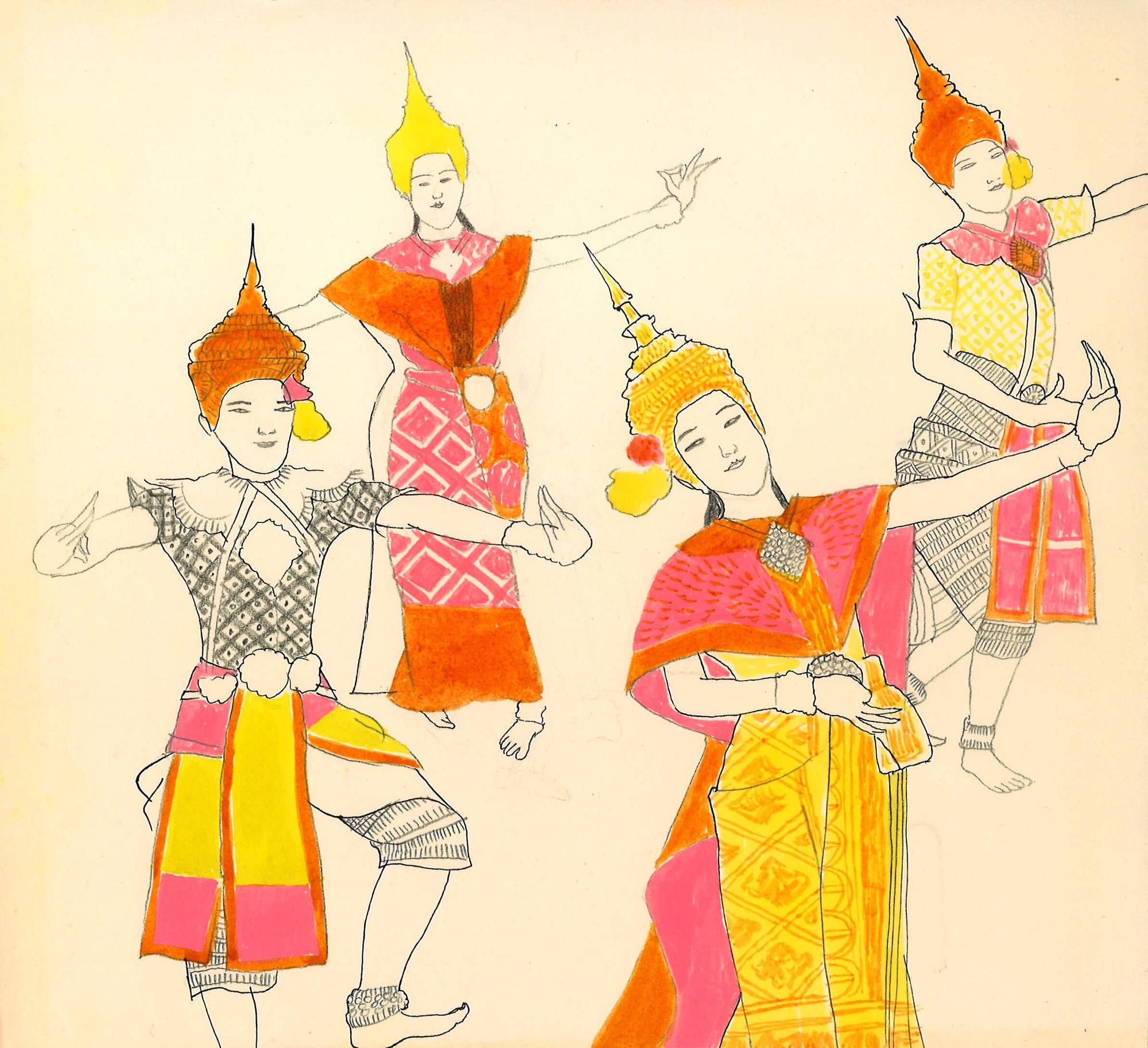
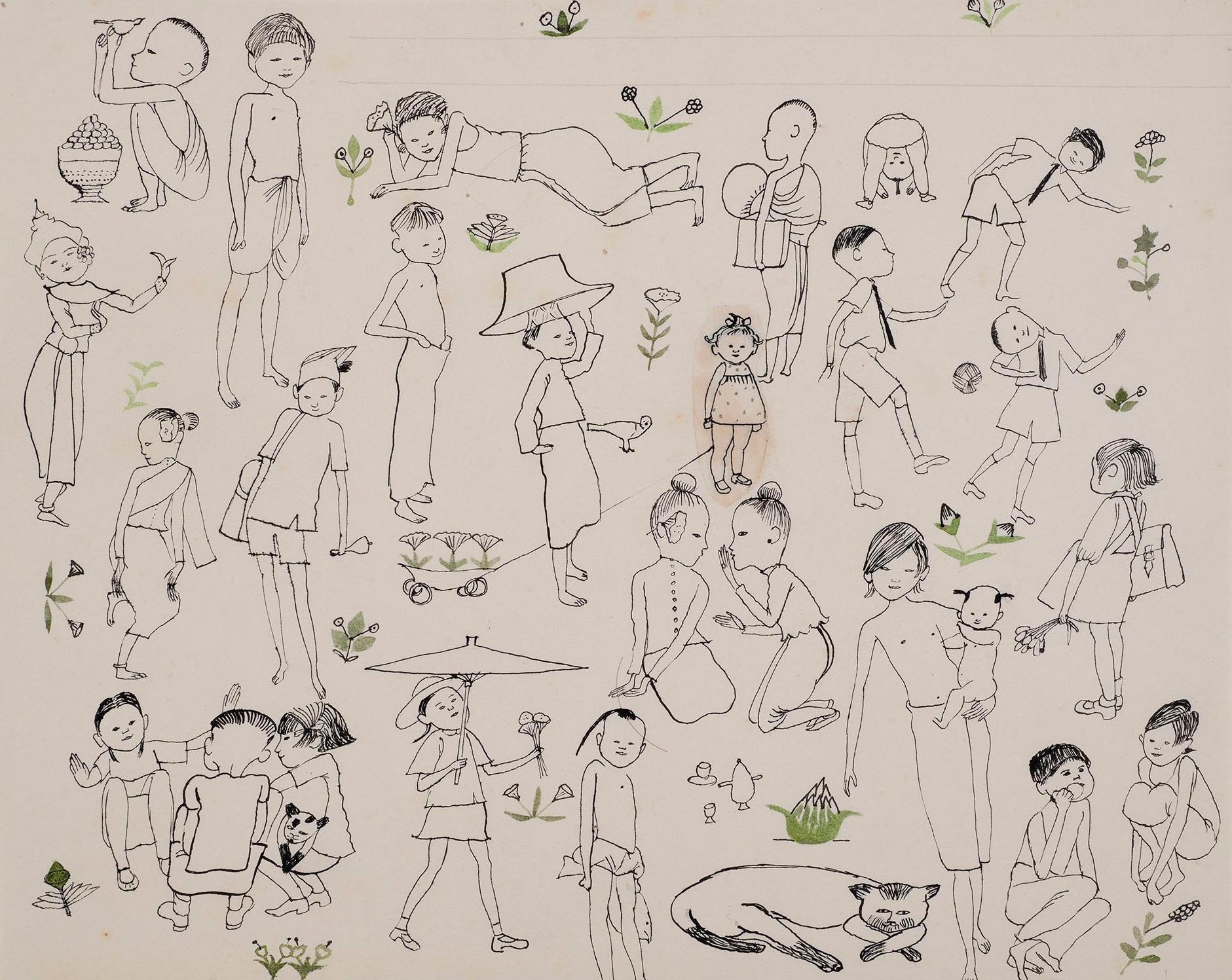
Jacqueline Ayer (1930–2012) had a career that spanned many creative fields. She began as a fashion illustrator, and later turned her hand to children’s books, textiles and garments, as she worked in New York, Paris, London, Bangkok, Hong Kong and across India. Jacqueline Ayer could not find children's books for her daughters when she first moved to Bangkok, Thailand, and so she made this nursery rhyme book out of magazines.
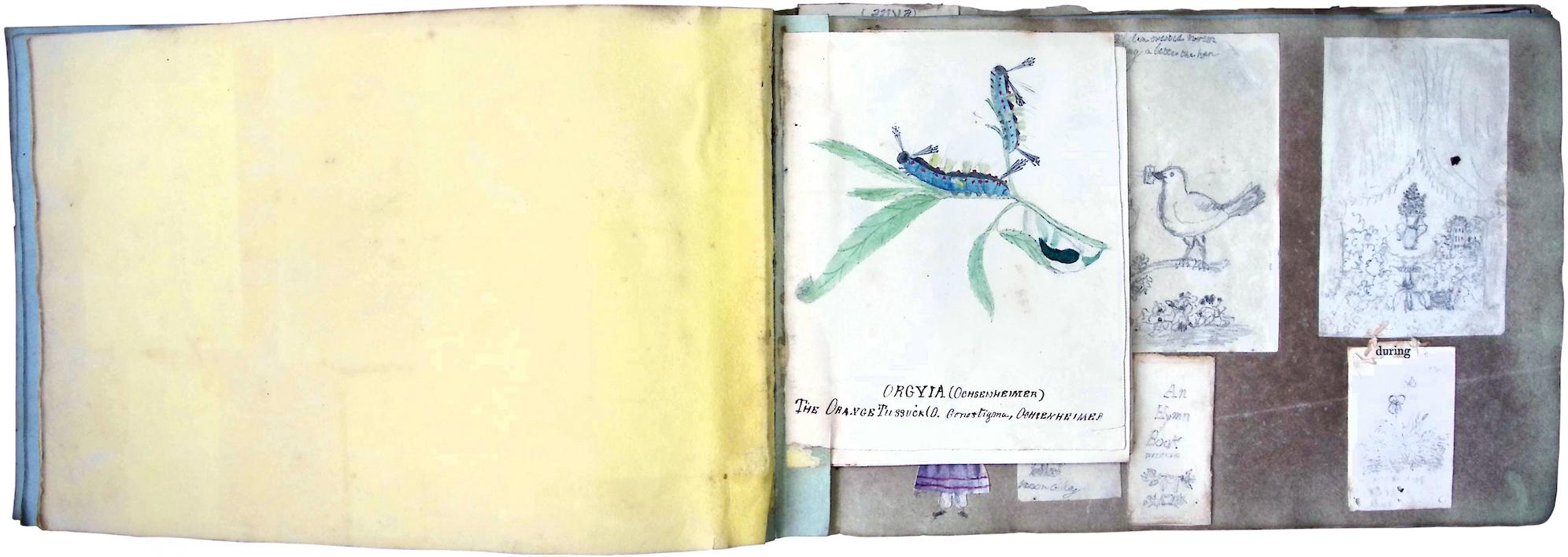
Untitled (childhood sketchbook), 1833
Eleanor Vere Boyle (1825 – 1916) illustrated poetry and prose by some of the most popular authors of her time. She regularly drew and painted using ink and watercolour, sketching landscapes, animals and her children from life. She also made drawings from her imagination, often reflecting spiritual themes. Boyle learnt how to draw and paint from her mother and older sister, Alba. She kept this sketchbook when she was eight years old. It includes miniature drawings, cut out paper shapes, and tiny books that she made as gifts for family.
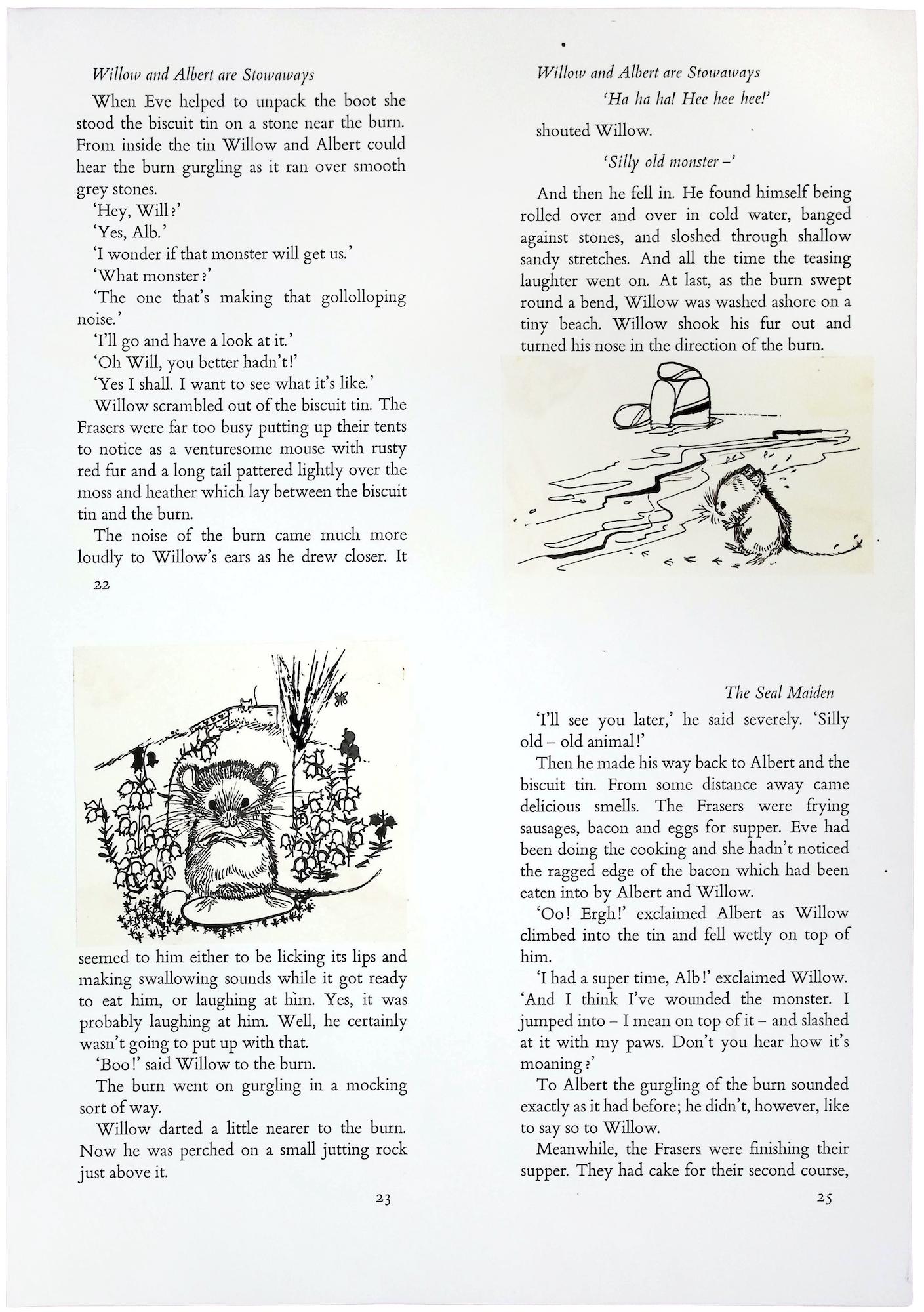
Layout proof for Willow and Albert are Stowaways, c. 1970
British illustrator Janina Ede (1937-2018) created covers and illustrations for over 100 books from the 1950s to the 1980s. Many of her illustrations feature animals, which she drew from life.
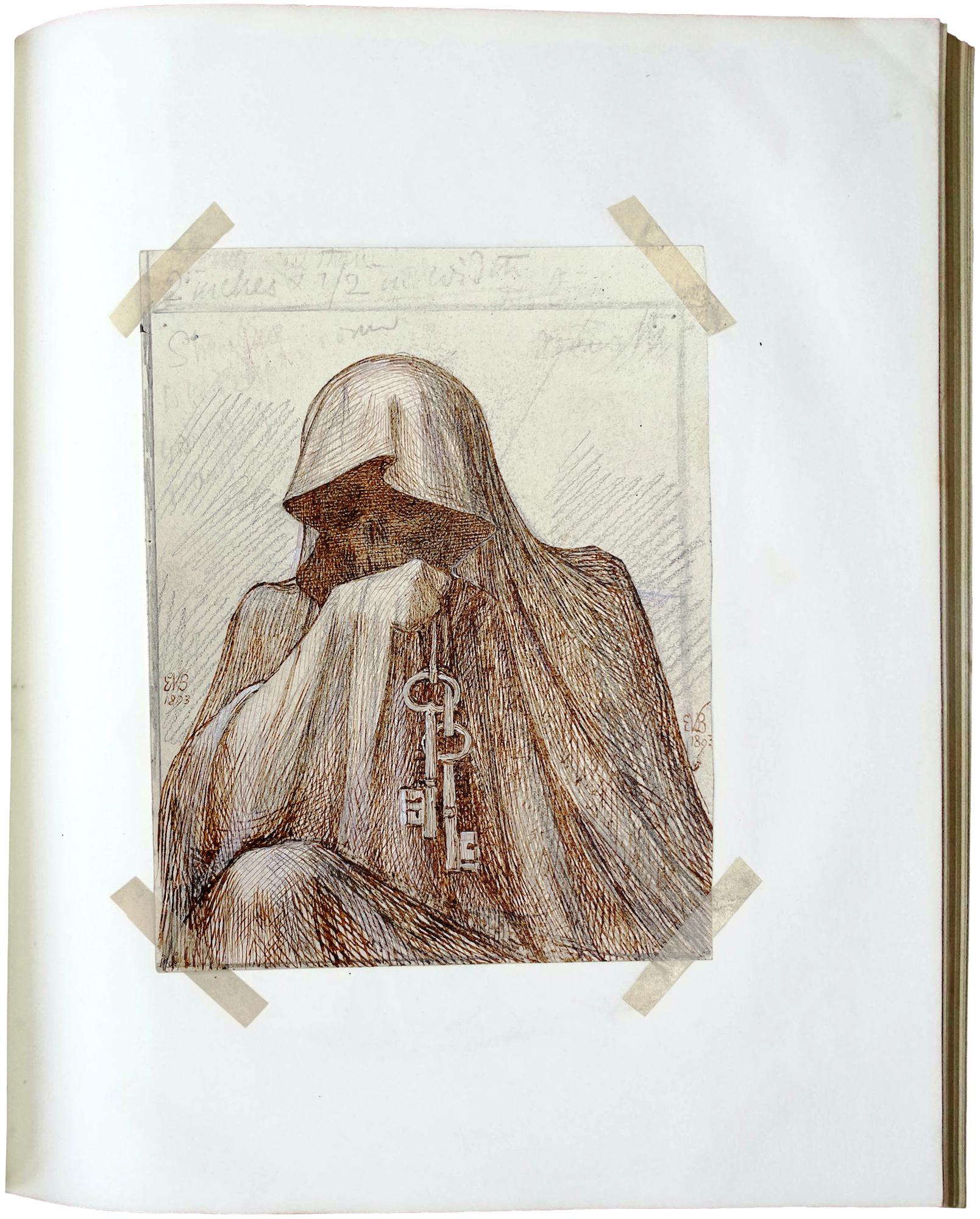
Untitled (illustration for A Book of Heavenly Birthdays, 'The Shadow Waiting with the Keys'), 1893
Eleanor Vere Boyle (1825 – 1916) illustrated poetry and prose by some of the most popular authors of her time. She regularly drew and painted using ink and watercolour, sketching landscapes, animals and her children from life. She also made drawings from her imagination, often reflecting spiritual themes. This drawing was used as one of the final illustrations printed in the artists' publication A Book of Heavenly Birthdays (1893, London Elliot Stock)
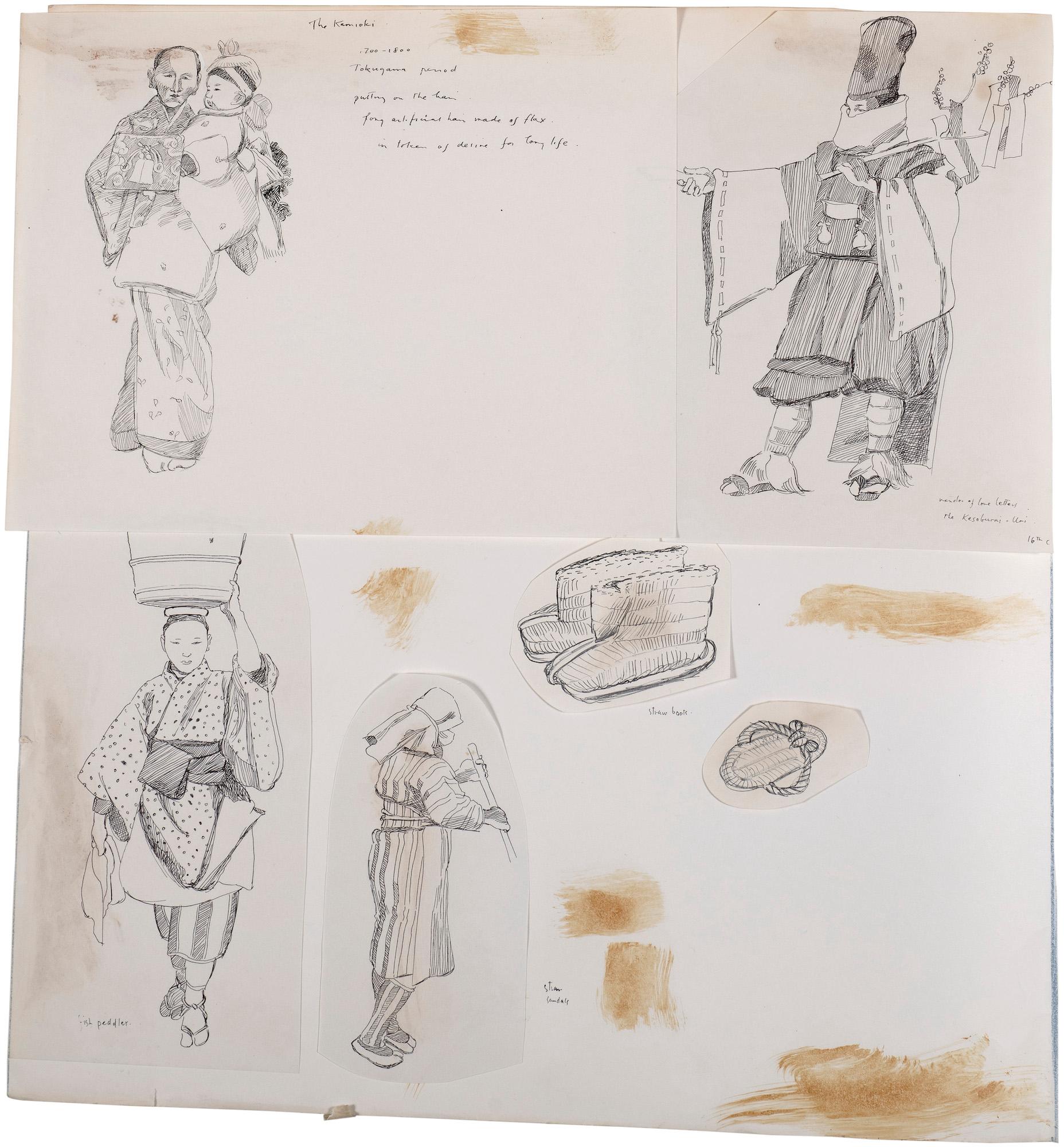
Jacqueline Ayer, Untitled (various clothing, Japan), c. 1973
Jacqueline Ayer (1930–2012) had a career that spanned many creative fields. She began as a fashion illustrator, and later turned her hand to children’s books, textiles and garments, as she worked in New York, Paris, London, Bangkok, Hong Kong and across India. These drawings were used as some of the final illustrations printed in Ayer's publication Oriental* Costume (1974). Descriptions from top left, clockwise: Grandmother and child. 19th century; Vendor of love letters, the 'Kasoburni-Uri', 16th century; Straw boots; Straw sandals; Fish pedlar, Iyo Ehime prefecture, contemporary. *The term ‘oriental’ has colonial and racist origins. It was established during a period when European powers took political control of other countries and defined non-European cultures as ‘inferior’ to their own. ‘Oriental’ was commonly used in English-speaking countries until the late 20th century to group together people, culture and places in Northern Africa, East Asia and Southeast Asia, as well as objects thought to have originated in these areas. The term has been widely rejected today as it exoticizes and ‘others’ these diverse cultures. Ayer used the term here to collectively refer to modes of dress from Cambodia, China, Japan, Mongolia, Nepal, Thailand and Tibet.
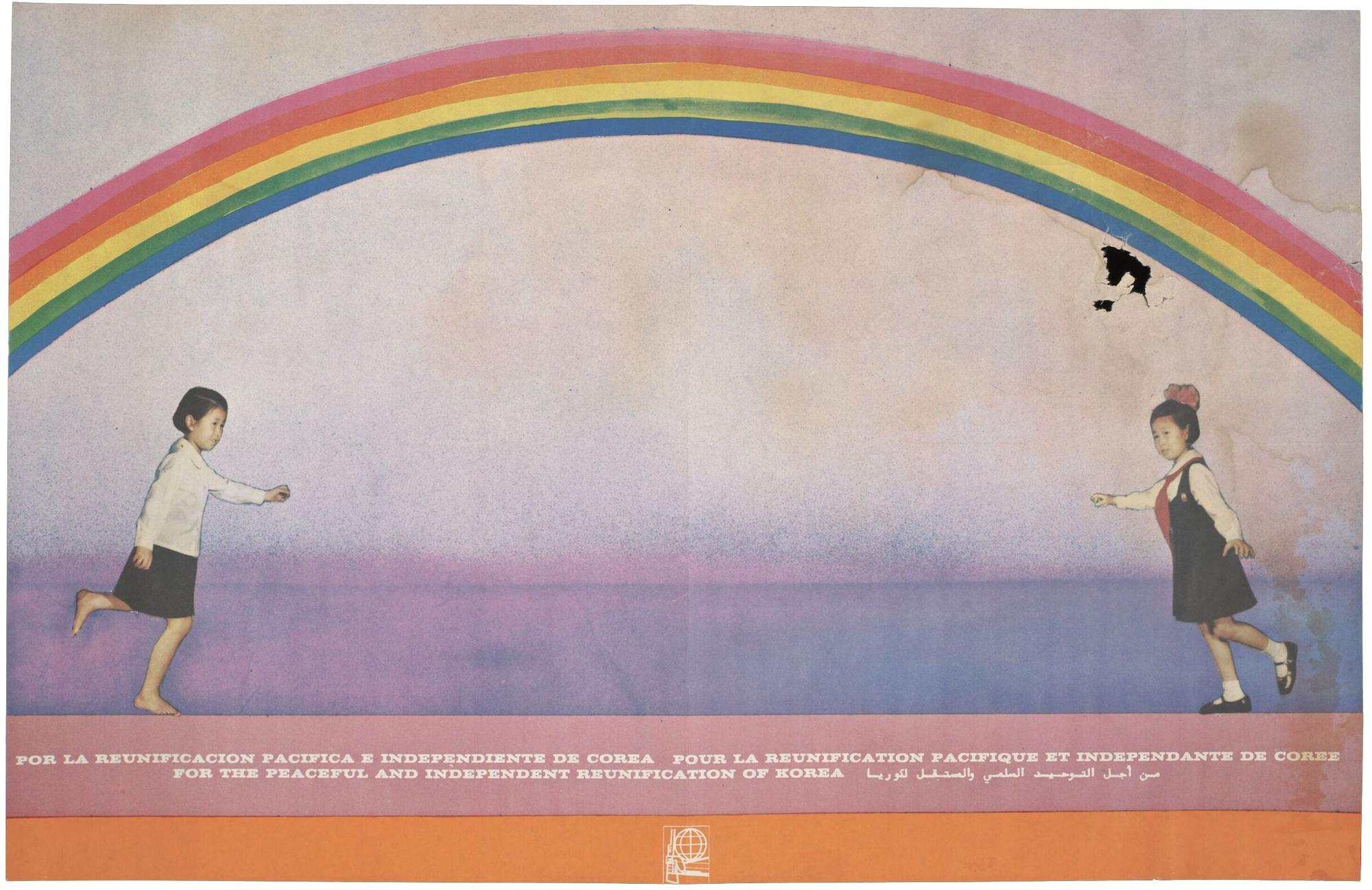
FOR THE PEACEFUL AND INDEPENDENT REUNIFICATION OF KOREA, 1969
Between the 1960s and 1990s, more than fifty designers worked at OSPAAAL (the Organisation of Solidarity with the People of Africa, Asia and Latin America). Based in Cuba, they made magazines and posters that were sent around the world. Their aim was to promote radical political ideas. Many of their posters celebrate socialist revolutions and liberation movements from the Global South. This poster advocates for the reunification of the Republic of Korea (known as South Korea), represented by the child on the left, and the Democratic People’s Republic of Korea (known as North Korea) represented by the child on the right. During the 1960s, the governments of Cuba and the Democratic People’s Republic of Korea formed close ties based on a shared opposition to the U.S.A. OSPAAAL’s designers regularly used adapted photographs from the organisation’s news desk. Photographs were sometimes used out of context, with the same photographs appearing in posters and magazine illustrations to represent different themes. The identity of the children in this photograph is not known.
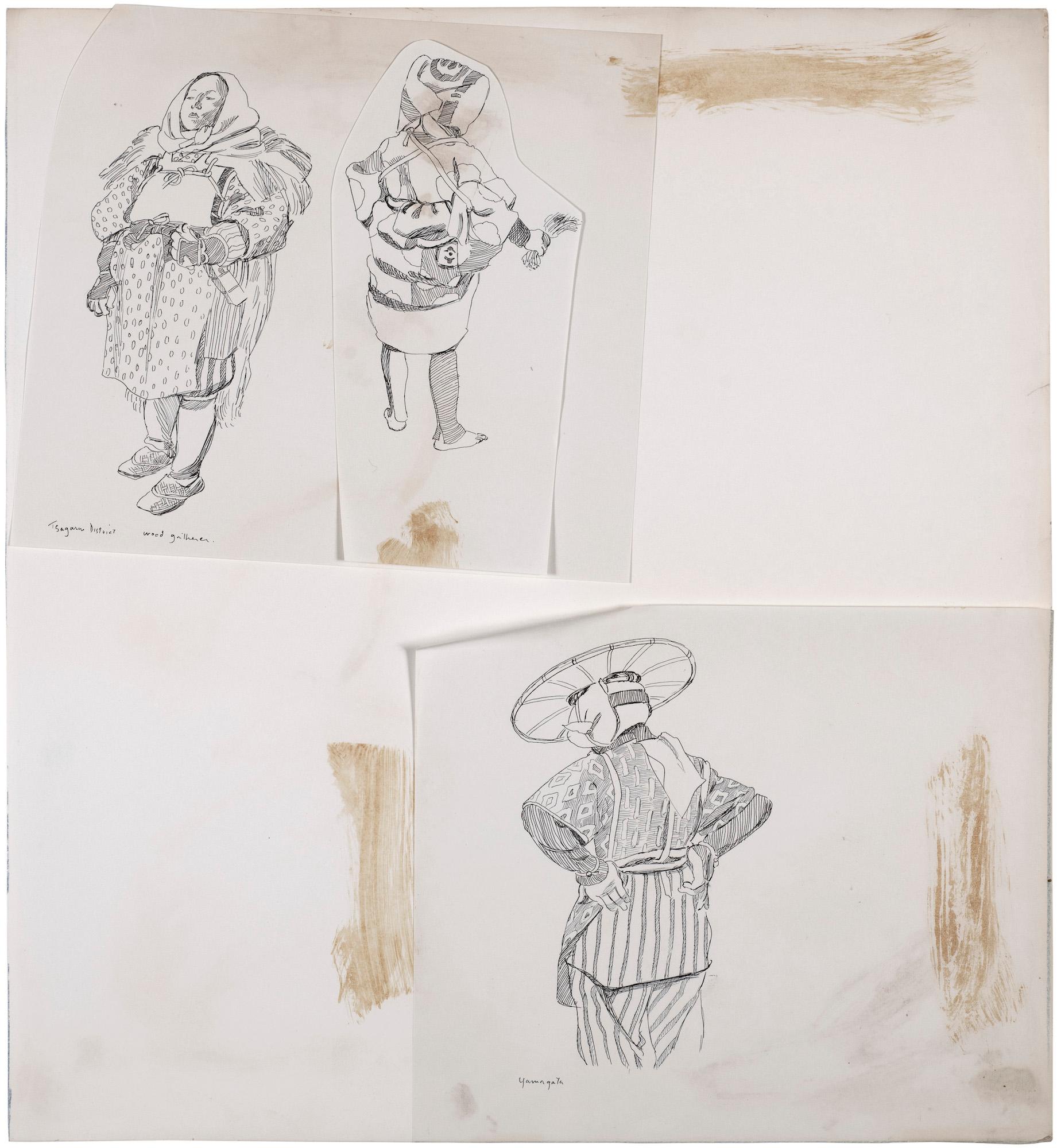
Jacqueline Ayer, Untitled (various Japanese working attire), c. 1973
Jacqueline Ayer (1930–2012) had a career that spanned many creative fields. She began as a fashion illustrator, and later turned her hand to children’s books, textiles and garments, as she worked in New York, Paris, London, Bangkok, Hong Kong and across India. These drawings were used as some of the final illustrations printed in Ayer's publication Oriental* Costume (1974). Descriptions from left: Tsaguru wood gatherer, Japan; Rice planter, Kochi; Yamagata field worker (back view). *The term ‘oriental’ has colonial and racist origins. It was established during a period when European powers took political control of other countries and defined non-European cultures as ‘inferior’ to their own. ‘Oriental’ was commonly used in English-speaking countries until the late 20th century to group together people, culture and places in Northern Africa, East Asia and Southeast Asia, as well as objects thought to have originated in these areas. The term has been widely rejected today as it exoticizes and ‘others’ these diverse cultures. Ayer used the term here to collectively refer to modes of dress from Cambodia, China, Japan, Mongolia, Nepal, Thailand and Tibet.
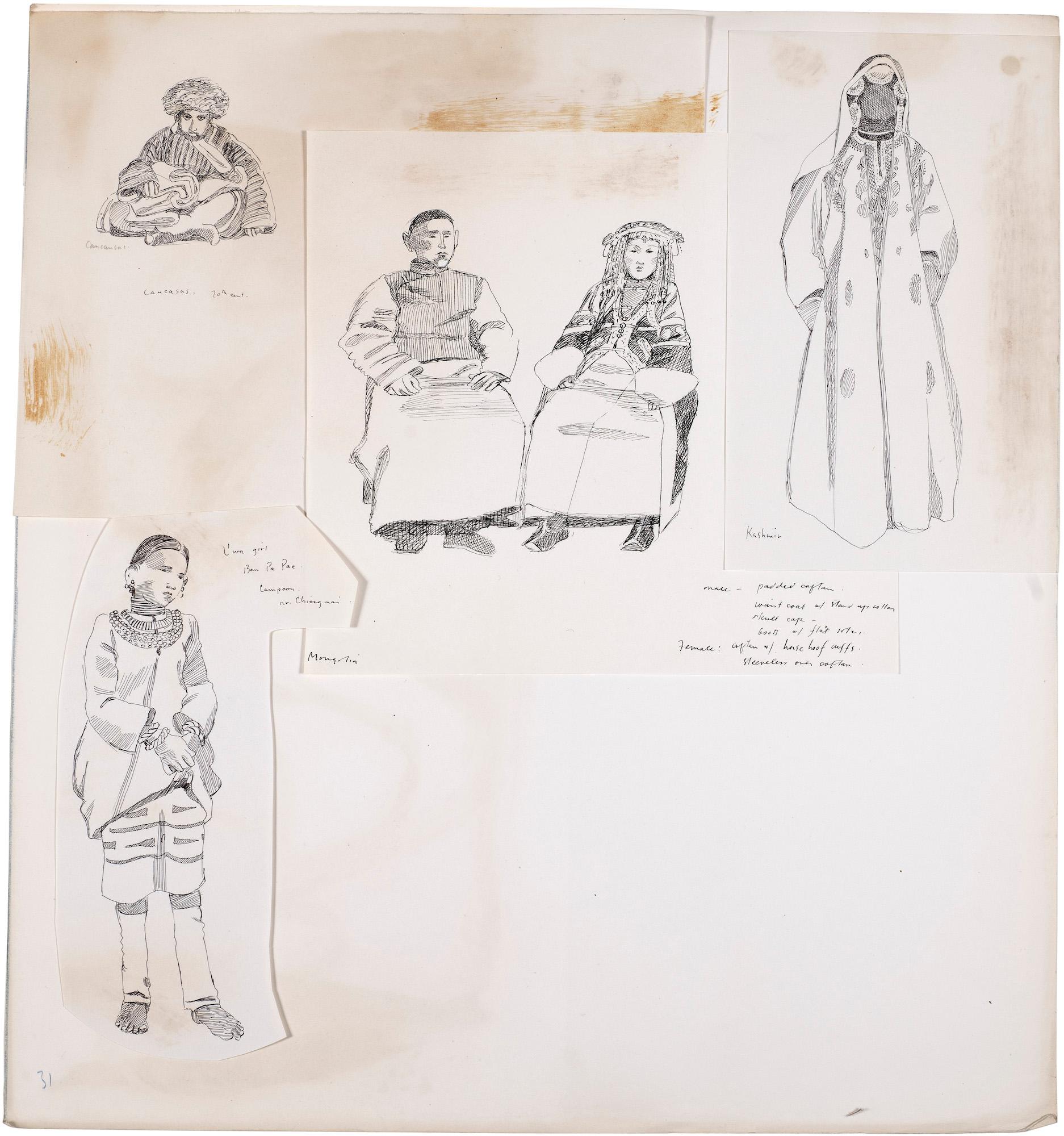
Jacqueline Ayer, Untitled (various clothing featured on page titled 'The Closed Sewn Garment', and Karen woman), c. 1973
Jacqueline Ayer (1930–2012) had a career that spanned many creative fields. She began as a fashion illustrator, and later turned her hand to children’s books, textiles and garments, as she worked in New York, Paris, London, Bangkok, Hong Kong and across India. This drawing was used as one of the final illustrations printed in Ayer's publication Oriental* Costume (1974). Descriptions from left: Padded loose robe, Caucasus, 19th century; Diagonal closed sewn garment, the layered caftan, Mongolia, 19th century; Closed sewn garment, Kashmir, contemporary; Karen woman. *The term ‘oriental’ has colonial and racist origins. It was established during a period when European powers took political control of other countries and defined non-European cultures as ‘inferior’ to their own. ‘Oriental’ was commonly used in English-speaking countries until the late 20th century to group together people, culture and places in Northern Africa, East Asia and Southeast Asia, as well as objects thought to have originated in these areas. The term has been widely rejected today as it exoticizes and ‘others’ these diverse cultures. Ayer used the term here to collectively refer to modes of dress from Cambodia, China, Japan, Mongolia, Nepal, Thailand and Tibet.
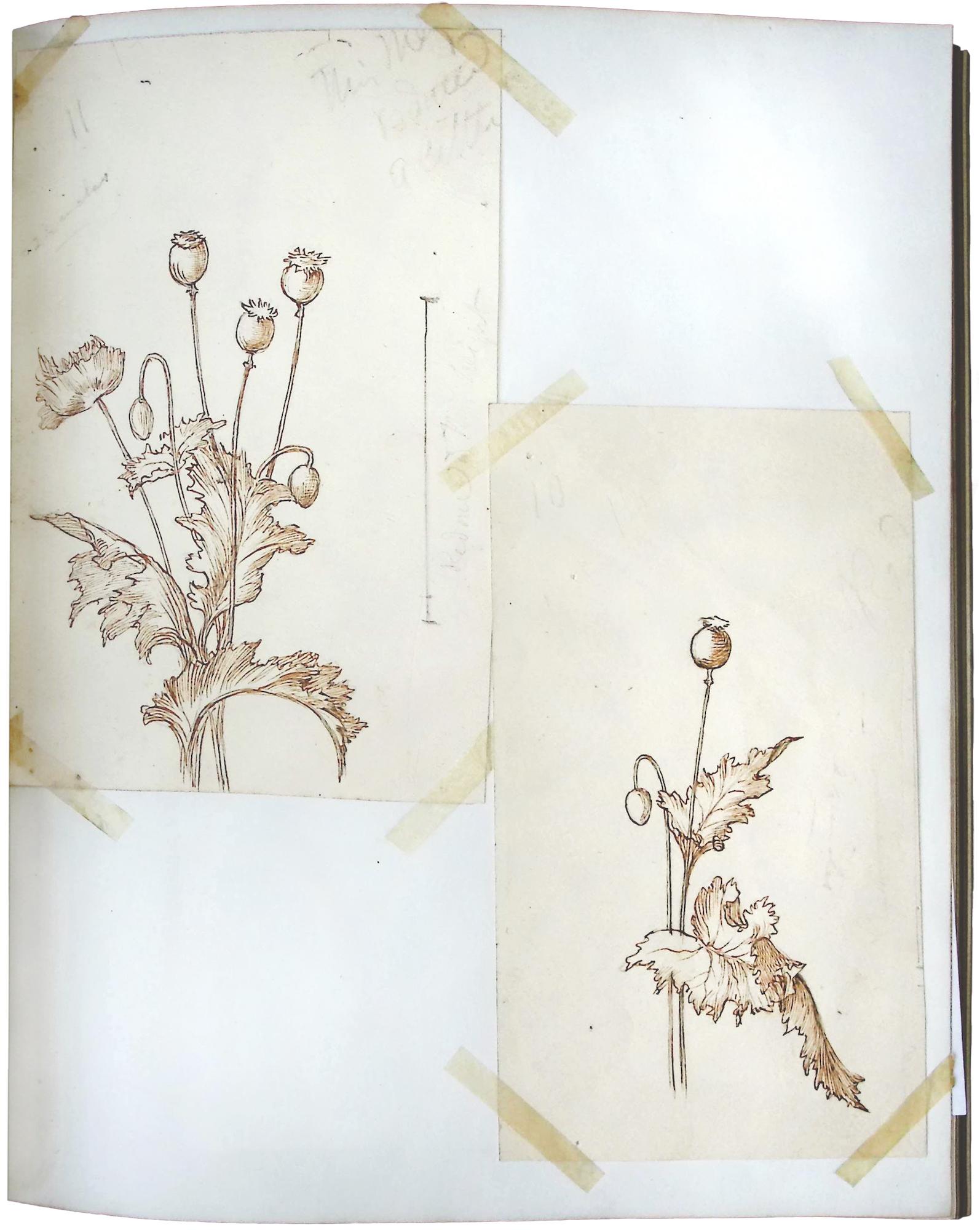
Untitled, c. 1893
Eleanor Vere Boyle (1825 – 1916) illustrated poetry and prose by some of the most popular authors of her time. She regularly drew and painted using ink and watercolour, sketching landscapes, animals and her children from life. She also made drawings from her imagination, often reflecting spiritual themes. These drawings were used as some of the final illustrations printed in the artists' publication A Book of Heavenly Birthdays (1893, London Elliot Stock)
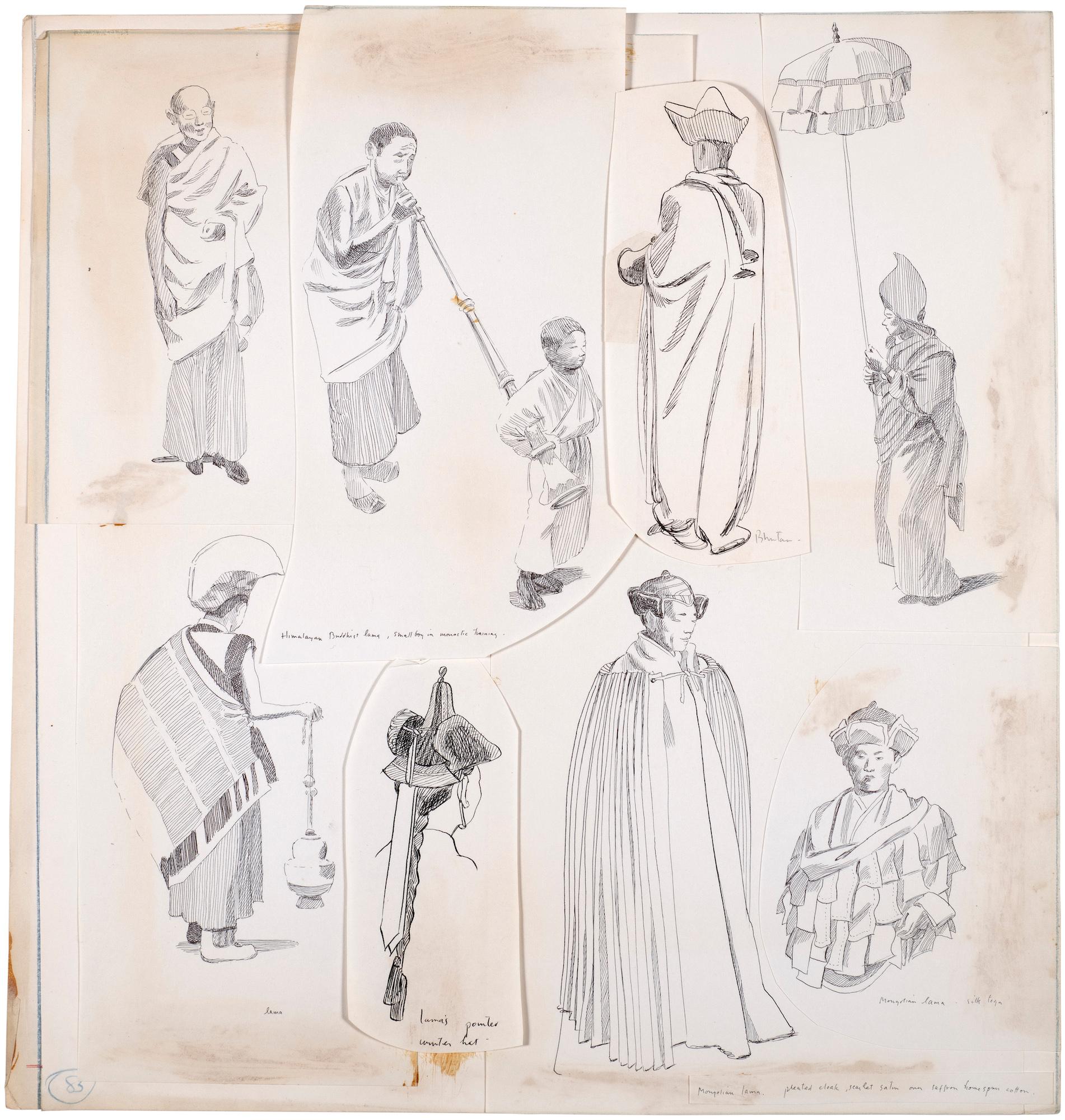
Jacqueline Ayer, Untitled (various Northern Buddhists clothing), c. 1973
Jacqueline Ayer (1930–2012) had a career that spanned many creative fields. She began as a fashion illustrator, and later turned her hand to children’s books, textiles and garments, as she worked in New York, Paris, London, Bangkok, Hong Kong and across India. This drawing was used as one of the final illustrations printed in Ayer's publication Oriental* Costume (1974). Descriptions from top left, clockwise: A high-ranking lama, Sikkim, 1971; Himalayan Buddhist lama, Sikkim, 1969; Lama calling morning prayers, Bhutan, contemporary; Lama in procession, Sikkim, contemporary; Mongolian lama, contemporary; Mongolian lama, contemporary; Ceremonial hat, winter style, Himalayan lama, contemporary; Ceremonial dress, Sikkim, contemporary. *The term ‘oriental’ has colonial and racist origins. It was established during a period when European powers took political control of other countries and defined non-European cultures as ‘inferior’ to their own. ‘Oriental’ was commonly used in English-speaking countries until the late 20th century to group together people, culture and places in Northern Africa, East Asia and Southeast Asia, as well as objects thought to have originated in these areas. The term has been widely rejected today as it exoticizes and ‘others’ these diverse cultures. Ayer used the term here to collectively refer to modes of dress from Cambodia, China, Japan, Mongolia, Nepal, Thailand and Tibet.
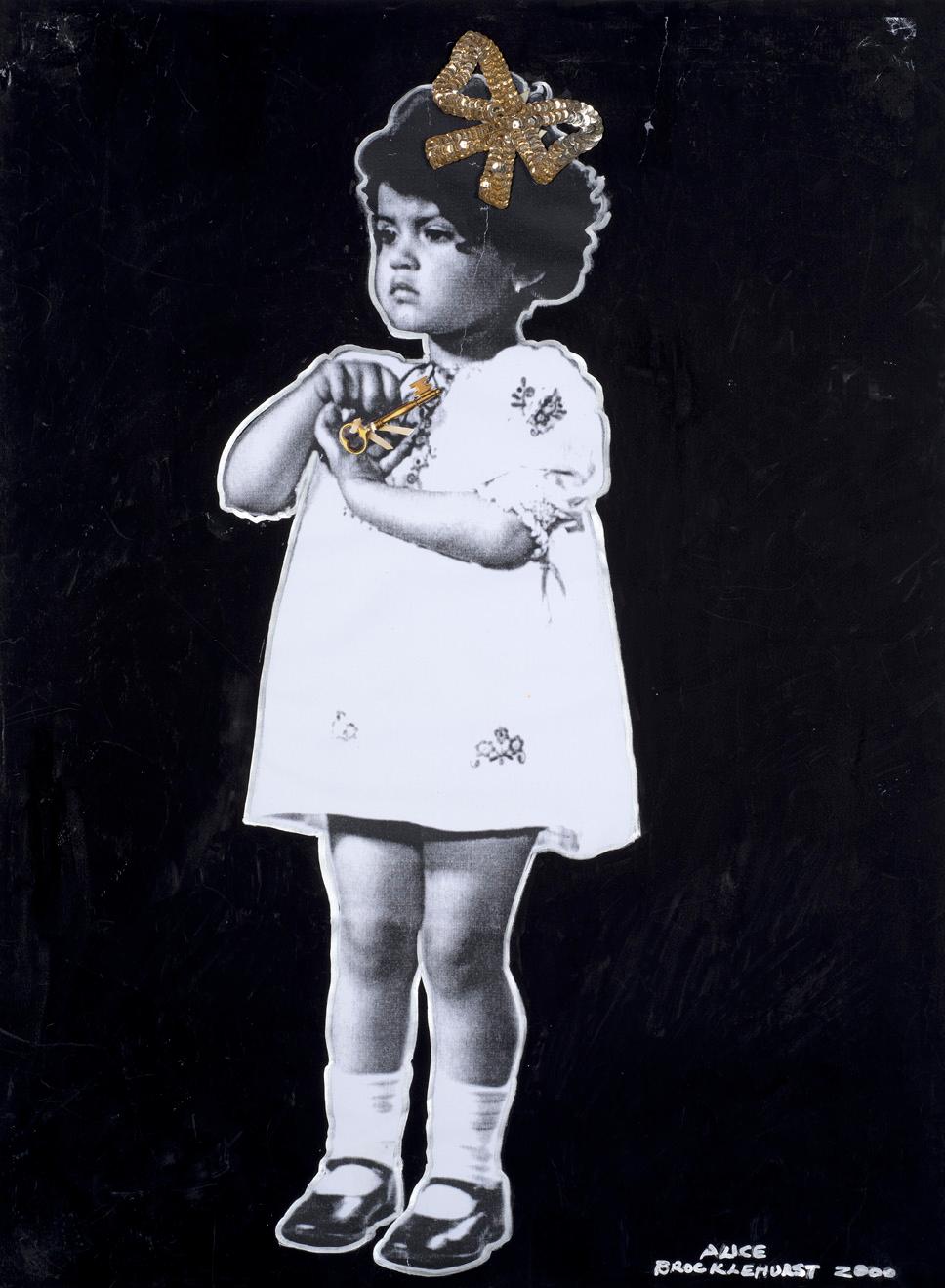
Jo Brocklehurst, Alice (from Brocklehurst Through the Looking-Glass), 2000
Jo (Josephine) Brocklehurst (1935 - 2006) studied at Central Saint Martins and began her career as a fashion illustrator. She later focused on portraiture, drawing directly from models at her studio in West Hampstead and in nightclubs and theatres in Berlin, London and New York. Her work documents the alternative subcultures of the 1970s, 80s and 90s that went on to shape mainstream fashion and performance scenes. This work is from Brocklehurst Through the Looking-Glass, Brocklehurst’s final series. With this image of herself as a child as the centrepiece, Brocklehurst made hundreds of drawings that re-imagined characters from Lewis Carroll’s Alice novels. Her models were friends and dedicated club-goers who designed and made their own clothes. Works from the series were framed with bright plastic gemstones and hung on every available space at Brocklehurst’s home studio. She used metallic and neon inks that transformed under ultraviolet lights that she switched on for her guests in the evenings.
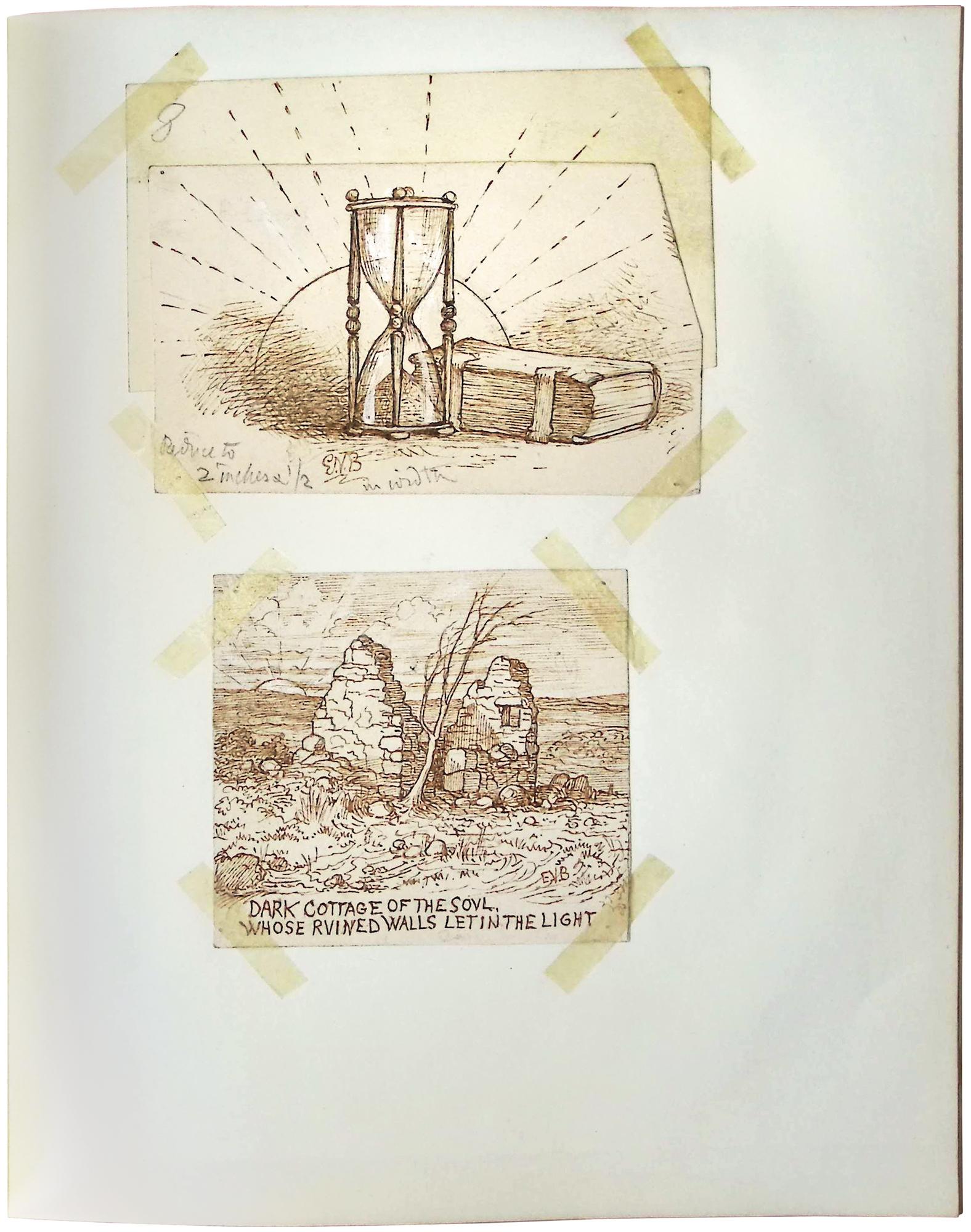
Untitled (illustrations for A Book of Heavenly Birthdays), c. 1893
Eleanor Vere Boyle (1825 – 1916) illustrated poetry and prose by some of the most popular authors of her time. She regularly drew and painted using ink and watercolour, sketching landscapes, animals and her children from life. She also made drawings from her imagination, often reflecting spiritual themes. These drawings were used as some of the final illustrations printed in the artists' publication A Book of Heavenly Birthdays (1893, London Elliot Stock)
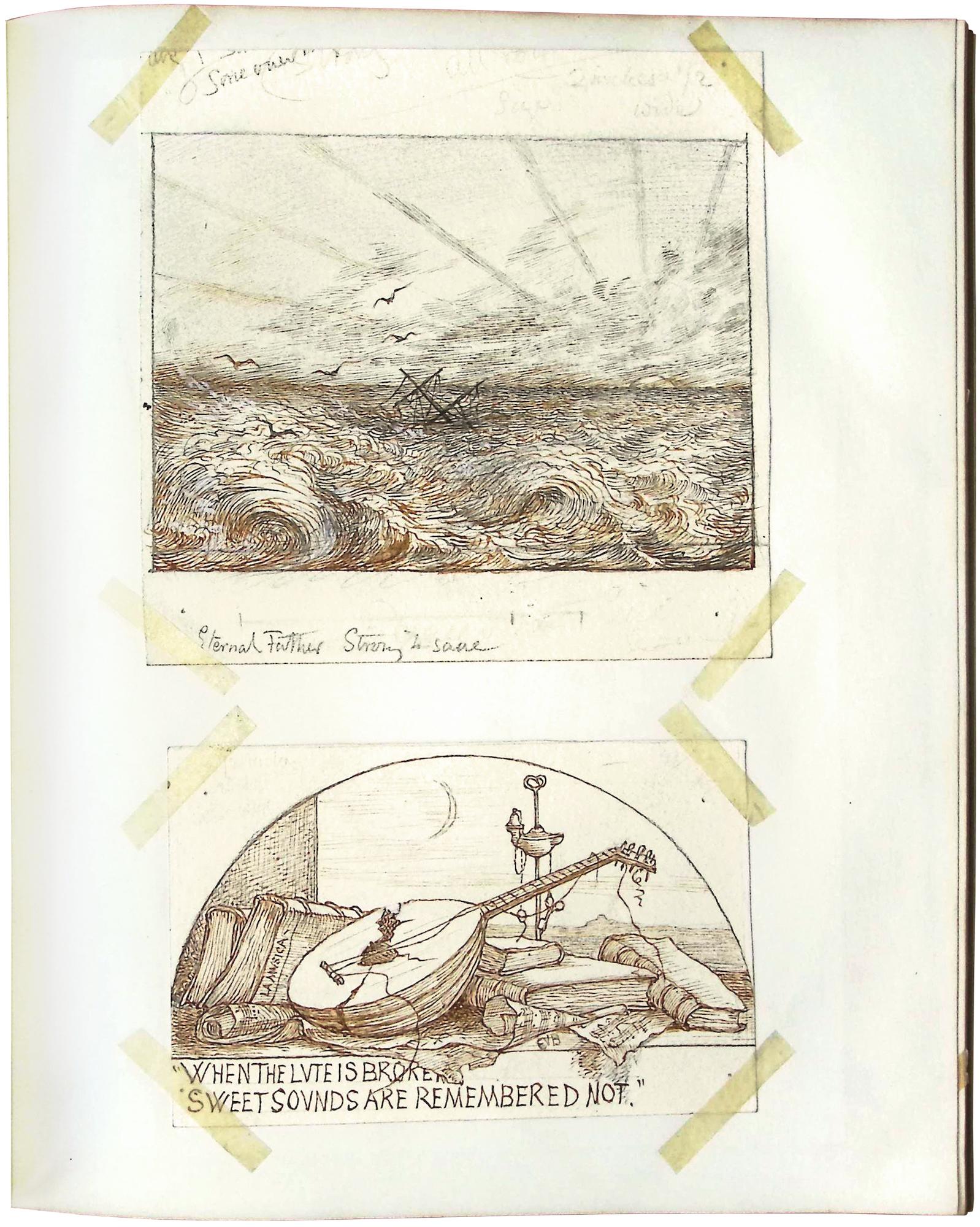
Untitled (illustrations for A Book of Heavenly Birthdays), c. 1893
Eleanor Vere Boyle (1825 – 1916) illustrated poetry and prose by some of the most popular authors of her time. She regularly drew and painted using ink and watercolour, sketching landscapes, animals and her children from life. She also made drawings from her imagination, often reflecting spiritual themes. These drawings were used as some of the final illustrations printed in the artists' publication A Book of Heavenly Birthdays (1893, London Elliot Stock)
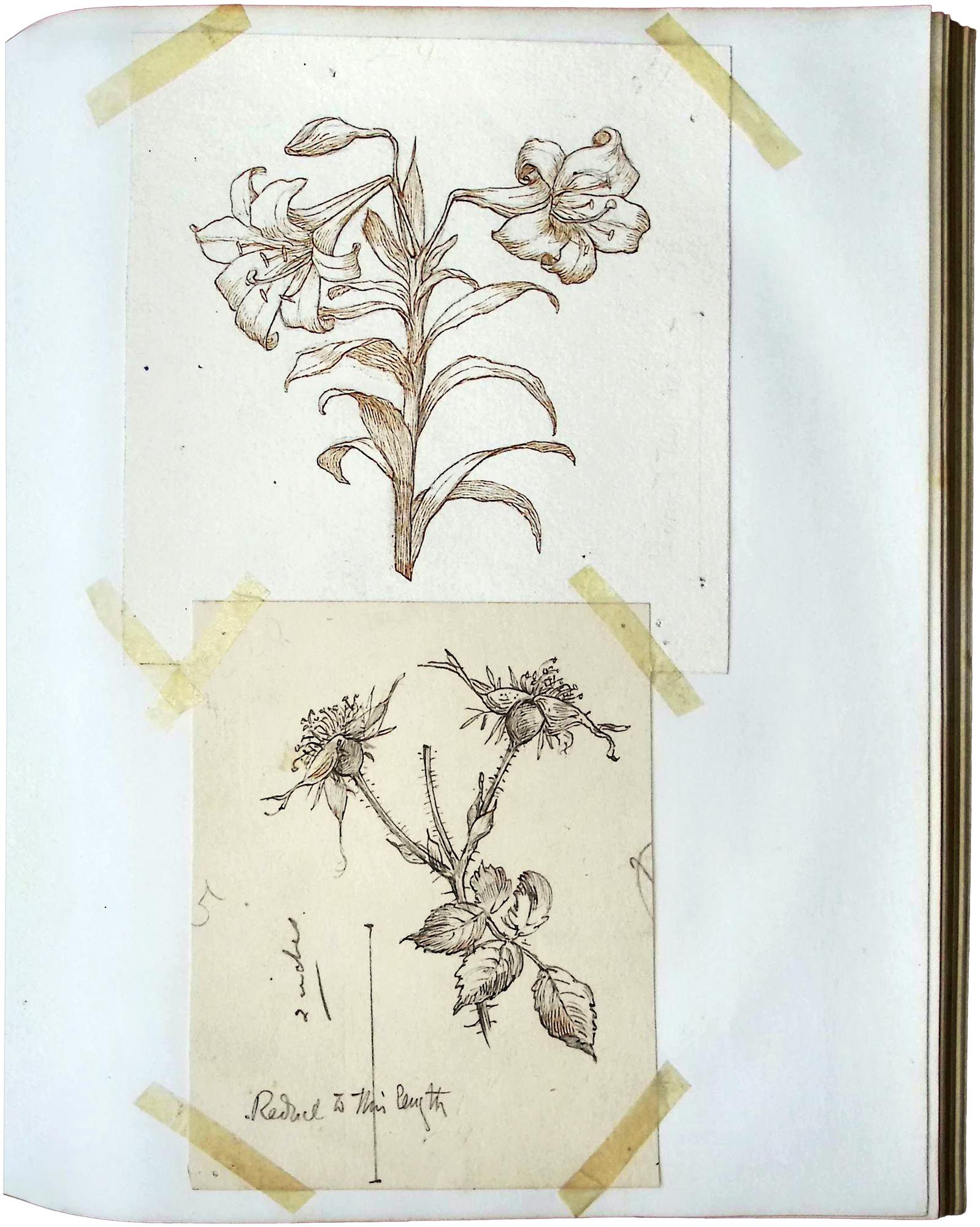
Untitled, c. 1893
Eleanor Vere Boyle (1825 – 1916) illustrated poetry and prose by some of the most popular authors of her time. She regularly drew and painted using ink and watercolour, sketching landscapes, animals and her children from life. She also made drawings from her imagination, often reflecting spiritual themes. These drawings were used as some of the final illustrations printed in the artists' publication A Book of Heavenly Birthdays (1893, London Elliot Stock)
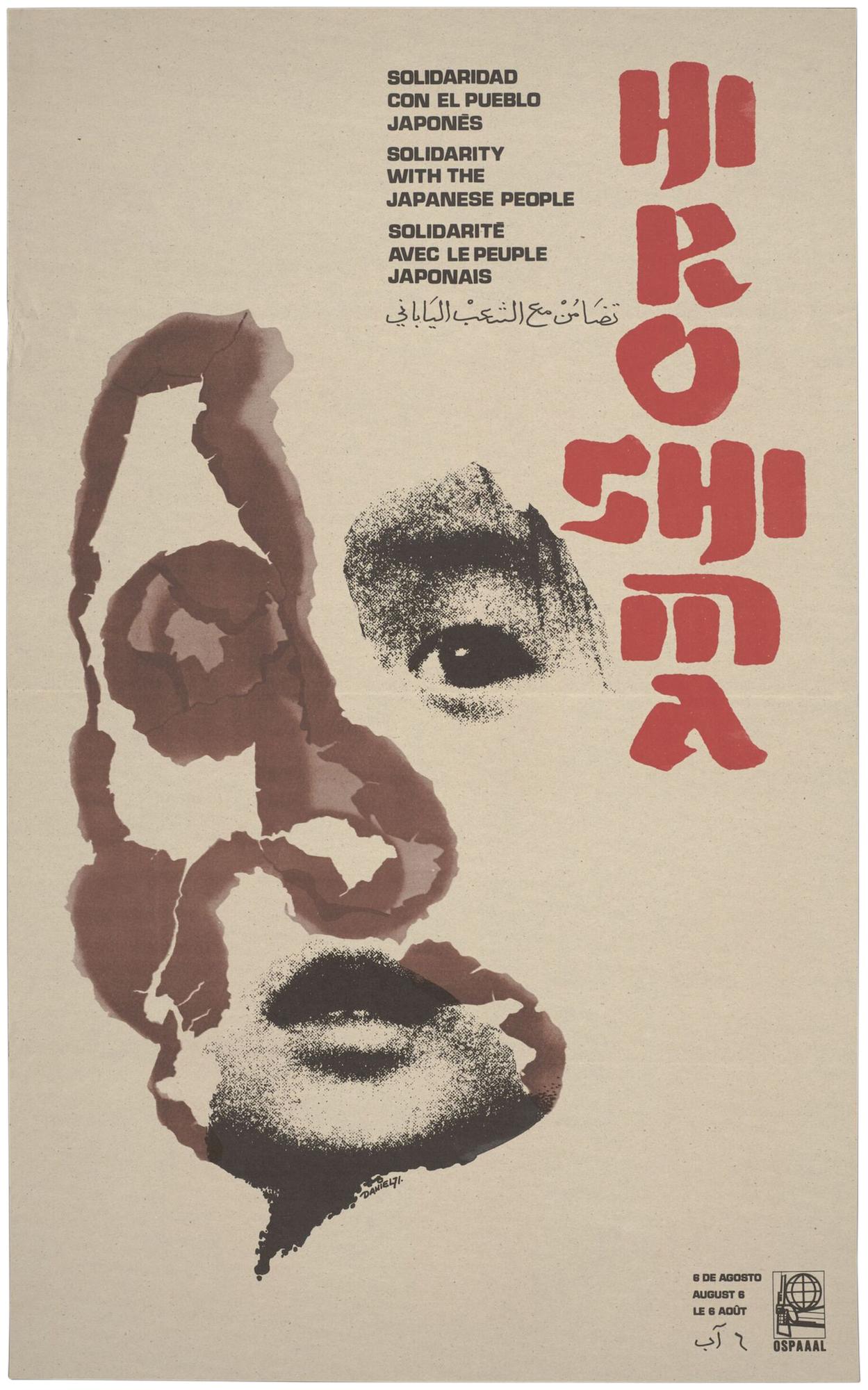
HIROSHIMA - SOLIDARITY WITH THE JAPANESE PEOPLE, 1972
Between the 1960s and 1990s, more than fifty designers worked at OSPAAAL (the Organisation of Solidarity with the People of Africa, Asia and Latin America). Based in Cuba, they made magazines and posters that were sent around the world. Their aim was to promote radical political ideas. Many of their posters celebrate socialist revolutions and liberation movements from the Global South. OSPAAAL marked the date of the atomic bombing of the city of Hiroshima by the U.S.A. as a day of solidarity with Japanese citizens. By collaging fragments of a photograph and burned paper, Daniel García stressed the horrific consequences of deploying nuclear weapons. OSPAAAL’s designers regularly used adapted photographs from the organisation’s news desk. Photographs were sometimes used out of context, with the same photographs appearing in posters and magazine illustrations to represent different themes. The identity of the person in this photograph is not recorded.
Content warning: Injury, burns
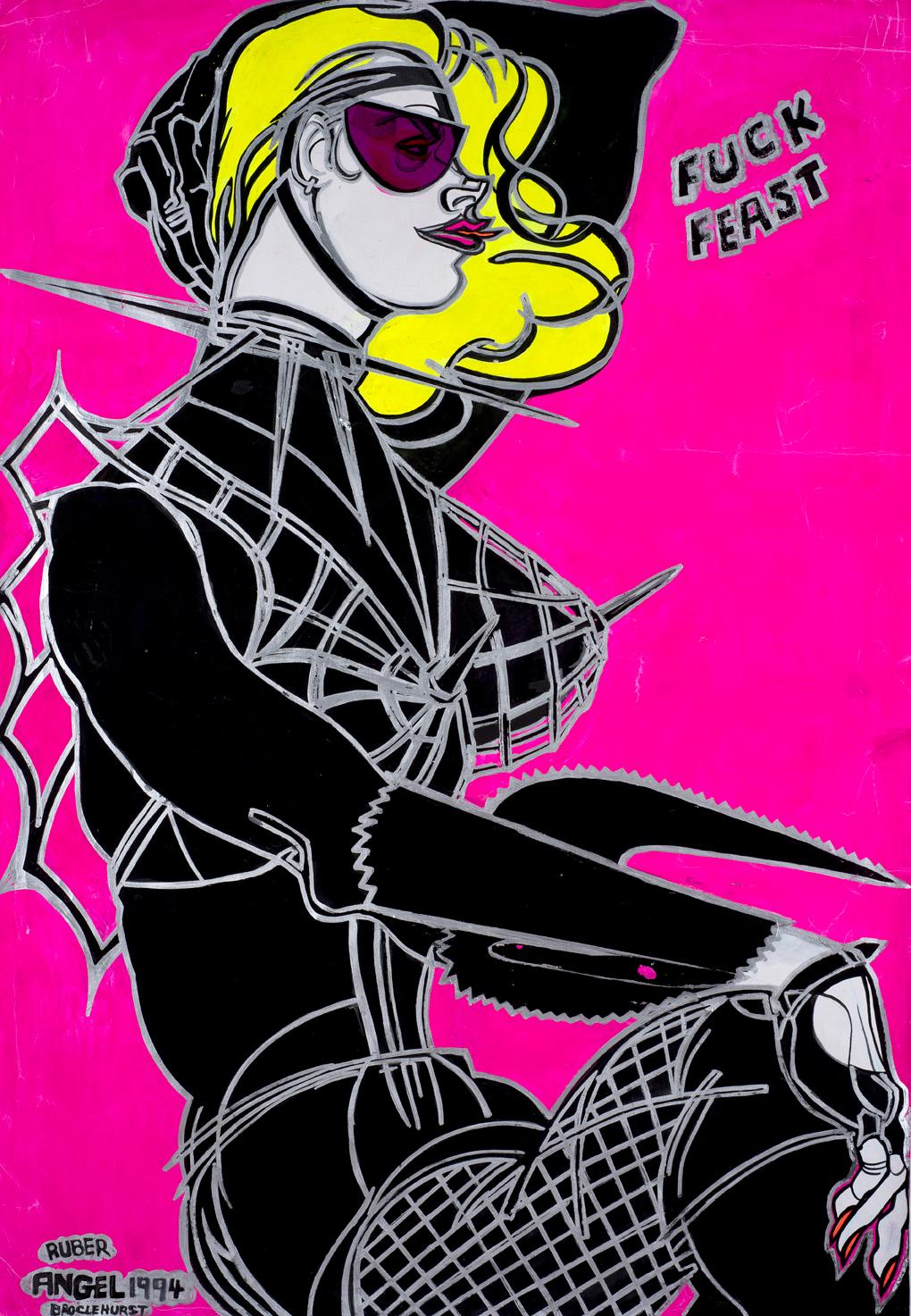
Jo Brocklehurst, Ruber Angel (portrait of Isabelle Bricknall), 1994
Jo (Josephine) Brocklehurst (1935 - 2006) studied at Central Saint Martins and began her career as a fashion illustrator. She later focused on portraiture, drawing directly from models at her studio in West Hampstead and in nightclubs and theatres in Berlin, London and New York. Her work documents the alternative subcultures of the 1970s, 80s and 90s that went on to shape mainstream fashion and performance scenes. In the 1990s, Brocklehurst began drawing the fashion designers and performers finding space for experimentation in the fetish clubs of Soho and King’s Cross. This portrait is of Brocklehurst’s regular collaborator Isabelle Bricknall, whose collection of steel ‘body armour’ (constructed by Anthony Gregory) was designed as ‘protection’ for nights on the fetish scene.
Content warning: strong language