An interview with Quentin Blake
by Anna Trench
The following article was originally published in April 2008 by Varsity(opens in new window). Anna Trench interviewed Quentin Blake in Cambridge, where he had studied English over fifty years before, and in his studio in London where he still works today. Quentin discusses the humour behind his work and compares illustrating to directing a play, while Trench notes his commitment to promoting illustration.
Now, nearly two decades following this interview, Quentin Blake Centre for Illustration has opened as the world’s largest permanent place dedicated to illustration and we’re bringing this interview out of the archives.
Along with MURUGIAH’s first solo show, we have opened with the exhibitions Quentin Blake: Performance, which explores Quentin’s work through a uniquely theatrical lens, and Queer as Comics which explores queer comics from the 1940s to the present day. One such work to feature in this exhibition is the 2025 graphic novel Florrie created by Trench years after she interviewed Quentin.
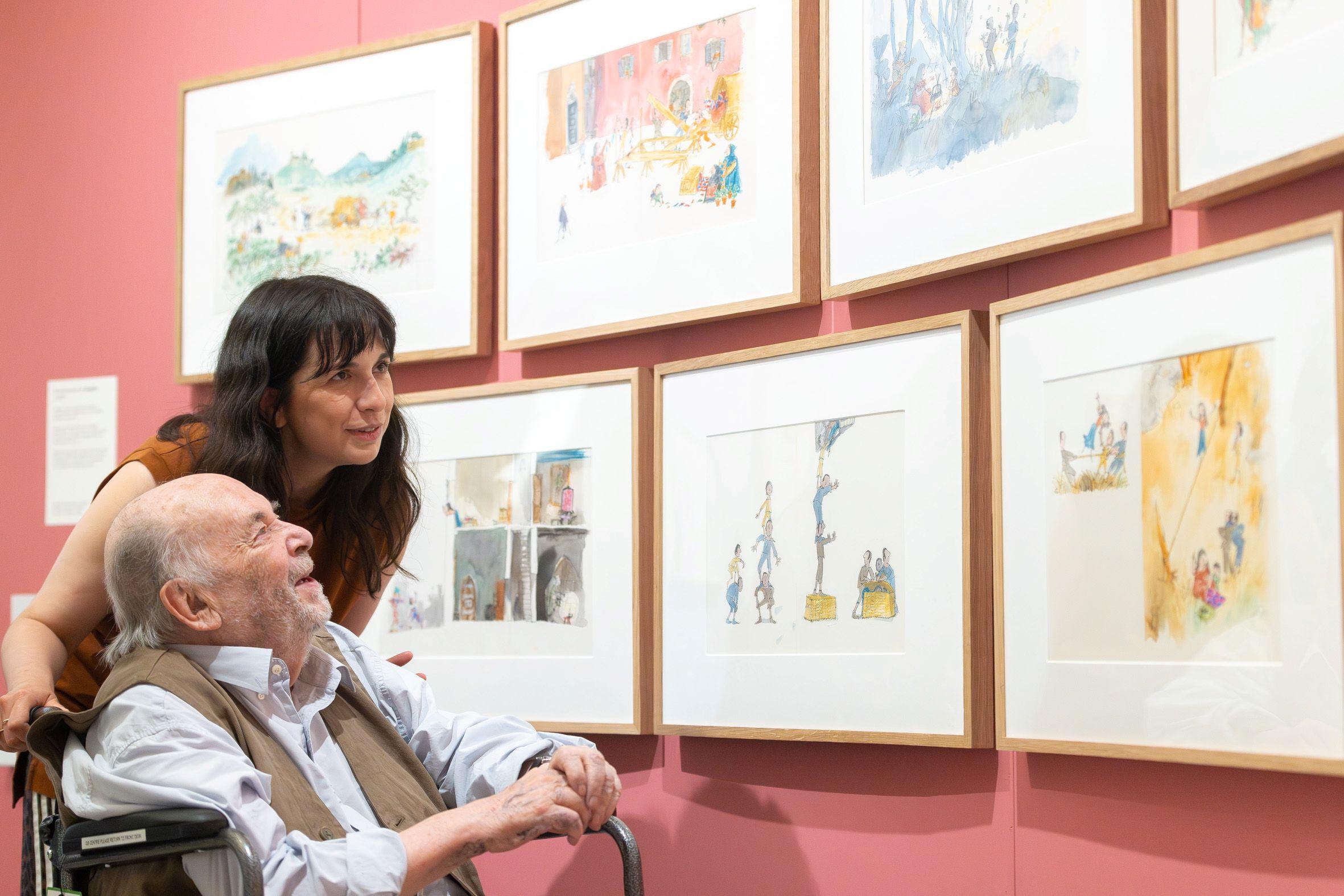
Quentin Blake is one of Britain’s best-loved illustrators. Anna Trench interviews the man whose drawings enlightened a generation
25 April 2008 I expected to meet a man who looked like one of his characters – scratchy and colourful, scruffy and beaming, possibly doing a cartwheel. But the man who greeted me on the steps of Downing library was quietly dressed; he smiled, he did not grin, and when he shook my hand we did not fly away into the sunset on a giant multicoloured bird. In fact, Quentin Blake was rather ordinary, although his eyes certainly twinkled.
We sat in the sun on a tiny bench. Over fifty years ago, Blake read English here, presided over by F.R. Leavis. When I ask for some wild anecdotes of student adventures he mumbles, “Oh, I just crept around writing essays and doing drawings.” After Cambridge he attended Chelsea as a part time student and eventually went on to be head of illustration at the Royal College.
Almost all the books he has illustrated are collaborations between words and pictures. Indeed, Words and Pictures(opens in new window) is the title of the essential guide to how and why he works, published in 2000, with illustrations ranging from his A-level days right up to his most recent books. His reasoning at the time was “If I go to an art school I might stop reading, but if I read English I won’t stop drawing – I kind of get both.”
And he was right, because Blake has successfully made his living his whole life out of drawing, from when he was published in Punch aged sixteen up to now. “Also,” he continues, “because it’s books and because the words are important I discovered I’m interested in the editorial aspect of it – how you fit the words and pictures together.”
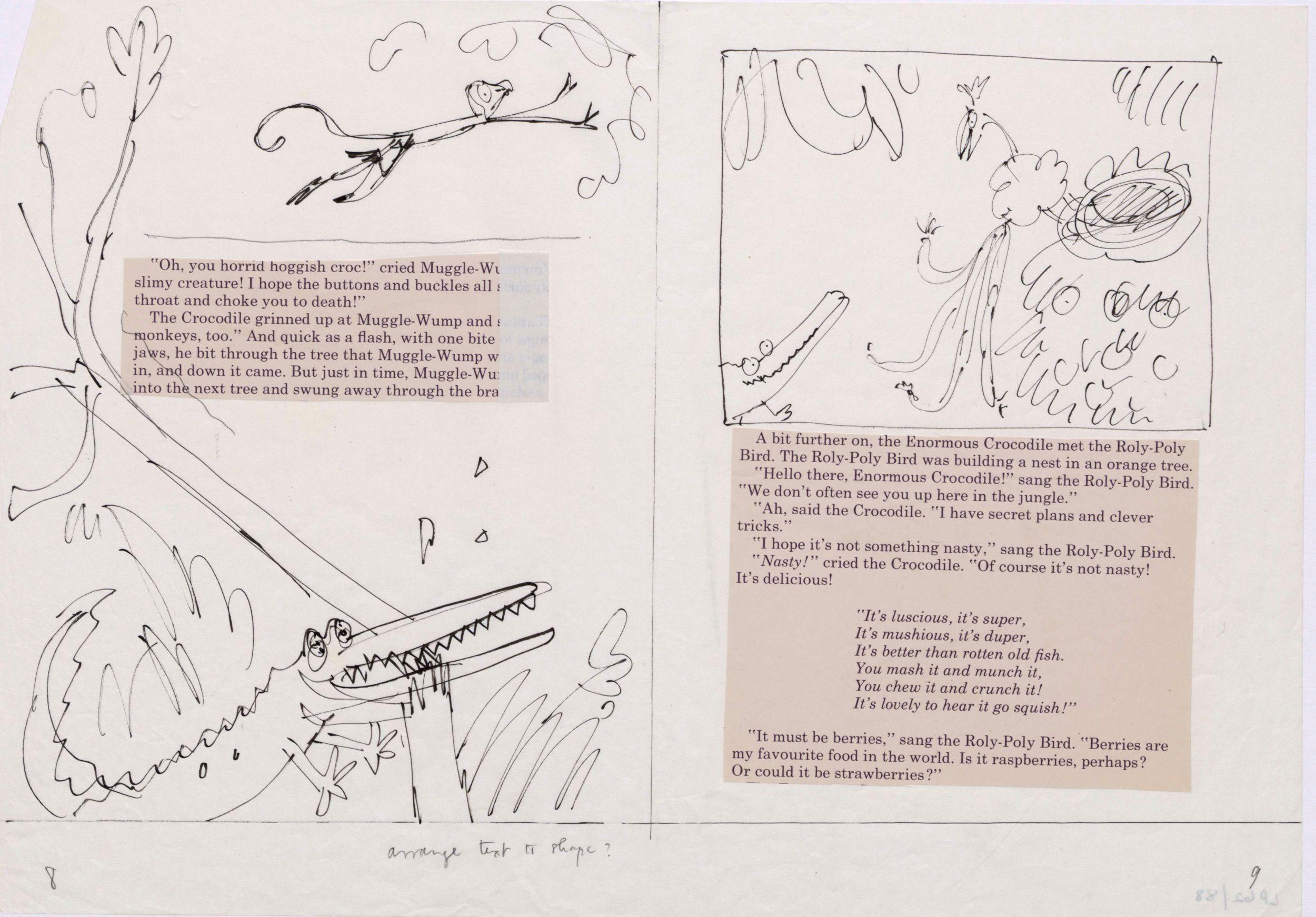
Quentin Blake likens his role to that of a theatre director: “Here’s the text of the play – how do we bring it about?”
When he was working with Roald Dahl, they would meet up and see if they could slightly “change the text to see if we could get a better picture”. Famously, Dahl sent his own Norwegian slippers in the post to Blake as inspiration for the BFG’s shoes. Blake has illustrated over 300 books by a dozen authors, including Evelyn Waugh. But Waugh, he says, was “very difficult because he’s just too funny. If you’re working with someone you let them have the limelight and you do a bit when it’s quiet – but Evelyn Waugh’s just funny all the time. So I felt a little superfluous.”
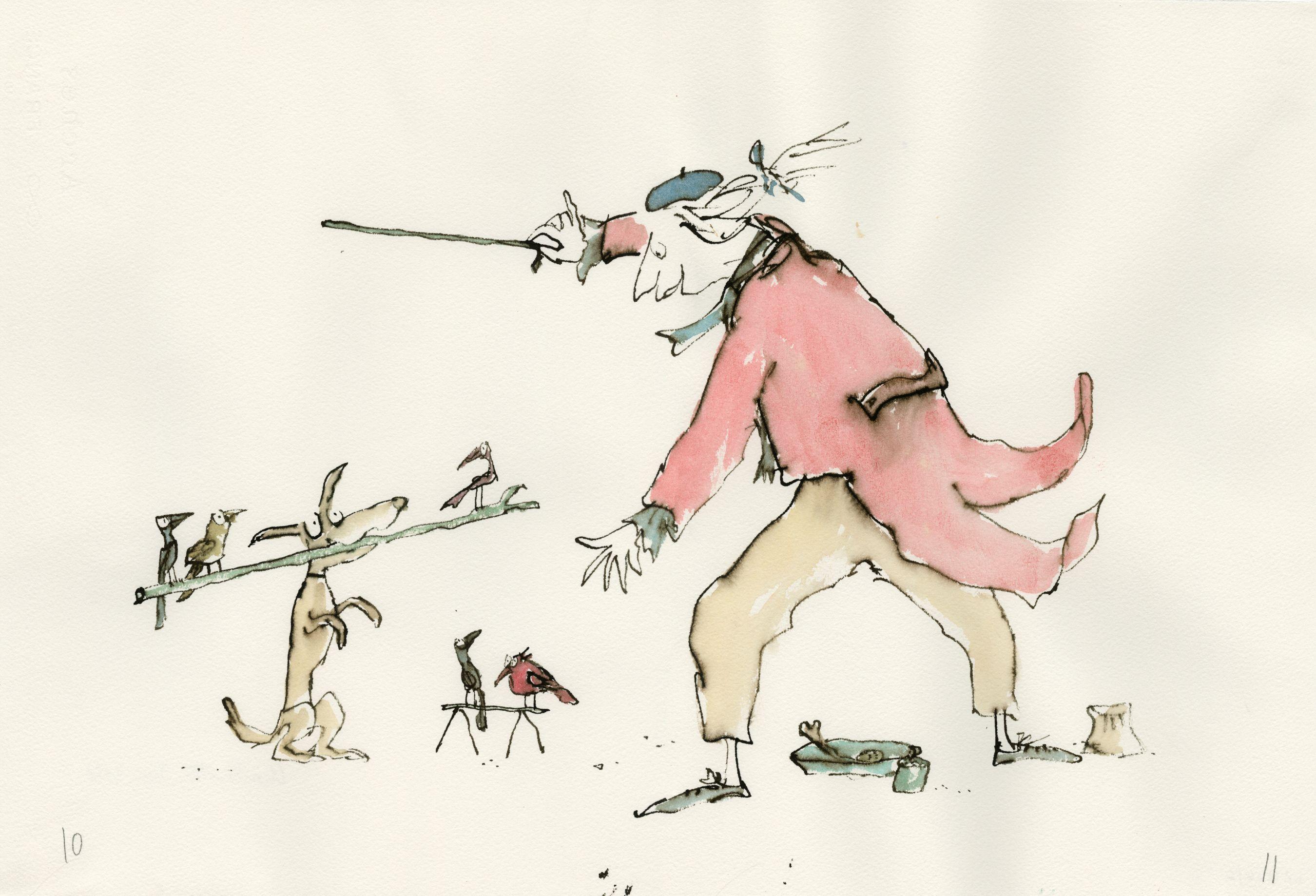
“It’s sort of a celebration of… being alive.”
Humour is crucial to Blake’s work. His energetic characters cannot help but make you smile. “I’m in the funny business,” he says. “I don’t do gloomy things. When people theorise about humour it’s always about other people’s misfortunes – banana skins – but it’s not entirely about that. Certain humour is just seeing what people do.”
Blake admires the eighteenth-century satirists Daumier and Cruickshank, and Ronald Searle, whom he met doing national service, and told me he would like to illustrate some Dickens at some point, like Phiz. But Blake’s work is not social satire. “There is an element of social observation,” he agrees with me. “But it’s not what we’re there for, not the attack.” I ask whether his work, with all those eccentric characters and wild adventures, is about escapism. He agrees, but does not seem entirely convinced.
Later I ask what he thinks the purpose of drawing is. “It’s a sort of celebration of… oh, I don’t know…” he laughs awkwardly, “…being alive.” If this had come from anyone else I would have considered it an almost trite comment. But coming from Quentin Blake, a man who seems to understand the importance of his drawings for millions of children and adults, it is actually very powerful. “Vitality,” he concludes. “That’s what it is.”
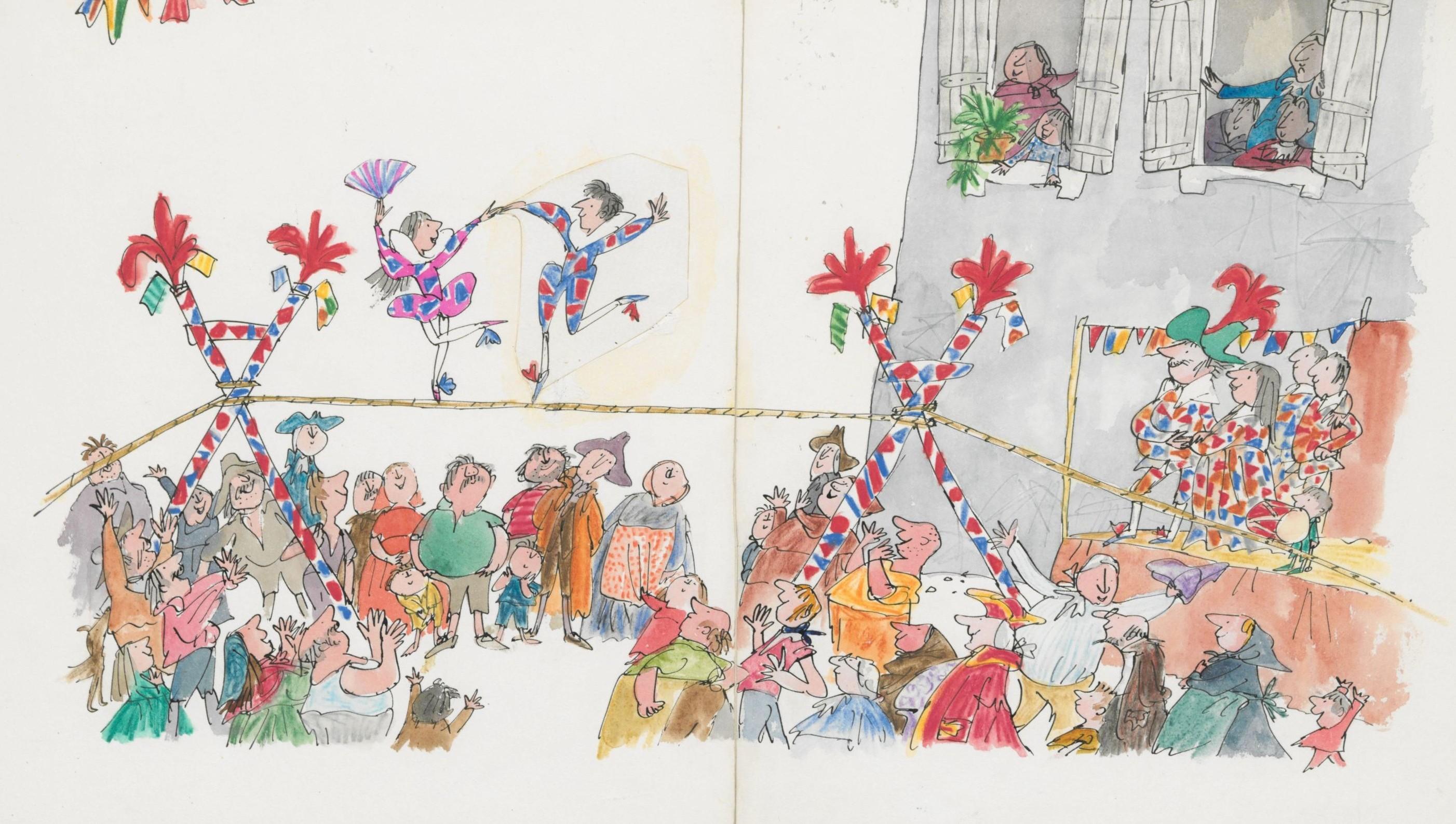
Although Blake insists he is in the “funny business”, one of the most popular, and certainly the most powerful book he has illustrated, is not funny at all: Sad Book(opens in new window) by Michael Rosen is about the death of Rosen’s teenage son. Blake says he feels “slightly embarrassed talking about it… I want to talk about the business of illustrating – but it’s too real.” It’s an honest, sparse book. Rosen “had done it so that you could alternate dark and white… he gave me the candles and I sort of found the end.” There are few children’s books that deal directly with bereavement, and Sad Book is for adults as much as for children. It is not depressing or patronising; it is confused and angry, raw and beautiful. Sad Book is not gloomy: it is about dealing with death, and as Blake says, it is “about getting over it”.
When I met Blake at Downing he was charming and informative, but what I really wanted was to see the place where he put his characters on paper. I wanted to see him at his drawing board, what pens he used and where he kept them. So I invited myself to his London studio.
Through the door I was greeted by old cut-outs of Daumier’s work from magazines. This time Blake conformed more to my expectations: unshaven, in a brightly-coloured stripy shirt with what is left of his hair standing slightly on end. We sat in his studio, an enormous room at tree top level. In the centre of the room is a large light box where Blake stands up and draws. His desk is full of mugs of pens and pencils and brushes, and in one corner is a cluster of exotic bird feathers, used as quills.
Blake sketches a rough first and then draws over the barely visible image on the light box. Images come first, stories later. When he draws he is thinking of several things at once: “the characters, how it’s going to fit on the page, and where that’s going to go.” You get the feeling that Blake only ever draws what he likes, and he must enjoy it immensely, standing up next to the light box and imagining he is these mad characters.
I left with the feeling that what Quentin Blake does is more than a “celebration of being alive”; it’s a means to enable others to celebrate being alive too.
Although we know Blake for his drawings, he used to paint a lot, and has a separate studio for it. He shows me a book full of huge watercolours of women reading. They are loose and expressive in blues and greys. In comparison to painting, illustration is often belittled. “It’s a minor form, but not inferior,” he says. But if anyone is going to change that, it’s Quentin Blake.
Before I leave, he generously gives me two books, one of which is about his time as Children’s Laureate. He took his position as the first Children’s Laureate very seriously, working tirelessly for two years to promote children’s literature and drawing. I left with the feeling that what Quentin Blake does is more than a “celebration of being alive”; it’s a means to enable others to celebrate being alive too.
My favourite book by Quentin Blake is a story he wrote and illustrated, called Jack and Nancy(opens in new window). They get swept away by an umbrella to a tropical island where they live with a parrot, before eventually being rescued by some jolly sailors. I tell him I always imagined Jack and Nancy were me and my brother. And surely that’s partly the point; we imagine ourselves as his characters. My enthusiasm was not universal. Blake saw a letter saying that his American agents had shown the book to two unimpressed teachers, who said “We don’t think we can use it; everybody thinks it’s just kind of dumb. Although actually we don’t know what children think about it.” Perhaps those teachers had no imagination, or perhaps Blake really is in a tiny minority: an adult who knows what children really think.