Pen
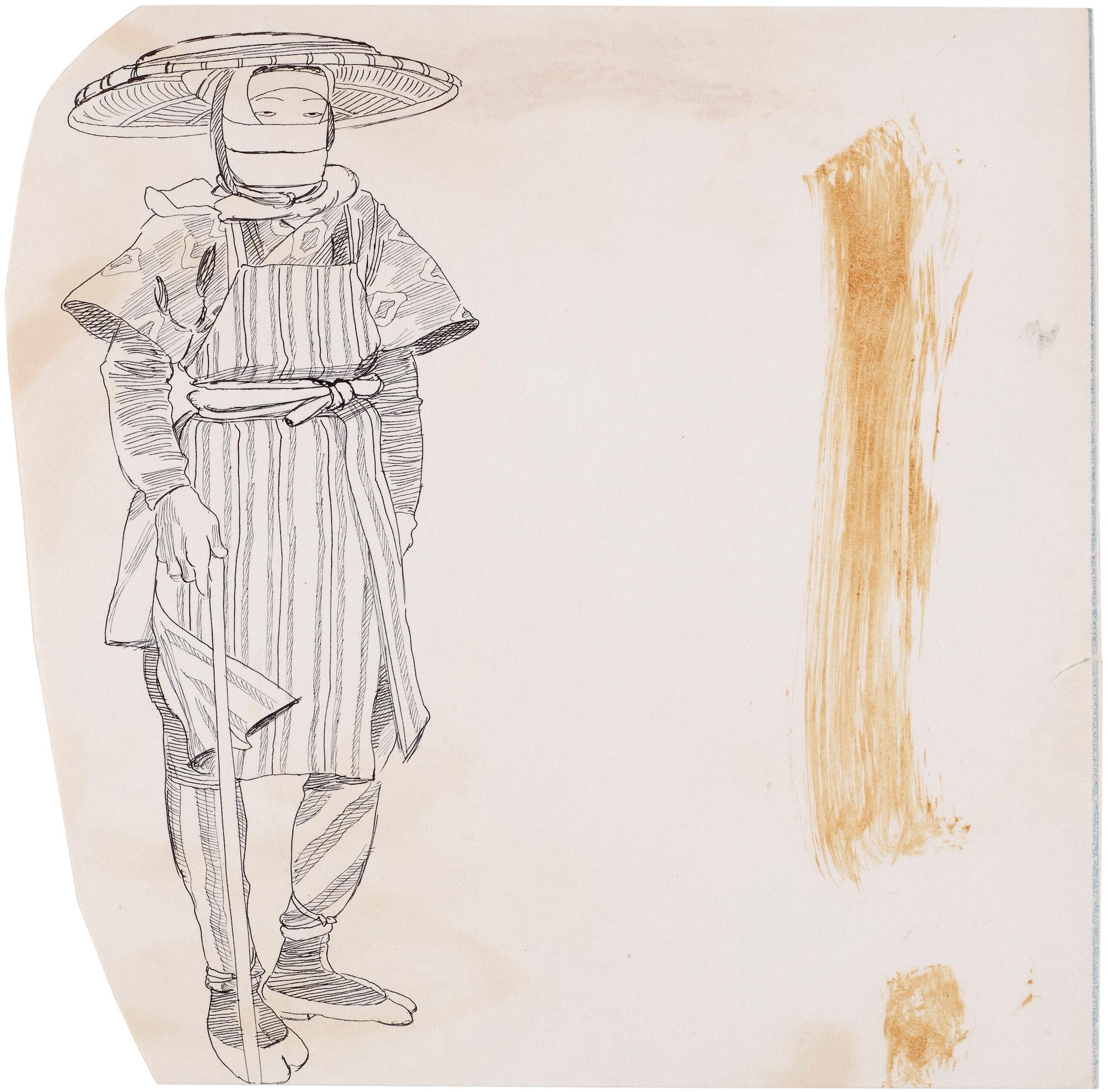
Jacqueline Ayer, Untitled (Female field worker, Yamagata prefecture), c. 1973
Jacqueline Ayer (1930–2012) had a career that spanned many creative fields. She began as a fashion illustrator, and later turned her hand to children’s books, textiles and garments, as she worked in New York, Paris, London, Bangkok, Hong Kong and across India. This drawing was used as one of the final illustrations printed in Ayer's publication Oriental* Costume (1974). *The term ‘oriental’ has colonial and racist origins. It was established during a period when European powers took political control of other countries and defined non-European cultures as ‘inferior’ to their own. ‘Oriental’ was commonly used in English-speaking countries until the late 20th century to group together people, culture and places in Northern Africa, East Asia and Southeast Asia, as well as objects thought to have originated in these areas. The term has been widely rejected today as it exoticizes and ‘others’ these diverse cultures. Ayer used the term here to collectively refer to modes of dress from Cambodia, China, Japan, Mongolia, Nepal, Thailand and Tibet.
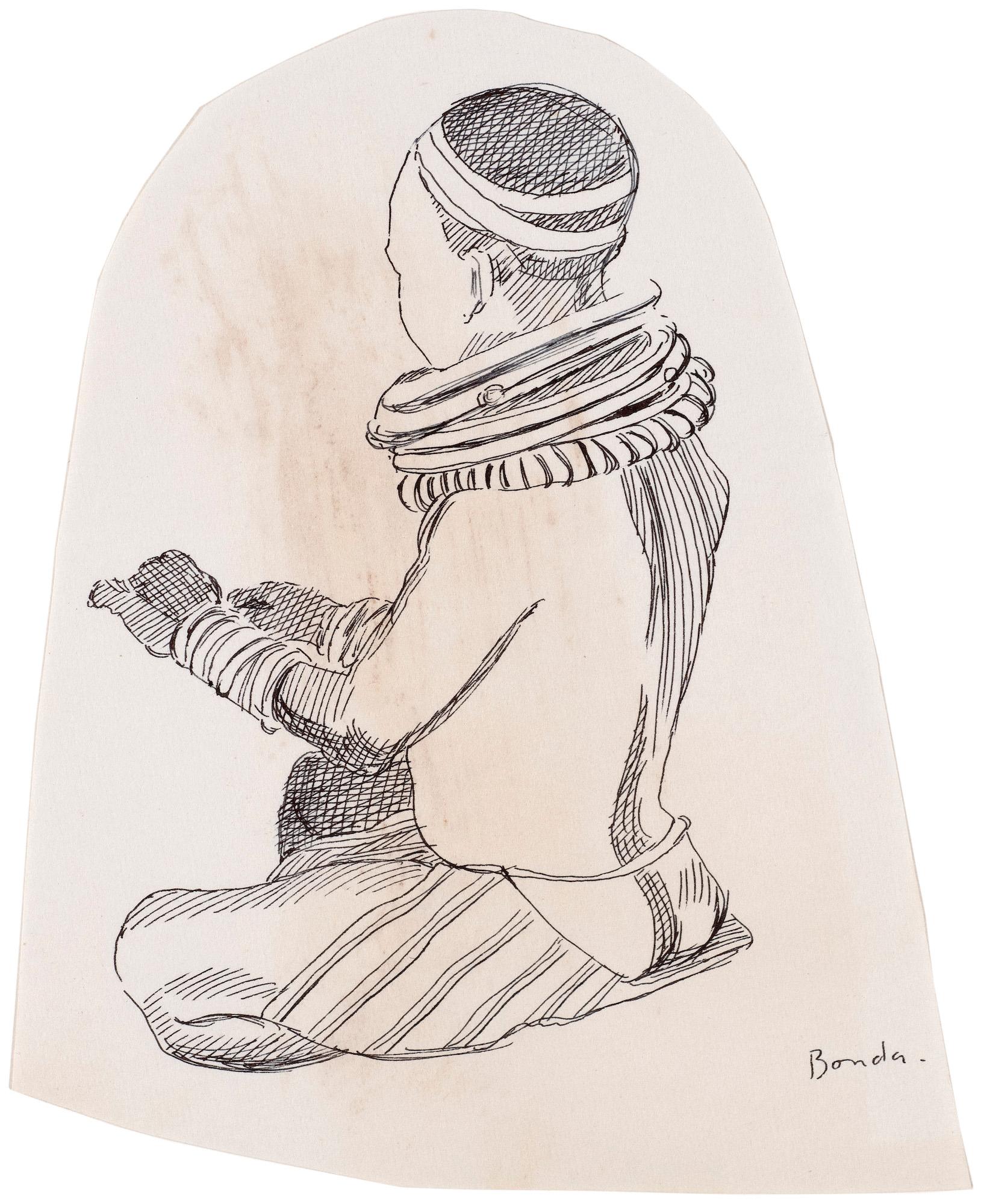
Jacqueline Ayer, Untitled (Bonda woman), c. 1973
Jacqueline Ayer (1930–2012) had a career that spanned many creative fields. She began as a fashion illustrator, and later turned her hand to children’s books, textiles and garments, as she worked in New York, Paris, London, Bangkok, Hong Kong and across India. This drawing was used as one of the final illustrations printed in Ayer's publication Oriental* Costume (1974). *The term ‘oriental’ has colonial and racist origins. It was established during a period when European powers took political control of other countries and defined non-European cultures as ‘inferior’ to their own. ‘Oriental’ was commonly used in English-speaking countries until the late 20th century to group together people, culture and places in Northern Africa, East Asia and Southeast Asia, as well as objects thought to have originated in these areas. The term has been widely rejected today as it exoticizes and ‘others’ these diverse cultures. Ayer used the term here to collectively refer to modes of dress from Cambodia, China, Japan, Mongolia, Nepal, Thailand and Tibet.
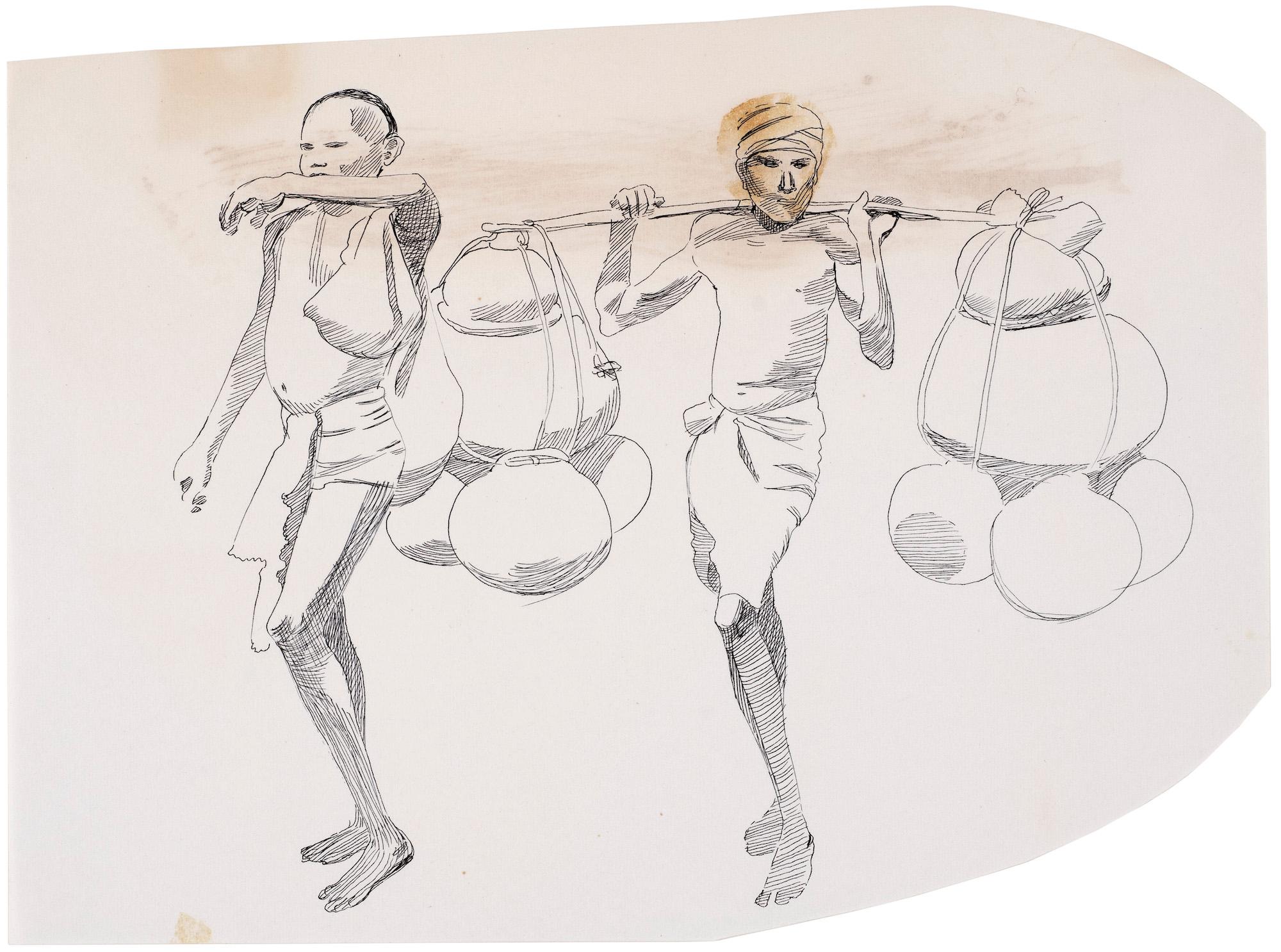
Jacqueline Ayer, Untitled (Marias on their way to market), c. 1973
Jacqueline Ayer (1930–2012) had a career that spanned many creative fields. She began as a fashion illustrator, and later turned her hand to children’s books, textiles and garments, as she worked in New York, Paris, London, Bangkok, Hong Kong and across India. This drawing was used as one of the final illustrations printed in Ayer's publication Oriental* Costume (1974). *The term ‘oriental’ has colonial and racist origins. It was established during a period when European powers took political control of other countries and defined non-European cultures as ‘inferior’ to their own. ‘Oriental’ was commonly used in English-speaking countries until the late 20th century to group together people, culture and places in Northern Africa, East Asia and Southeast Asia, as well as objects thought to have originated in these areas. The term has been widely rejected today as it exoticizes and ‘others’ these diverse cultures. Ayer used the term here to collectively refer to modes of dress from Cambodia, China, Japan, Mongolia, Nepal, Thailand and Tibet.
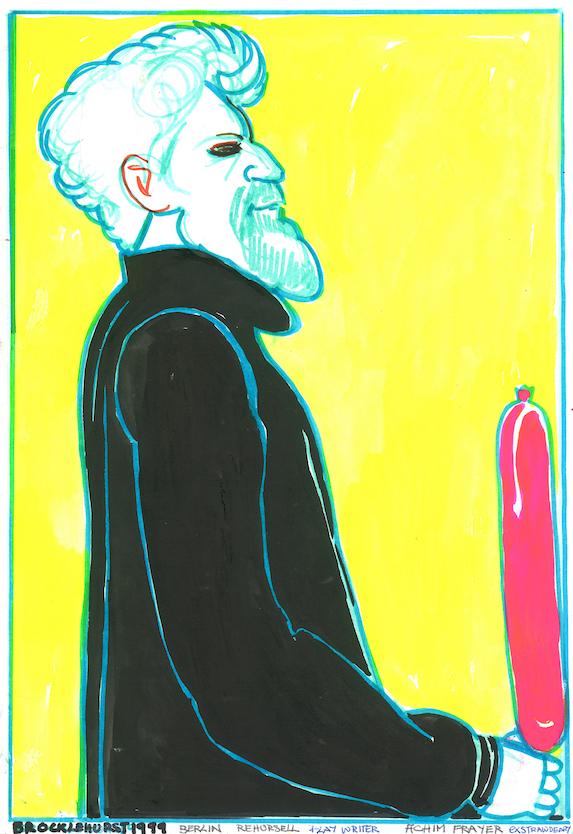
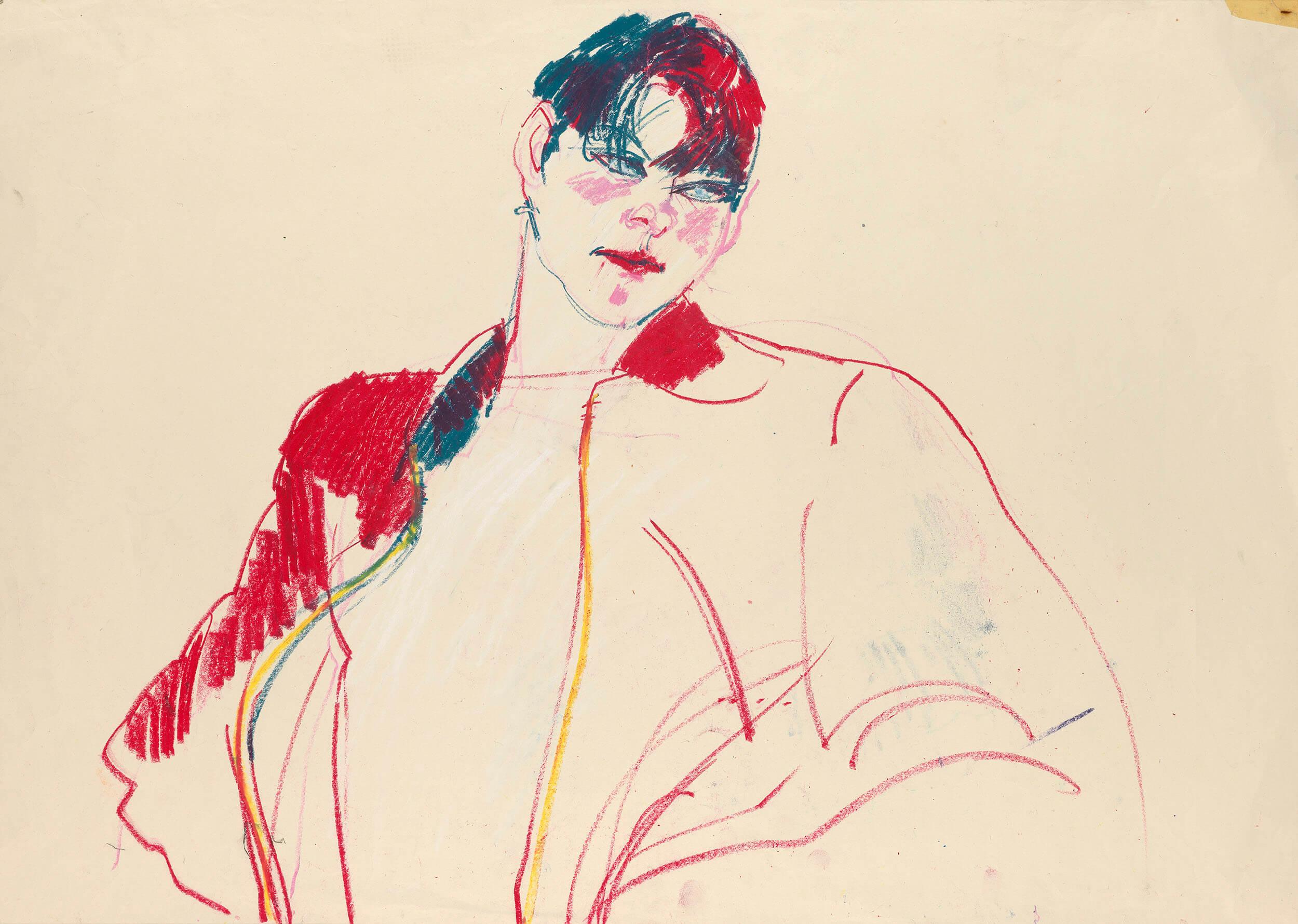
Jo Brocklehurst, Berlin Rehursell, Play Writer, Achim Frayer, Exstrawdeary, 1999
Jo (Josephine) Brocklehurst (1935 - 2006) studied at Central Saint Martins and began her career as a fashion illustrator. She later focused on portraiture, drawing directly from models at her studio in West Hampstead and in nightclubs and theatres in Berlin, London and New York. Her work documents the alternative subcultures of the 1970s, 80s and 90s that went on to shape mainstream fashion and performance scenes. In 1999, Brocklehurst was artist in residence at newspaper Berliner Zeitung during Berliner Theatertreffen, a festival of new German theatre. The paper wanted to revive the Weimar tradition of theatre reviews being accompanied by illustrations, rather than using photographs. Brocklehurst drew behind the scenes and from her seat during performances. Brocklehurst attended the a rehearsal and performance of the play Die Eingeborene and drew its director, Achim Frayer.
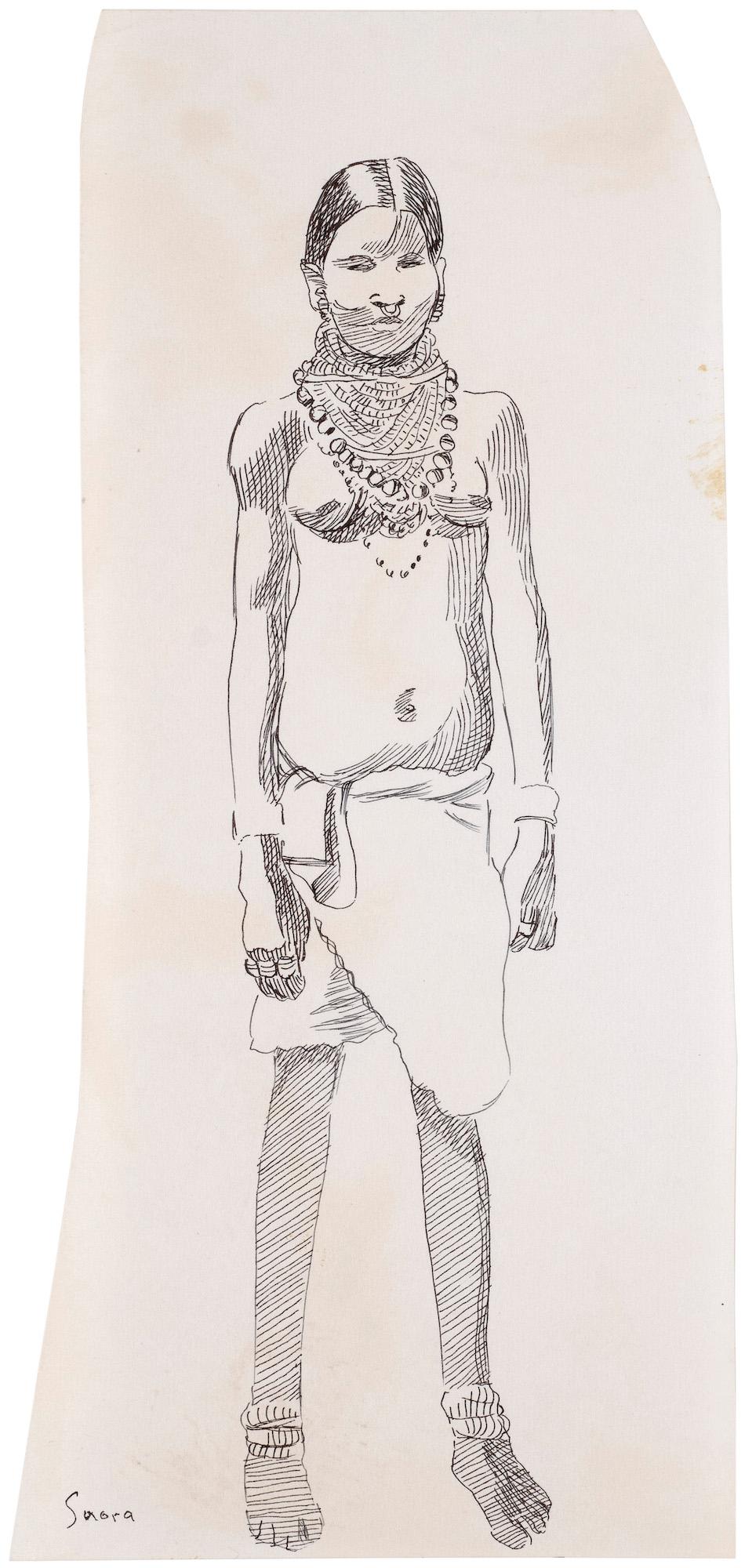
Jacqueline Ayer, Untitled (Young woman, Saora), c. 1973
Jacqueline Ayer (1930–2012) had a career that spanned many creative fields. She began as a fashion illustrator, and later turned her hand to children’s books, textiles and garments, as she worked in New York, Paris, London, Bangkok, Hong Kong and across India. This drawing was used as one of the final illustrations printed in Ayer's publication Oriental* Costume (1974). *The term ‘oriental’ has colonial and racist origins. It was established during a period when European powers took political control of other countries and defined non-European cultures as ‘inferior’ to their own. ‘Oriental’ was commonly used in English-speaking countries until the late 20th century to group together people, culture and places in Northern Africa, East Asia and Southeast Asia, as well as objects thought to have originated in these areas. The term has been widely rejected today as it exoticizes and ‘others’ these diverse cultures. Ayer used the term here to collectively refer to modes of dress from Cambodia, China, Japan, Mongolia, Nepal, Thailand and Tibet.
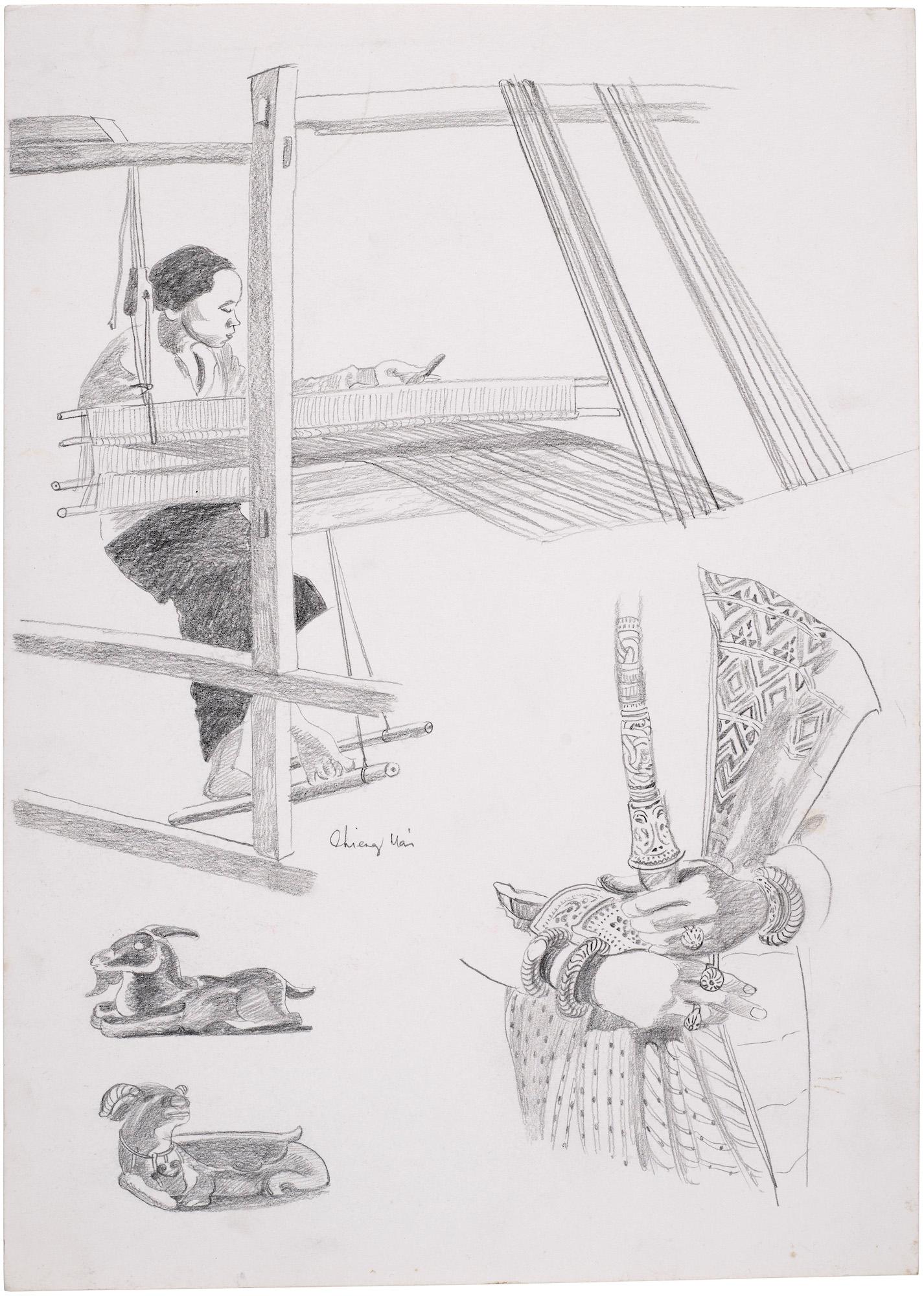
Jacqueline Ayer, Untitled, c. 1970s
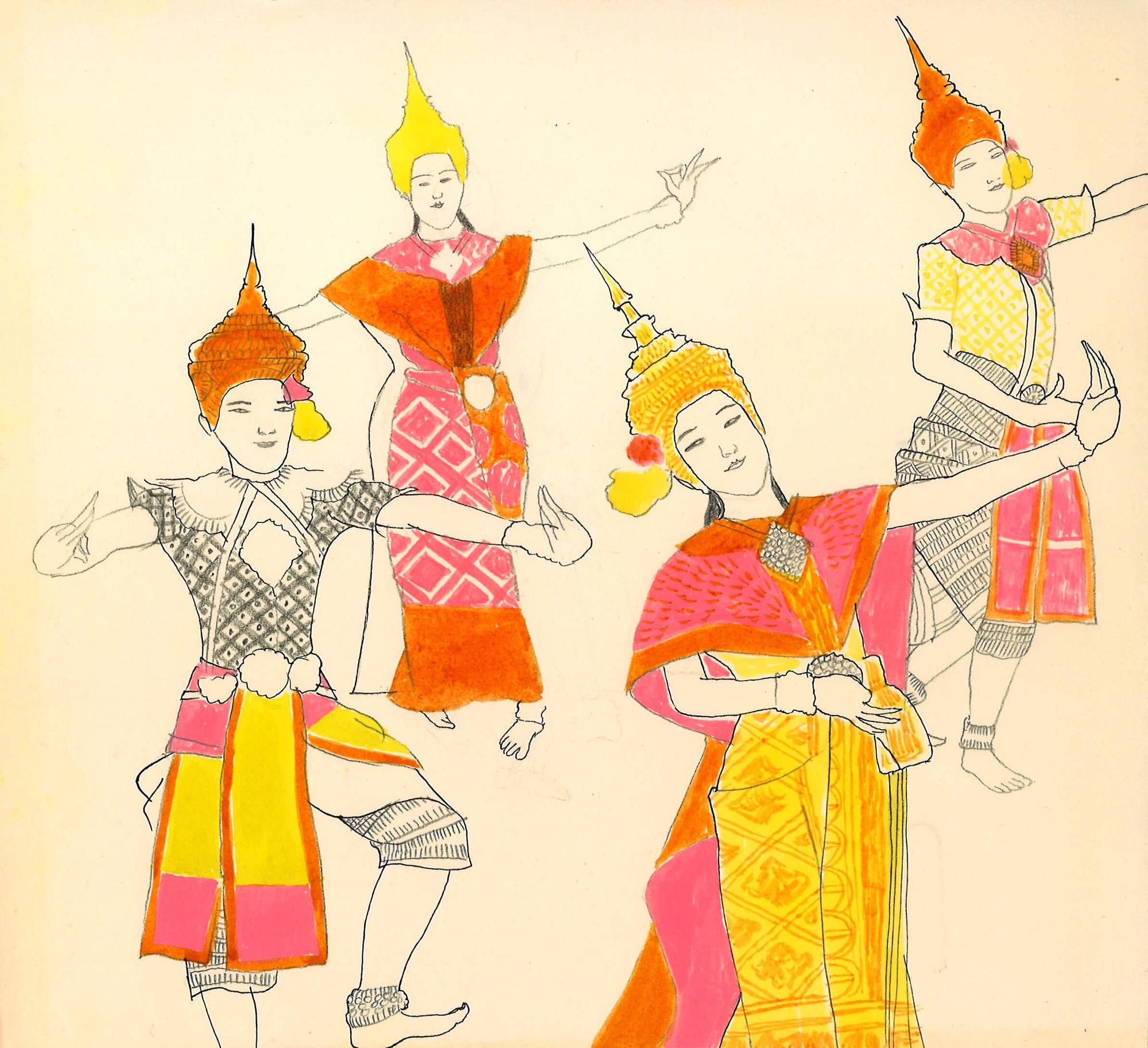
Jacqueline Ayer (1930–2012) had a career that spanned many creative fields. She began as a fashion illustrator, and later turned her hand to children’s books, textiles and garments, as she worked in New York, Paris, London, Bangkok, Hong Kong and across India. Ayer often used a sketchbook to record her observations and ideas for book narratives and fashion designs. The context for this drawing is unknown.
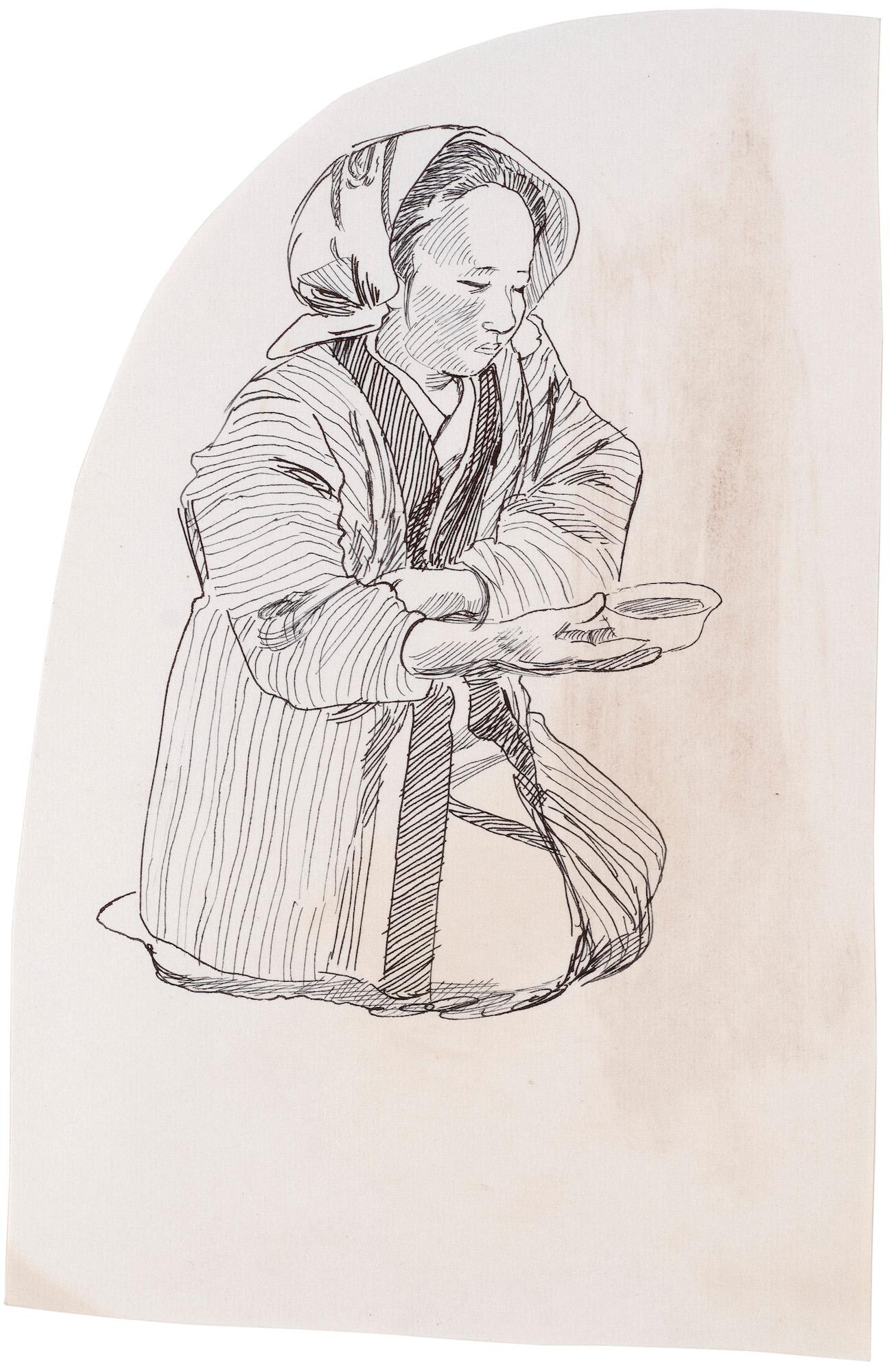
Jacqueline Ayer, Untitled (A farmer's wife), c. 1973
Jacqueline Ayer (1930–2012) had a career that spanned many creative fields. She began as a fashion illustrator, and later turned her hand to children’s books, textiles and garments, as she worked in New York, Paris, London, Bangkok, Hong Kong and across India. This drawing was used as one of the final illustrations printed in Ayer's publication Oriental* Costume (1974). *The term ‘oriental’ has colonial and racist origins. It was established during a period when European powers took political control of other countries and defined non-European cultures as ‘inferior’ to their own. ‘Oriental’ was commonly used in English-speaking countries until the late 20th century to group together people, culture and places in Northern Africa, East Asia and Southeast Asia, as well as objects thought to have originated in these areas. The term has been widely rejected today as it exoticizes and ‘others’ these diverse cultures. Ayer used the term here to collectively refer to modes of dress from Cambodia, China, Japan, Mongolia, Nepal, Thailand and Tibet.
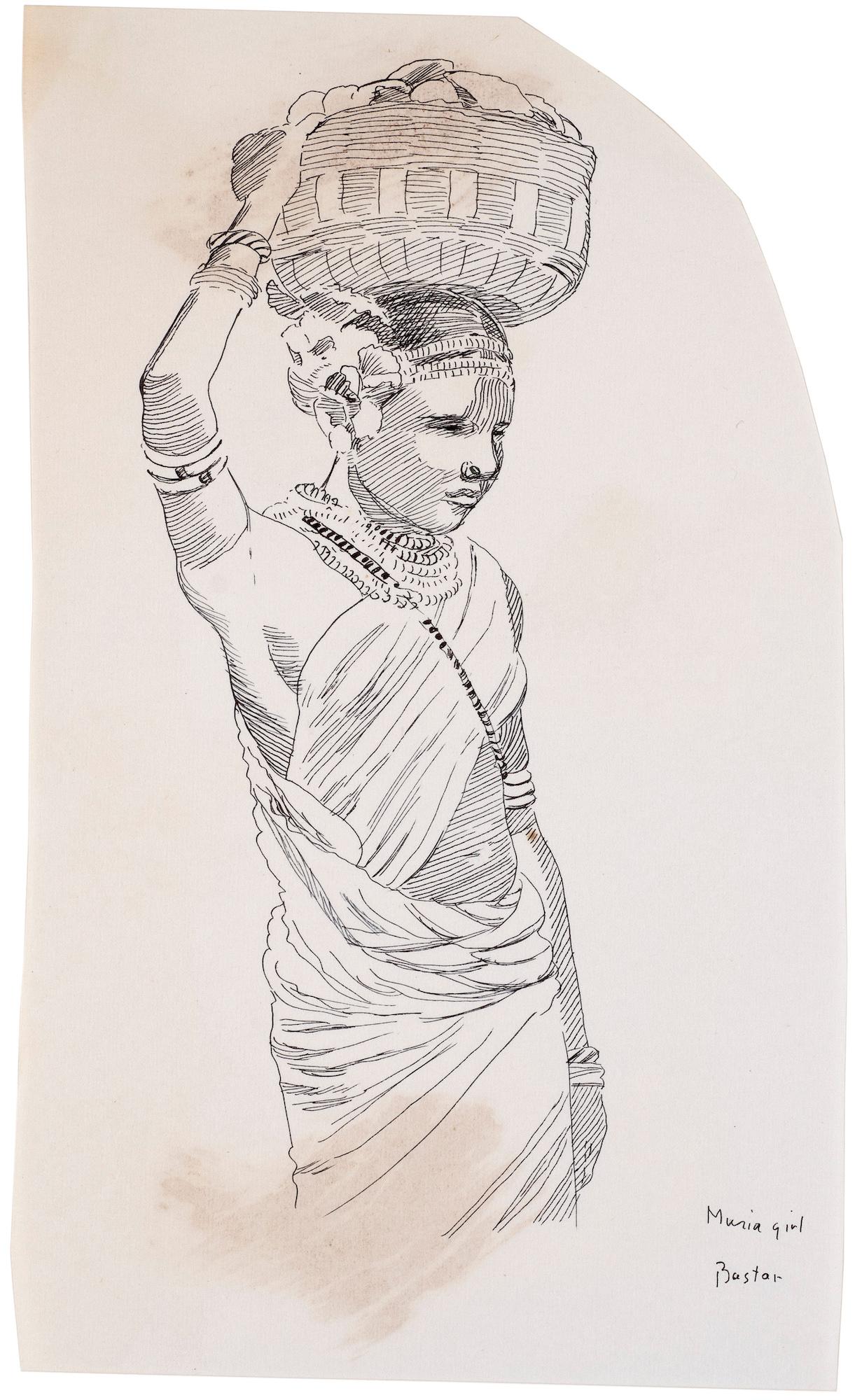
Jacqueline Ayer, Untitled (Muria girl, Bastar), c. 1973
Jacqueline Ayer (1930–2012) had a career that spanned many creative fields. She began as a fashion illustrator, and later turned her hand to children’s books, textiles and garments, as she worked in New York, Paris, London, Bangkok, Hong Kong and across India. This drawing was used as one of the final illustrations printed in Ayer's publication Oriental* Costume (1974). *The term ‘oriental’ has colonial and racist origins. It was established during a period when European powers took political control of other countries and defined non-European cultures as ‘inferior’ to their own. ‘Oriental’ was commonly used in English-speaking countries until the late 20th century to group together people, culture and places in Northern Africa, East Asia and Southeast Asia, as well as objects thought to have originated in these areas. The term has been widely rejected today as it exoticizes and ‘others’ these diverse cultures. Ayer used the term here to collectively refer to modes of dress from Cambodia, China, Japan, Mongolia, Nepal, Thailand and Tibet.
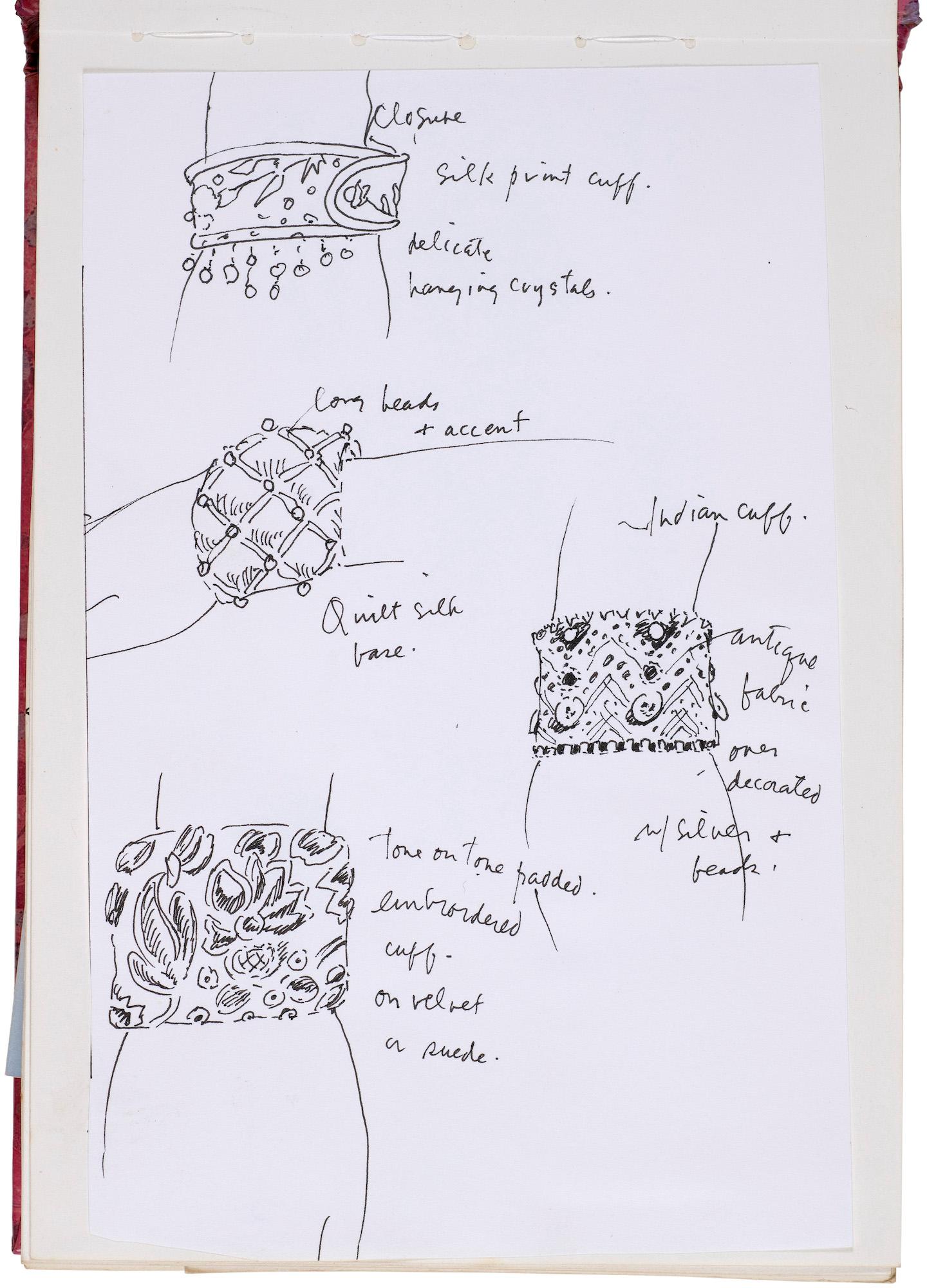
Jacqueline Ayer, Untitled, Date unknown
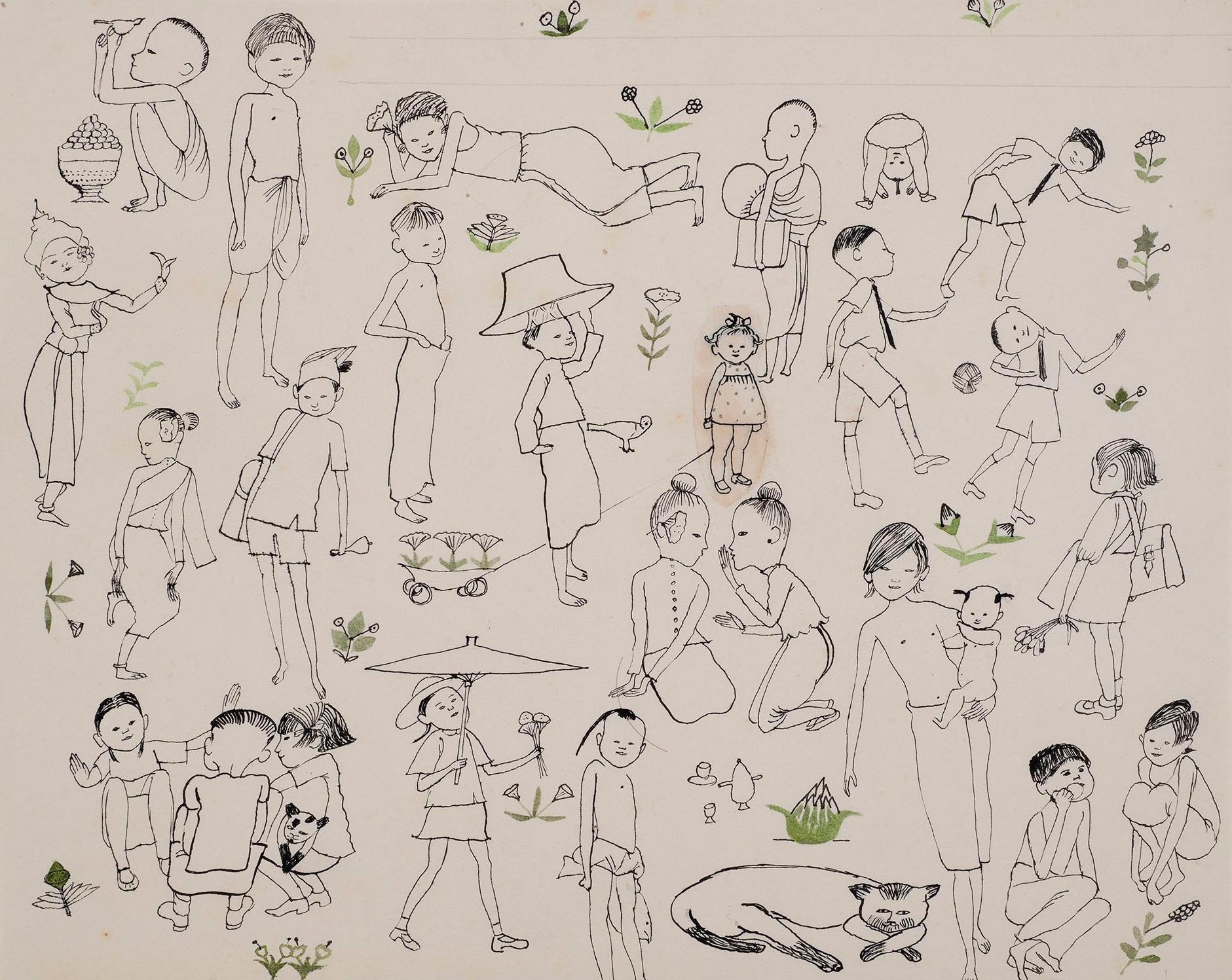
Jacqueline Ayer (1930–2012) had a career that spanned many creative fields. She began as a fashion illustrator, and later turned her hand to children’s books, textiles and garments, as she worked in New York, Paris, London, Bangkok, Hong Kong and across India. Ayer often used a sketchbook to record her observations and ideas for book narratives and fashion designs. The context for this drawing is unknown.
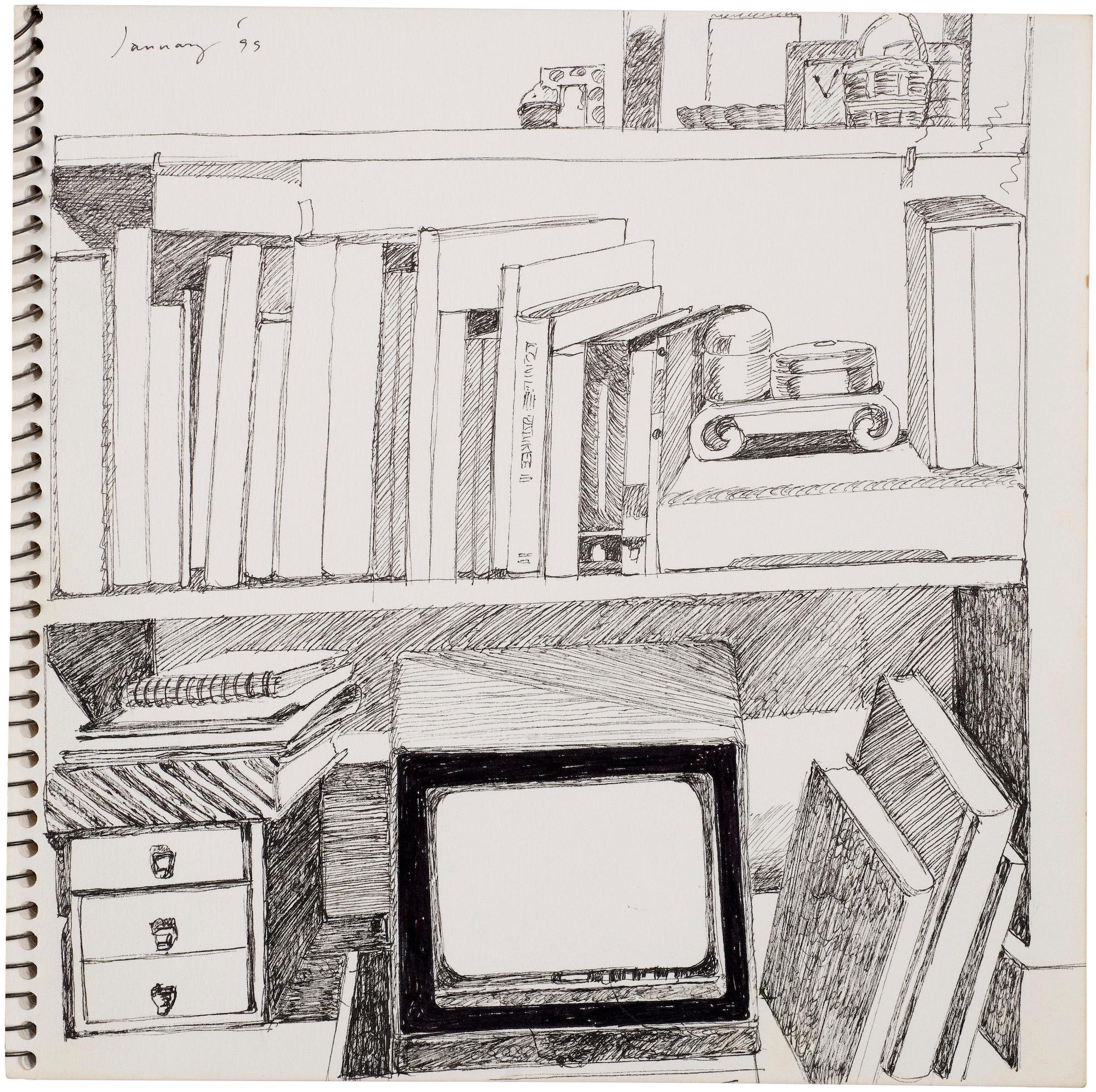
Jacqueline Ayer, Untitled, 1999
Jacqueline Ayer (1930–2012) had a career that spanned many creative fields. She began as a fashion illustrator, and later turned her hand to children’s books, textiles and garments, as she worked in New York, Paris, London, Bangkok, Hong Kong and across India. Ayer often used a sketchbook to record her observations and ideas for book narratives and fashion designs. The context for this drawing is unknown.
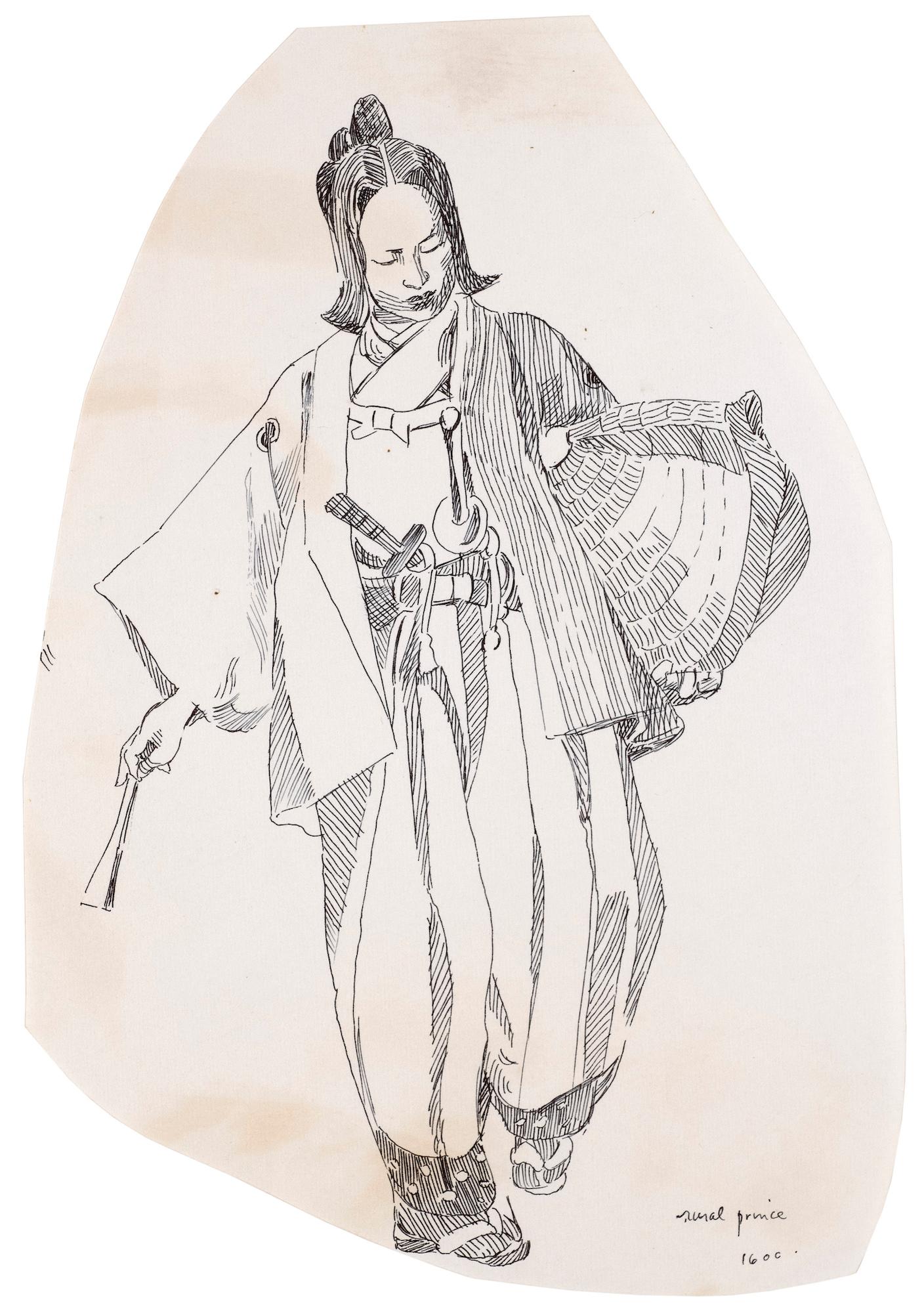
Jacqueline Ayer, Untitled (Provincial prince, 17th century), c. 1973
Jacqueline Ayer (1930–2012) had a career that spanned many creative fields. She began as a fashion illustrator, and later turned her hand to children’s books, textiles and garments, as she worked in New York, Paris, London, Bangkok, Hong Kong and across India. This drawing was used as one of the final illustrations printed in Ayer's publication Oriental* Costume (1974). *The term ‘oriental’ has colonial and racist origins. It was established during a period when European powers took political control of other countries and defined non-European cultures as ‘inferior’ to their own. ‘Oriental’ was commonly used in English-speaking countries until the late 20th century to group together people, culture and places in Northern Africa, East Asia and Southeast Asia, as well as objects thought to have originated in these areas. The term has been widely rejected today as it exoticizes and ‘others’ these diverse cultures. Ayer used the term here to collectively refer to modes of dress from Cambodia, China, Japan, Mongolia, Nepal, Thailand and Tibet.
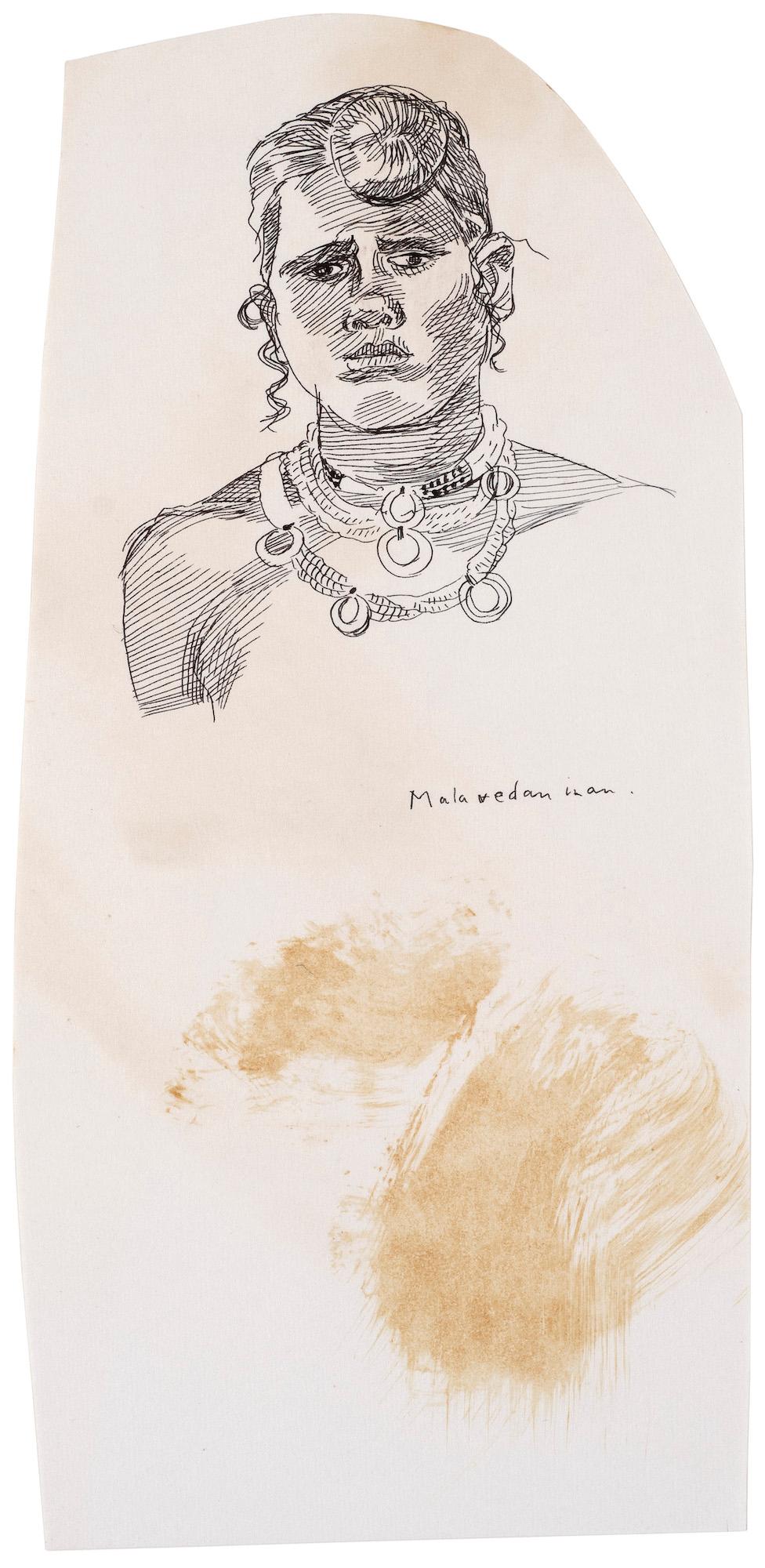
Jacqueline Ayer, Untitled (Malavedam man), c. 1973
Jacqueline Ayer (1930–2012) had a career that spanned many creative fields. She began as a fashion illustrator, and later turned her hand to children’s books, textiles and garments, as she worked in New York, Paris, London, Bangkok, Hong Kong and across India. This drawing was used as one of the final illustrations printed in Ayer's publication Oriental* Costume (1974). *The term ‘oriental’ has colonial and racist origins. It was established during a period when European powers took political control of other countries and defined non-European cultures as ‘inferior’ to their own. ‘Oriental’ was commonly used in English-speaking countries until the late 20th century to group together people, culture and places in Northern Africa, East Asia and Southeast Asia, as well as objects thought to have originated in these areas. The term has been widely rejected today as it exoticizes and ‘others’ these diverse cultures. Ayer used the term here to collectively refer to modes of dress from Cambodia, China, Japan, Mongolia, Nepal, Thailand and Tibet.
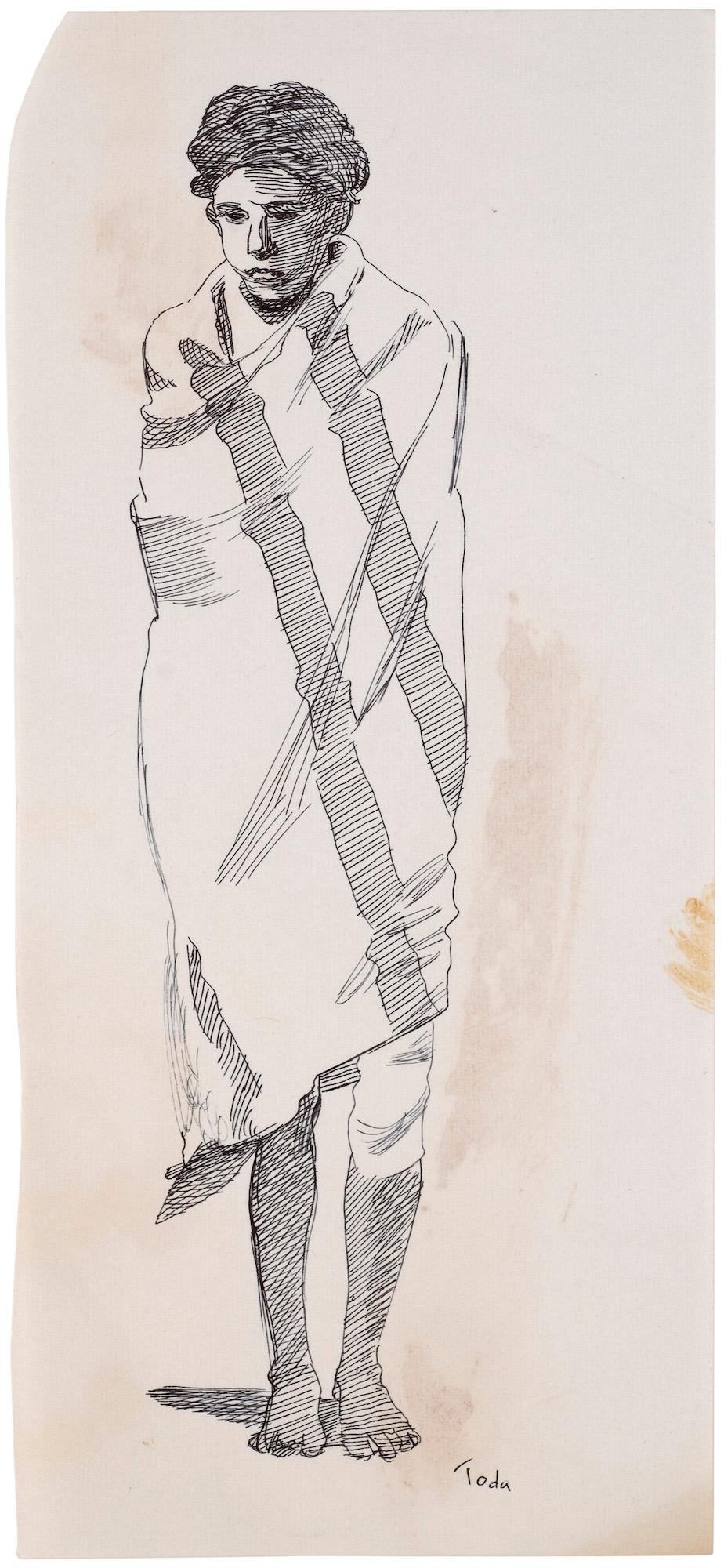
Jacqueline Ayer, Untitled (Toda man), c. 1973
Jacqueline Ayer (1930–2012) had a career that spanned many creative fields. She began as a fashion illustrator, and later turned her hand to children’s books, textiles and garments, as she worked in New York, Paris, London, Bangkok, Hong Kong and across India. This drawing was used as one of the final illustrations printed in Ayer's publication Oriental* Costume (1974). *The term ‘oriental’ has colonial and racist origins. It was established during a period when European powers took political control of other countries and defined non-European cultures as ‘inferior’ to their own. ‘Oriental’ was commonly used in English-speaking countries until the late 20th century to group together people, culture and places in Northern Africa, East Asia and Southeast Asia, as well as objects thought to have originated in these areas. The term has been widely rejected today as it exoticizes and ‘others’ these diverse cultures. Ayer used the term here to collectively refer to modes of dress from Cambodia, China, Japan, Mongolia, Nepal, Thailand and Tibet.
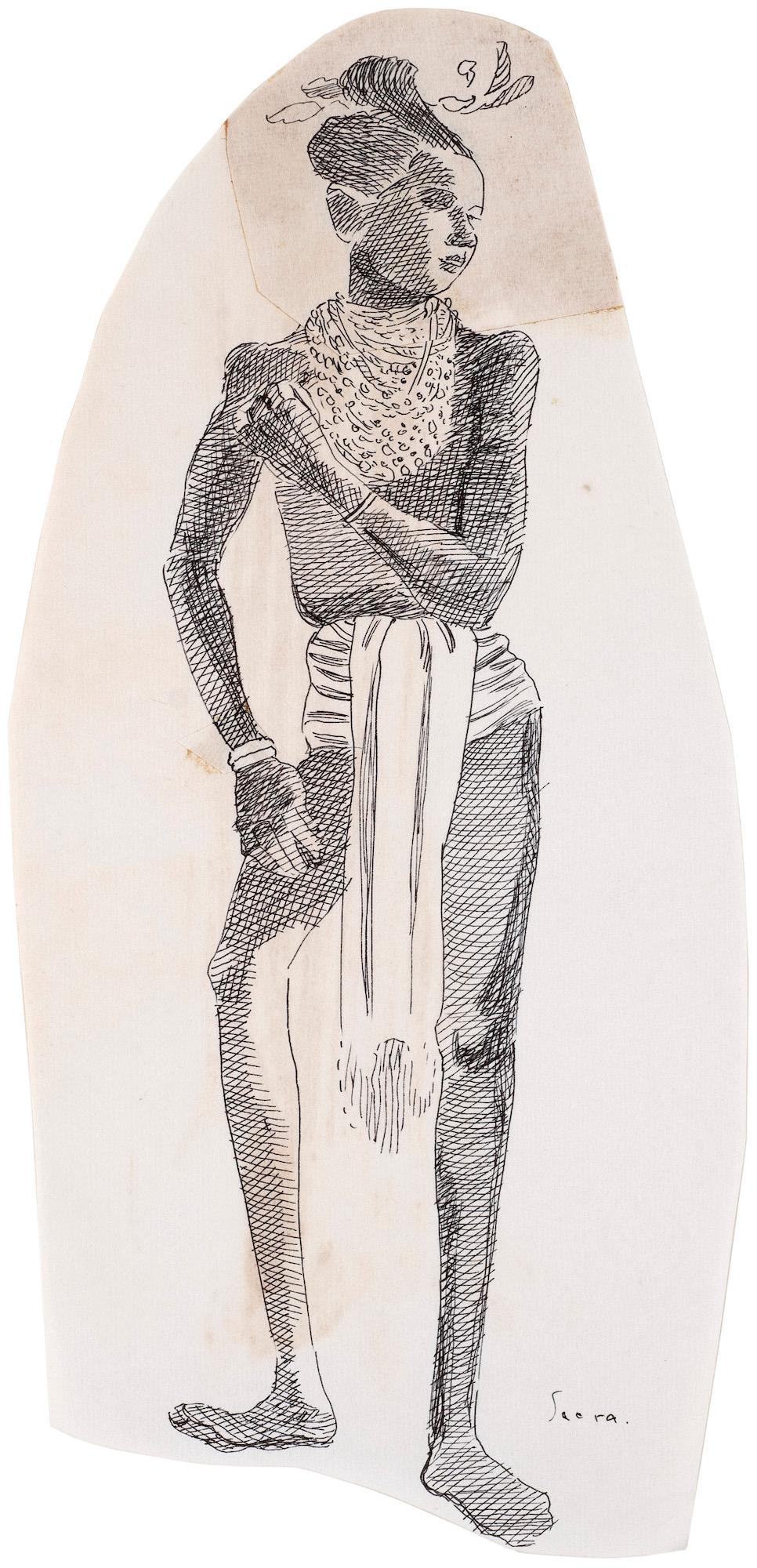
Jacqueline Ayer, Untitled (Young man in tribal finery, Saora), c. 1973
Jacqueline Ayer (1930–2012) had a career that spanned many creative fields. She began as a fashion illustrator, and later turned her hand to children’s books, textiles and garments, as she worked in New York, Paris, London, Bangkok, Hong Kong and across India. This drawing was used as one of the final illustrations printed in Ayer's publication Oriental* Costume (1974). *The term ‘oriental’ has colonial and racist origins. It was established during a period when European powers took political control of other countries and defined non-European cultures as ‘inferior’ to their own. ‘Oriental’ was commonly used in English-speaking countries until the late 20th century to group together people, culture and places in Northern Africa, East Asia and Southeast Asia, as well as objects thought to have originated in these areas. The term has been widely rejected today as it exoticizes and ‘others’ these diverse cultures. Ayer used the term here to collectively refer to modes of dress from Cambodia, China, Japan, Mongolia, Nepal, Thailand and Tibet.
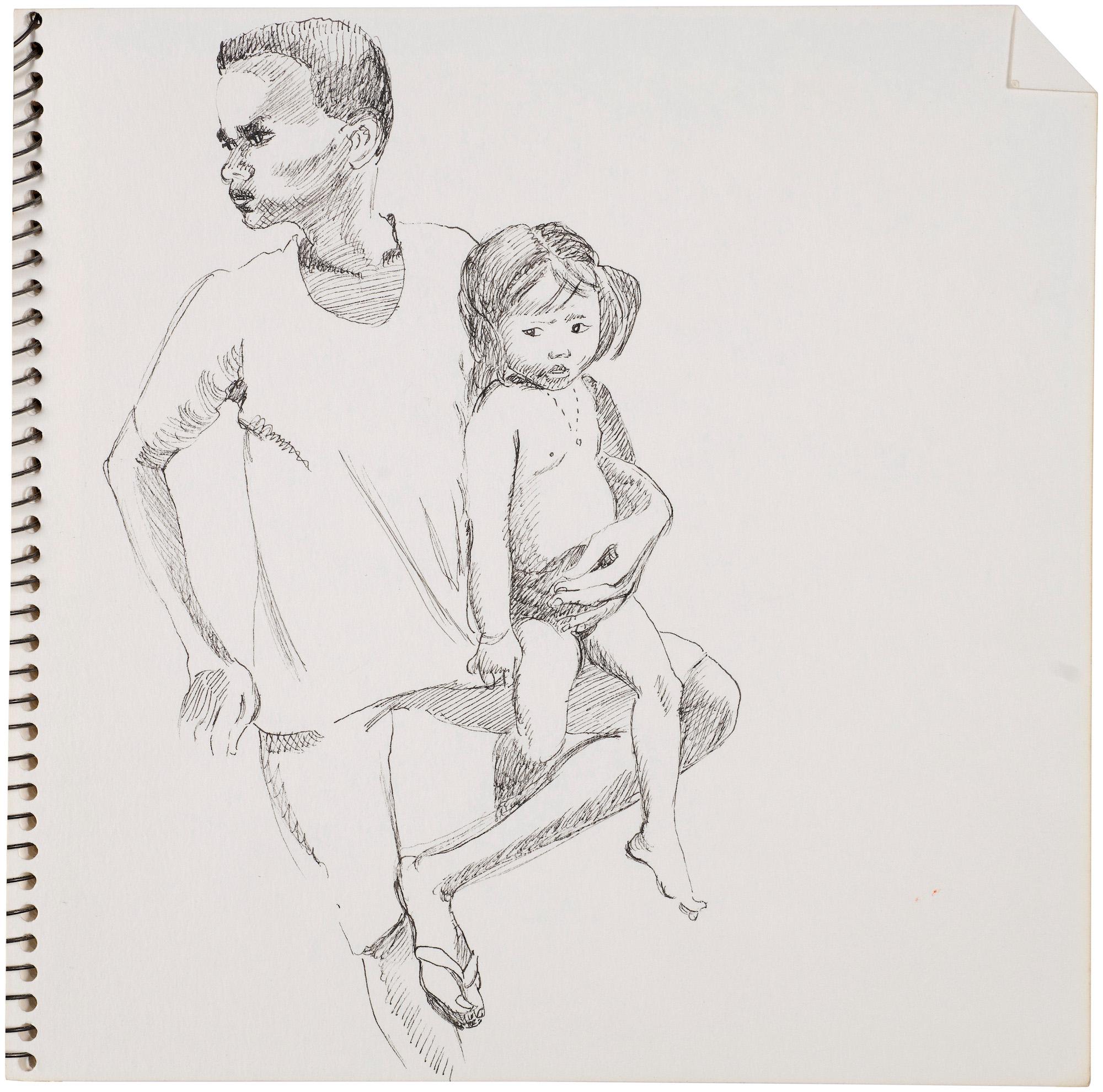
Jacqueline Ayer, Untitled, Date unknown
Jacqueline Ayer (1930–2012) had a career that spanned many creative fields. She began as a fashion illustrator, and later turned her hand to children’s books, textiles and garments, as she worked in New York, Paris, London, Bangkok, Hong Kong and across India. Ayer often used a sketchbook to record her observations and ideas for book narratives and fashion designs. The context for this drawing is unknown.
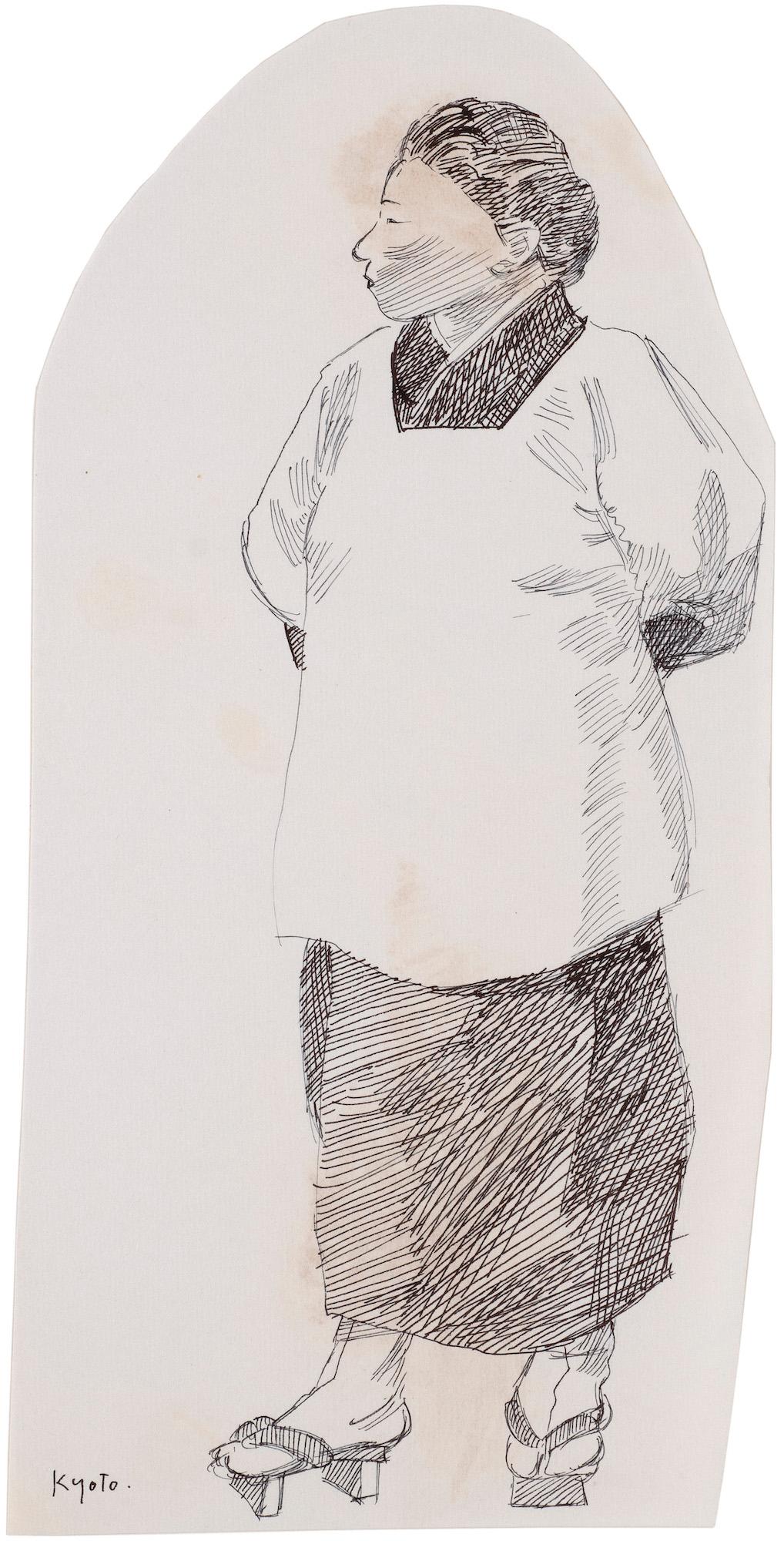
Jacqueline Ayer, Untitled (Shop keeper, Kyoto), c. 1973
Jacqueline Ayer (1930–2012) had a career that spanned many creative fields. She began as a fashion illustrator, and later turned her hand to children’s books, textiles and garments, as she worked in New York, Paris, London, Bangkok, Hong Kong and across India. This drawing was used as one of the final illustrations printed in Ayer's publication Oriental* Costume (1974). *The term ‘oriental’ has colonial and racist origins. It was established during a period when European powers took political control of other countries and defined non-European cultures as ‘inferior’ to their own. ‘Oriental’ was commonly used in English-speaking countries until the late 20th century to group together people, culture and places in Northern Africa, East Asia and Southeast Asia, as well as objects thought to have originated in these areas. The term has been widely rejected today as it exoticizes and ‘others’ these diverse cultures. Ayer used the term here to collectively refer to modes of dress from Cambodia, China, Japan, Mongolia, Nepal, Thailand and Tibet.
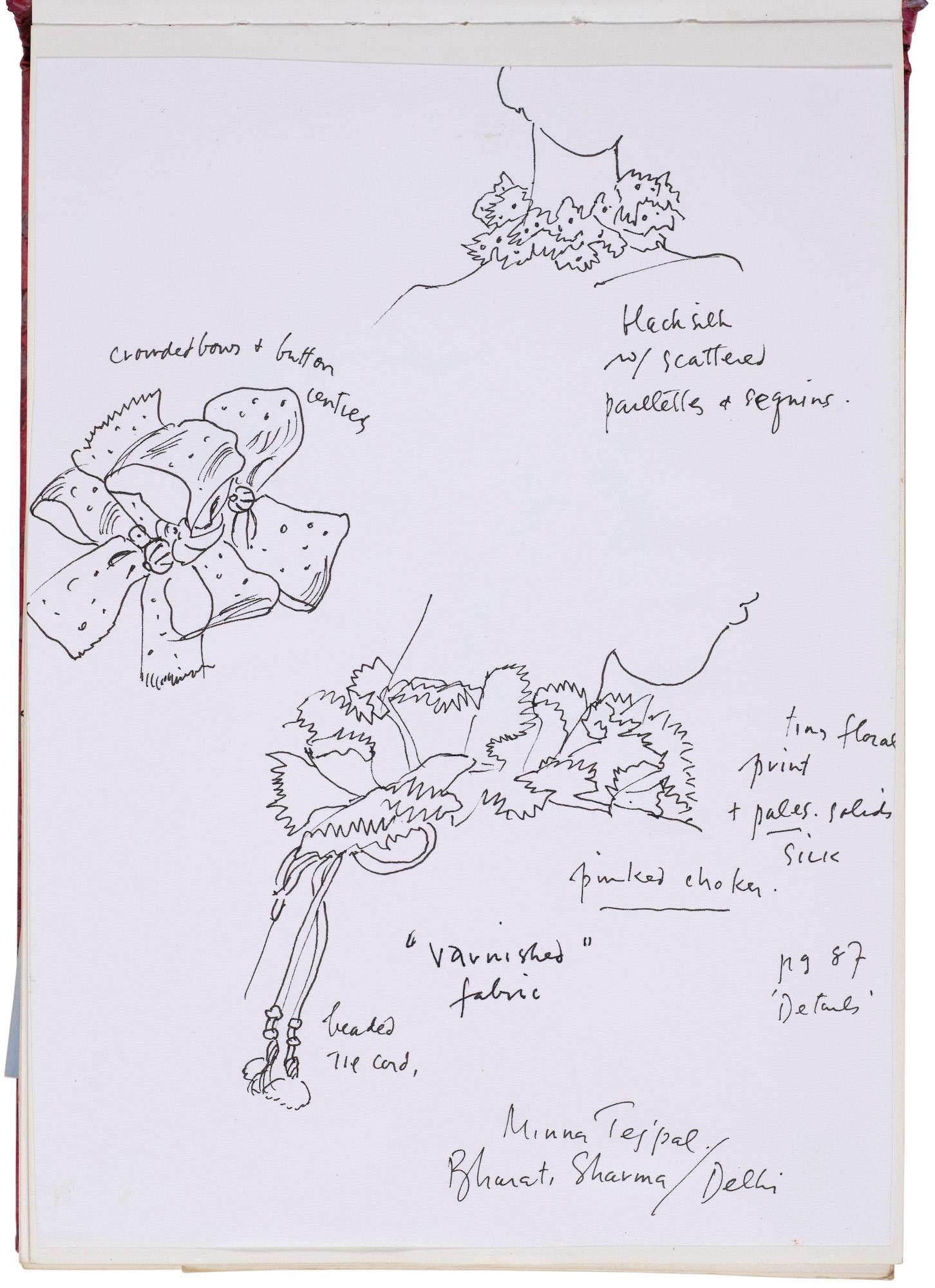
Jacqueline Ayer, Untitled, Date unknown
Jacqueline Ayer (1930–2012) had a career that spanned many creative fields. She began as a fashion illustrator, and later turned her hand to children’s books, textiles and garments, as she worked in New York, Paris, London, Bangkok, Hong Kong and across India. Ayer often used a sketchbook to record her observations and ideas for book narratives and fashion designs. The context for this drawing is unknown.
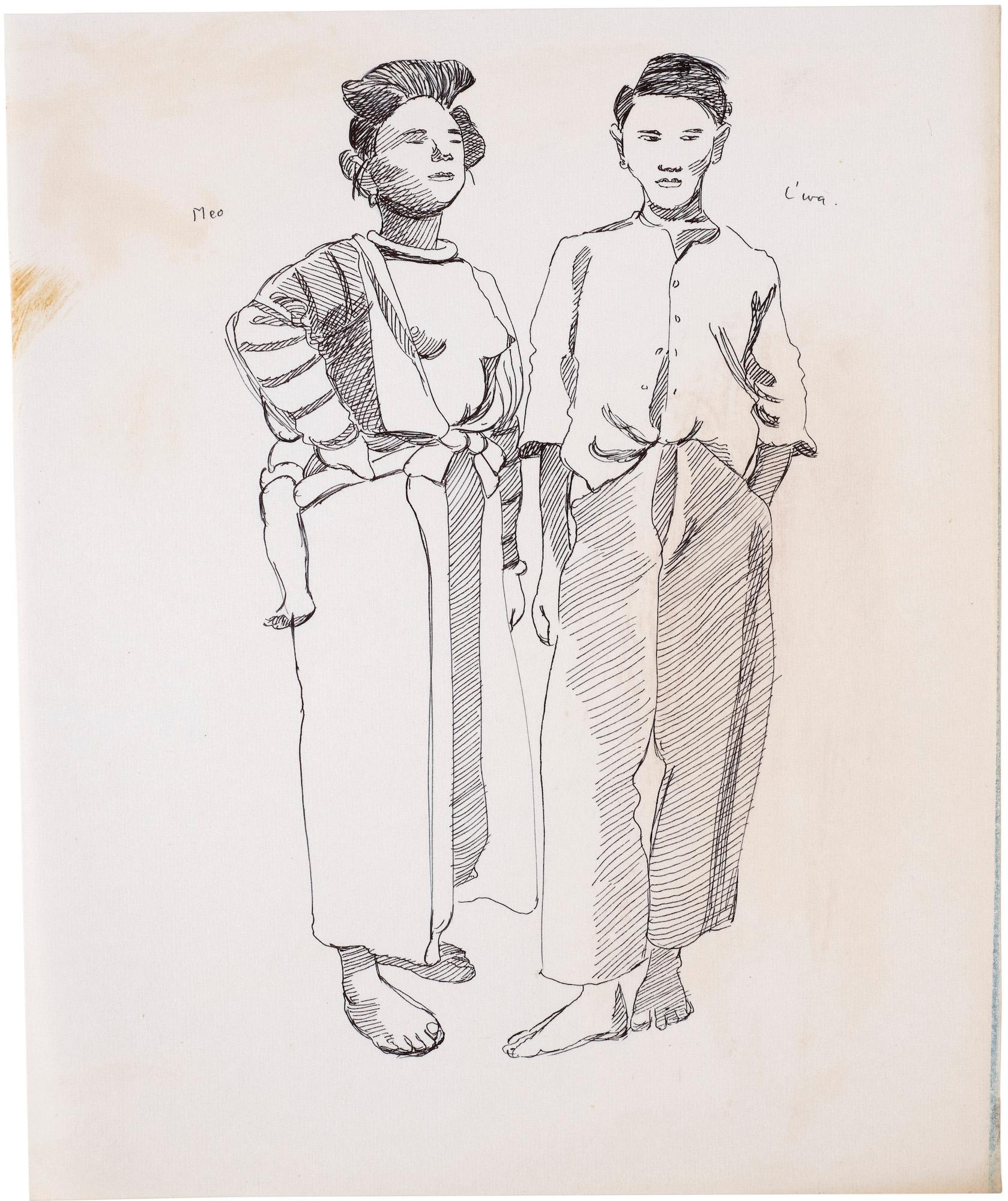
Jacqueline Ayer, Untitled (Meo woman and L'wa man, Thailand), c. 1973
Jacqueline Ayer (1930–2012) had a career that spanned many creative fields. She began as a fashion illustrator, and later turned her hand to children’s books, textiles and garments, as she worked in New York, Paris, London, Bangkok, Hong Kong and across India. This drawing was used as one of the final illustrations printed in Ayer's publication Oriental* Costume (1974). *The term ‘oriental’ has colonial and racist origins. It was established during a period when European powers took political control of other countries and defined non-European cultures as ‘inferior’ to their own. ‘Oriental’ was commonly used in English-speaking countries until the late 20th century to group together people, culture and places in Northern Africa, East Asia and Southeast Asia, as well as objects thought to have originated in these areas. The term has been widely rejected today as it exoticizes and ‘others’ these diverse cultures. Ayer used the term here to collectively refer to modes of dress from Cambodia, China, Japan, Mongolia, Nepal, Thailand and Tibet.
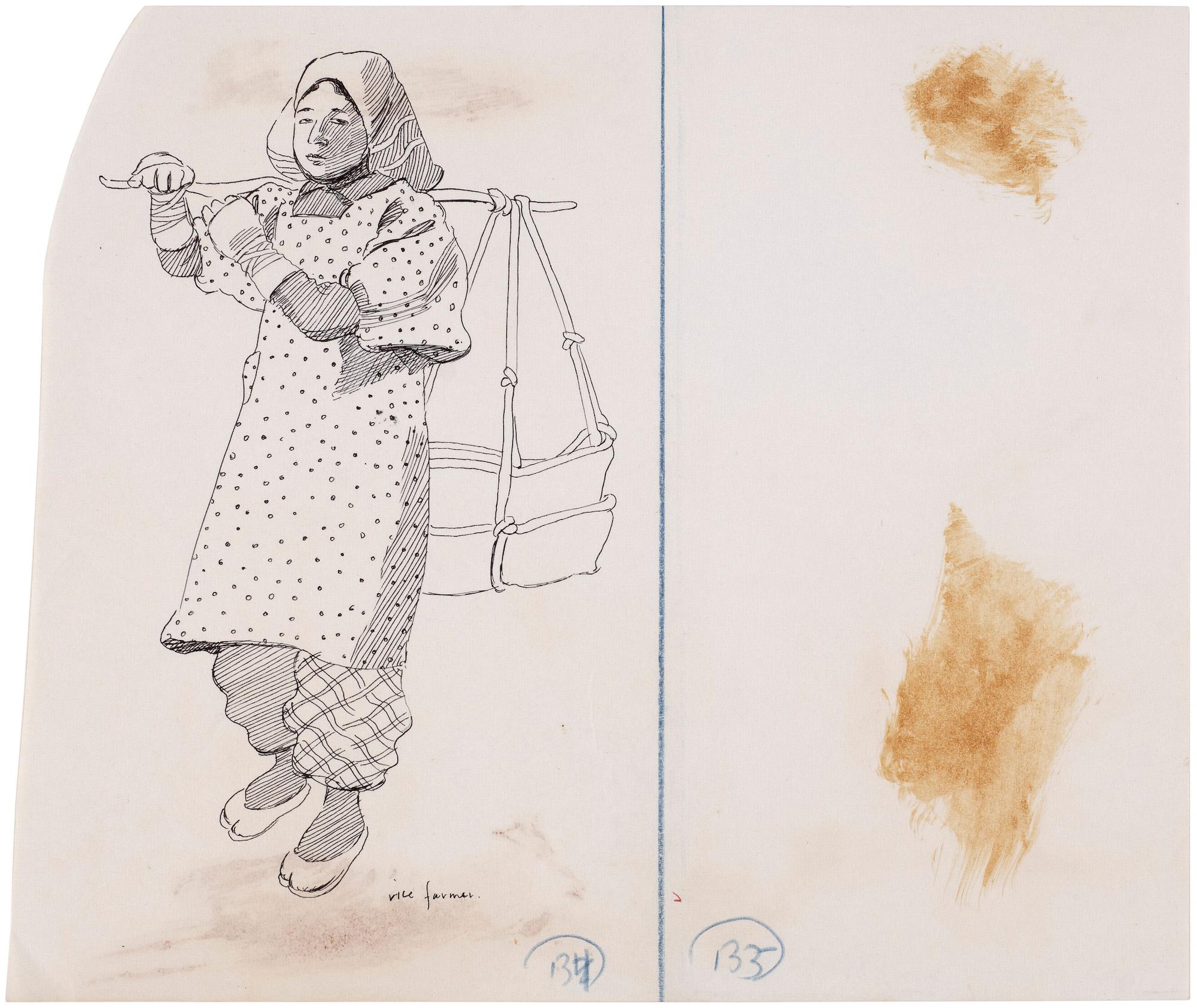
Jacqueline Ayer, Untitled (Rice farmer, Toyama prefecture), c. 1973
Jacqueline Ayer (1930–2012) had a career that spanned many creative fields. She began as a fashion illustrator, and later turned her hand to children’s books, textiles and garments, as she worked in New York, Paris, London, Bangkok, Hong Kong and across India. This drawing was used as one of the final illustrations printed in Ayer's publication Oriental* Costume (1974). *The term ‘oriental’ has colonial and racist origins. It was established during a period when European powers took political control of other countries and defined non-European cultures as ‘inferior’ to their own. ‘Oriental’ was commonly used in English-speaking countries until the late 20th century to group together people, culture and places in Northern Africa, East Asia and Southeast Asia, as well as objects thought to have originated in these areas. The term has been widely rejected today as it exoticizes and ‘others’ these diverse cultures. Ayer used the term here to collectively refer to modes of dress from Cambodia, China, Japan, Mongolia, Nepal, Thailand and Tibet.
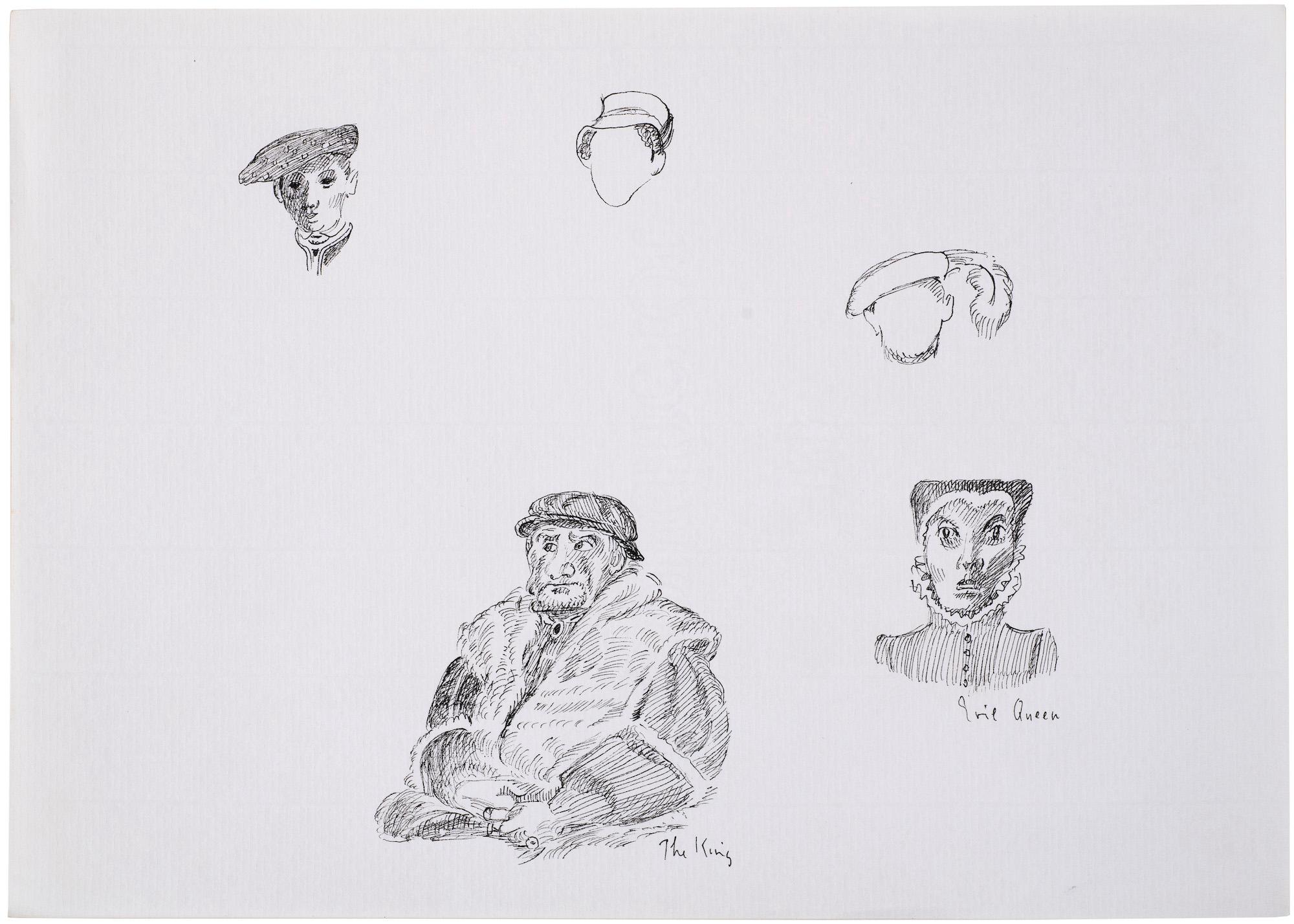
Jacqueline Ayer, Untitled, Date unknown
Jacqueline Ayer (1930–2012) had a career that spanned many creative fields. She began as a fashion illustrator, and later turned her hand to children’s books, textiles and garments, as she worked in New York, Paris, London, Bangkok, Hong Kong and across India. Ayer often used a sketchbook to record her observations and ideas for book narratives and fashion designs. The context for this drawing is unknown.
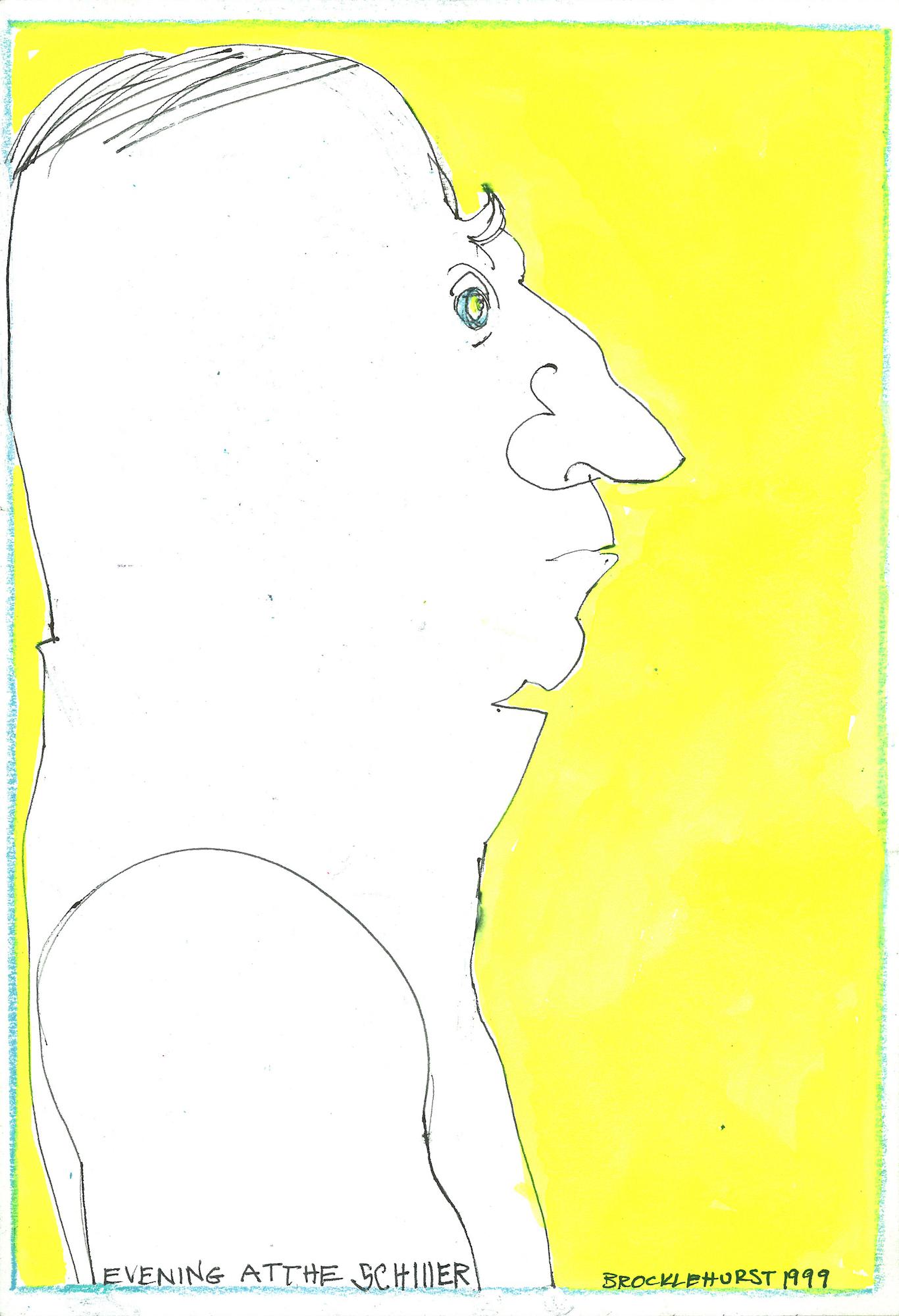
Jo Brocklehurst, Evening at the Schiller Theatre, 1999
Jo (Josephine) Brocklehurst (1935 - 2006) studied at Central Saint Martins and began her career as a fashion illustrator. She later focused on portraiture, drawing directly from models at her studio in West Hampstead and in nightclubs and theatres in Berlin, London and New York. Her work documents the alternative subcultures of the 1970s, 80s and 90s that went on to shape mainstream fashion and performance scenes. In 1999, Brocklehurst was artist in residence at newspaper Berliner Zeitung during Berliner Theatertreffen, a festival of new German theatre. The paper wanted to revive the Weimar tradition of theatre reviews being accompanied by illustrations, rather than using photographs. Brocklehurst drew behind the scenes and from her seat during performances. This drawing may have been made during the interval of a performance of play Die Eingeborene at the Schiller Theatre.
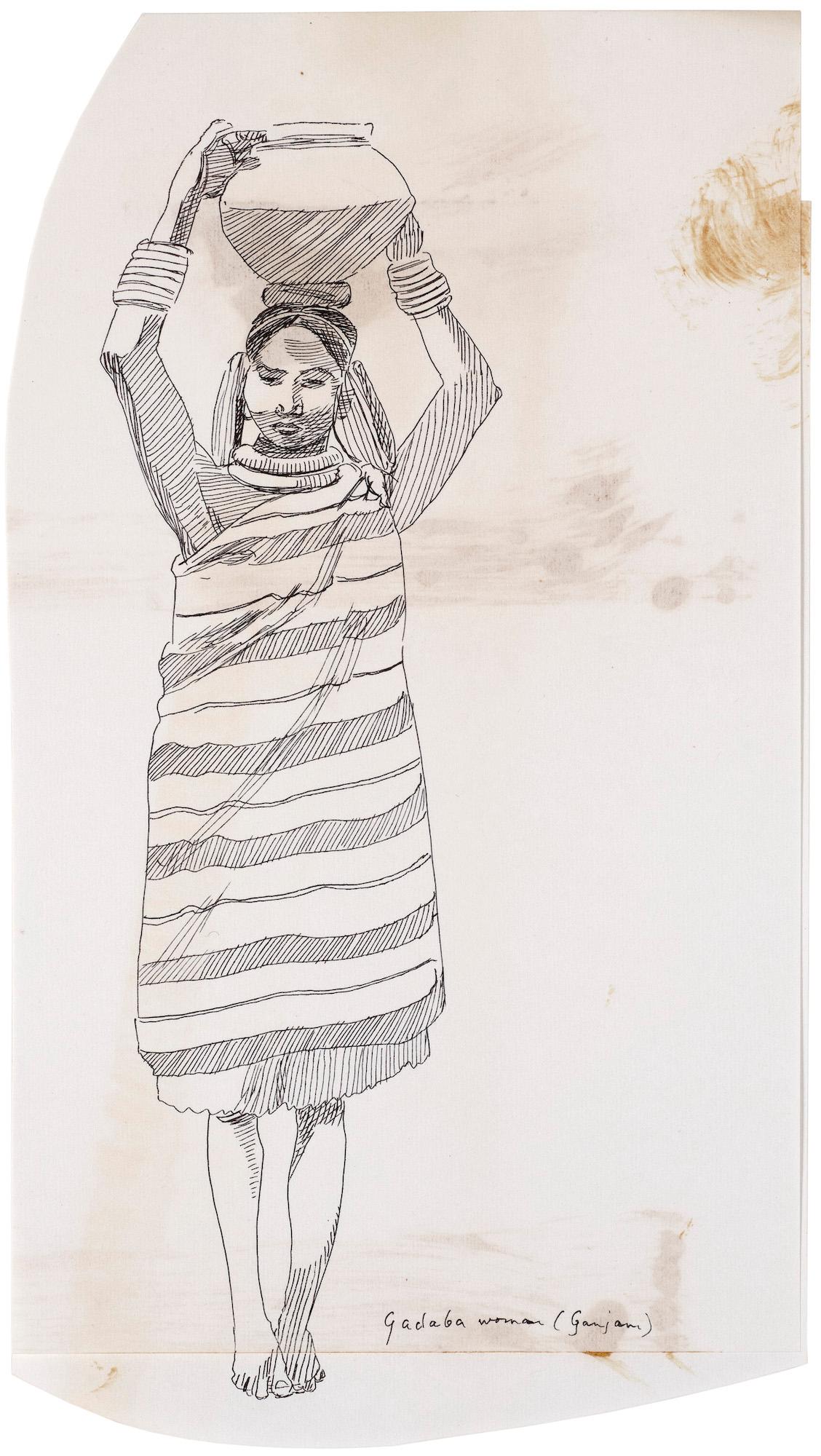
Jacqueline Ayer, Untitled (Gabada woman), c. 1973
Jacqueline Ayer (1930–2012) had a career that spanned many creative fields. She began as a fashion illustrator, and later turned her hand to children’s books, textiles and garments, as she worked in New York, Paris, London, Bangkok, Hong Kong and across India. This drawing was used as one of the final illustrations printed in Ayer's publication Oriental* Costume (1974). *The term ‘oriental’ has colonial and racist origins. It was established during a period when European powers took political control of other countries and defined non-European cultures as ‘inferior’ to their own. ‘Oriental’ was commonly used in English-speaking countries until the late 20th century to group together people, culture and places in Northern Africa, East Asia and Southeast Asia, as well as objects thought to have originated in these areas. The term has been widely rejected today as it exoticizes and ‘others’ these diverse cultures. Ayer used the term here to collectively refer to modes of dress from Cambodia, China, Japan, Mongolia, Nepal, Thailand and Tibet.
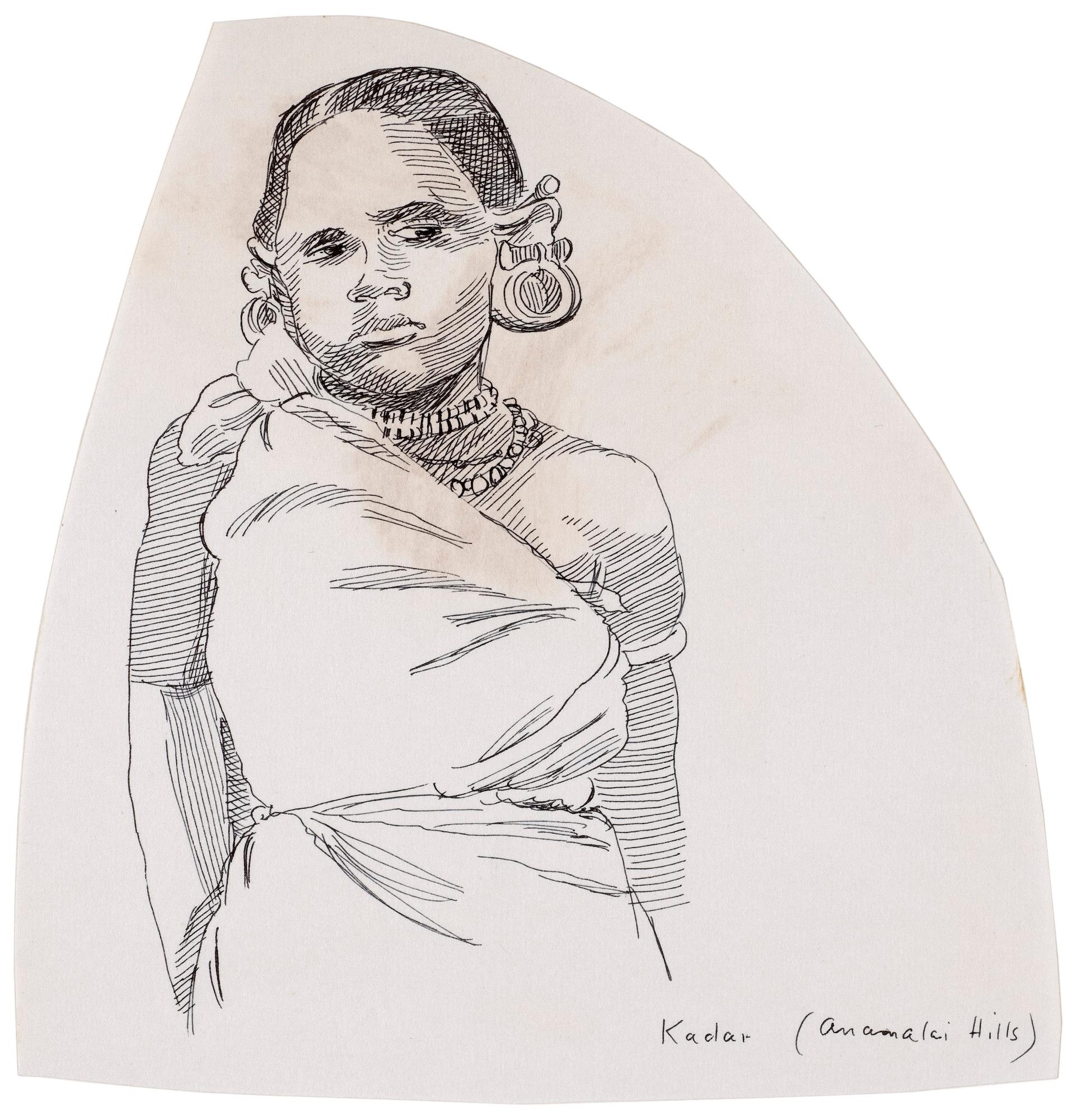
Jacqueline Ayer, Untitled (Married woman from the Anamalai hills, Kadar), c. 1973
Jacqueline Ayer (1930–2012) had a career that spanned many creative fields. She began as a fashion illustrator, and later turned her hand to children’s books, textiles and garments, as she worked in New York, Paris, London, Bangkok, Hong Kong and across India. This drawing was used as one of the final illustrations printed in Ayer's publication Oriental* Costume (1974). *The term ‘oriental’ has colonial and racist origins. It was established during a period when European powers took political control of other countries and defined non-European cultures as ‘inferior’ to their own. ‘Oriental’ was commonly used in English-speaking countries until the late 20th century to group together people, culture and places in Northern Africa, East Asia and Southeast Asia, as well as objects thought to have originated in these areas. The term has been widely rejected today as it exoticizes and ‘others’ these diverse cultures. Ayer used the term here to collectively refer to modes of dress from Cambodia, China, Japan, Mongolia, Nepal, Thailand and Tibet.
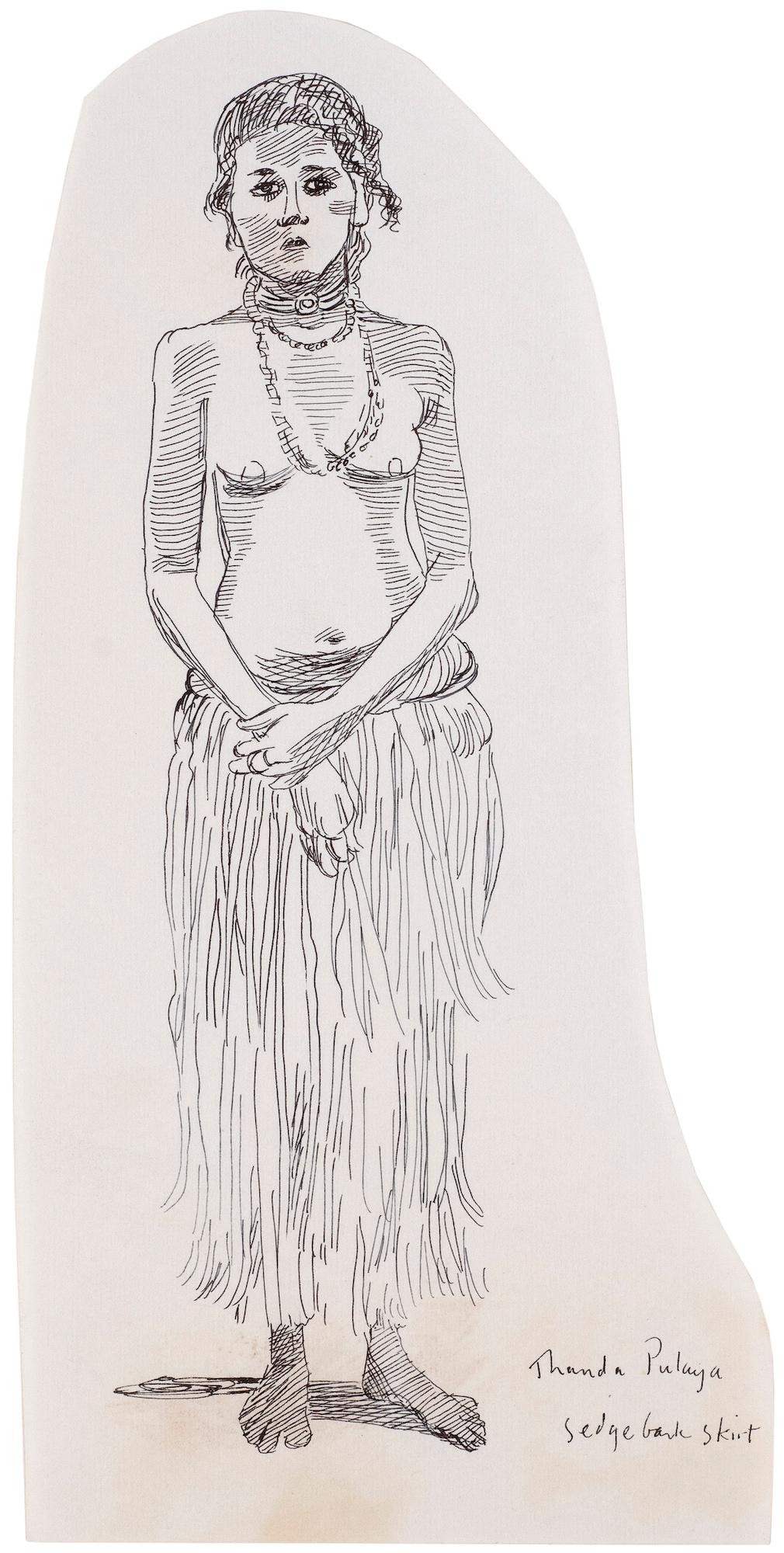
Jacqueline Ayer, Untitled (Thanda Pulaya, young woman in a sedgebark skirt), c. 1973
Jacqueline Ayer (1930–2012) had a career that spanned many creative fields. She began as a fashion illustrator, and later turned her hand to children’s books, textiles and garments, as she worked in New York, Paris, London, Bangkok, Hong Kong and across India. This drawing was used as one of the final illustrations printed in Ayer's publication Oriental* Costume (1974). *The term ‘oriental’ has colonial and racist origins. It was established during a period when European powers took political control of other countries and defined non-European cultures as ‘inferior’ to their own. ‘Oriental’ was commonly used in English-speaking countries until the late 20th century to group together people, culture and places in Northern Africa, East Asia and Southeast Asia, as well as objects thought to have originated in these areas. The term has been widely rejected today as it exoticizes and ‘others’ these diverse cultures. Ayer used the term here to collectively refer to modes of dress from Cambodia, China, Japan, Mongolia, Nepal, Thailand and Tibet.
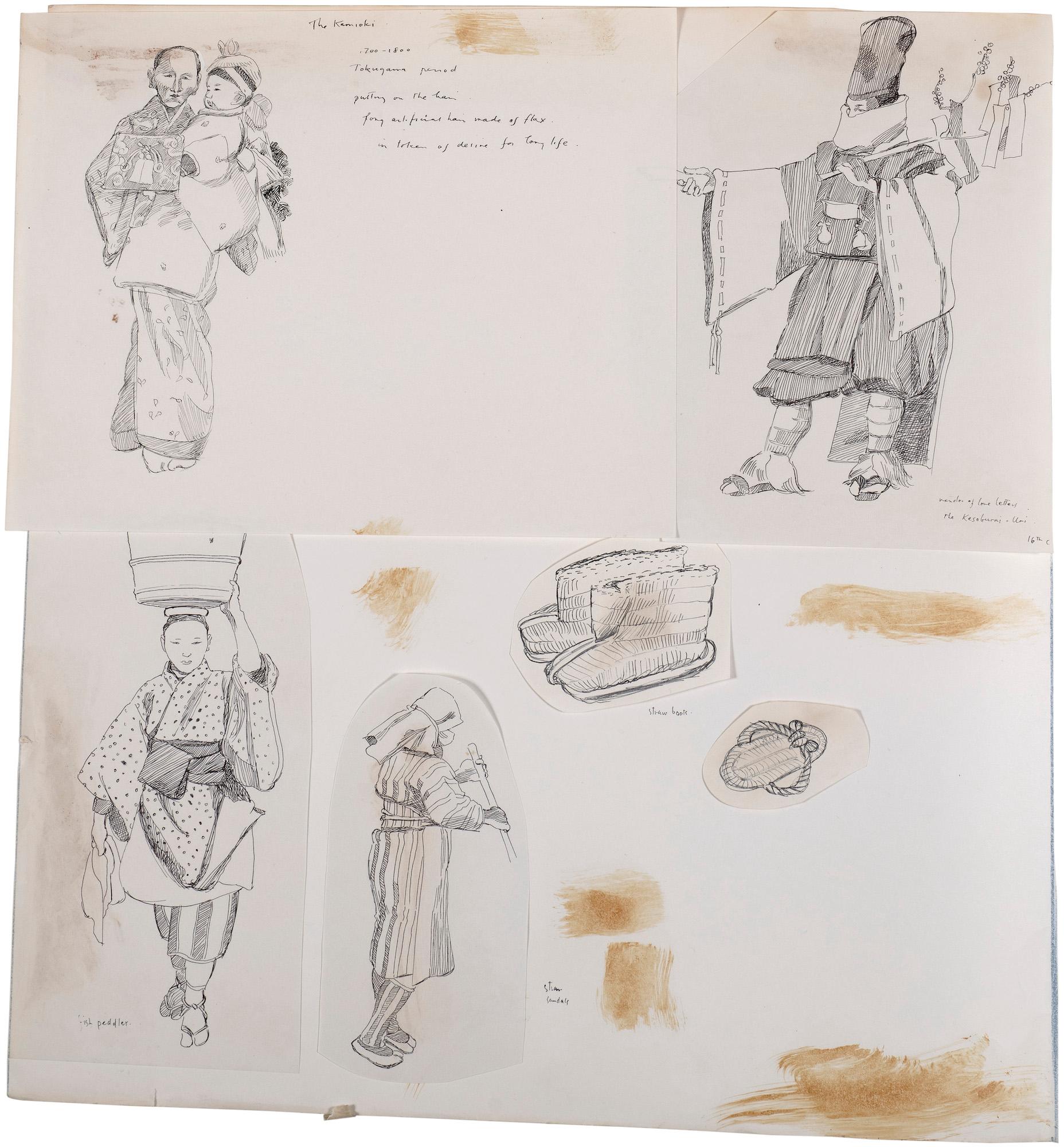
Jacqueline Ayer, Untitled (various clothing, Japan), c. 1973
Jacqueline Ayer (1930–2012) had a career that spanned many creative fields. She began as a fashion illustrator, and later turned her hand to children’s books, textiles and garments, as she worked in New York, Paris, London, Bangkok, Hong Kong and across India. These drawings were used as some of the final illustrations printed in Ayer's publication Oriental* Costume (1974). Descriptions from top left, clockwise: Grandmother and child. 19th century; Vendor of love letters, the 'Kasoburni-Uri', 16th century; Straw boots; Straw sandals; Fish pedlar, Iyo Ehime prefecture, contemporary. *The term ‘oriental’ has colonial and racist origins. It was established during a period when European powers took political control of other countries and defined non-European cultures as ‘inferior’ to their own. ‘Oriental’ was commonly used in English-speaking countries until the late 20th century to group together people, culture and places in Northern Africa, East Asia and Southeast Asia, as well as objects thought to have originated in these areas. The term has been widely rejected today as it exoticizes and ‘others’ these diverse cultures. Ayer used the term here to collectively refer to modes of dress from Cambodia, China, Japan, Mongolia, Nepal, Thailand and Tibet.
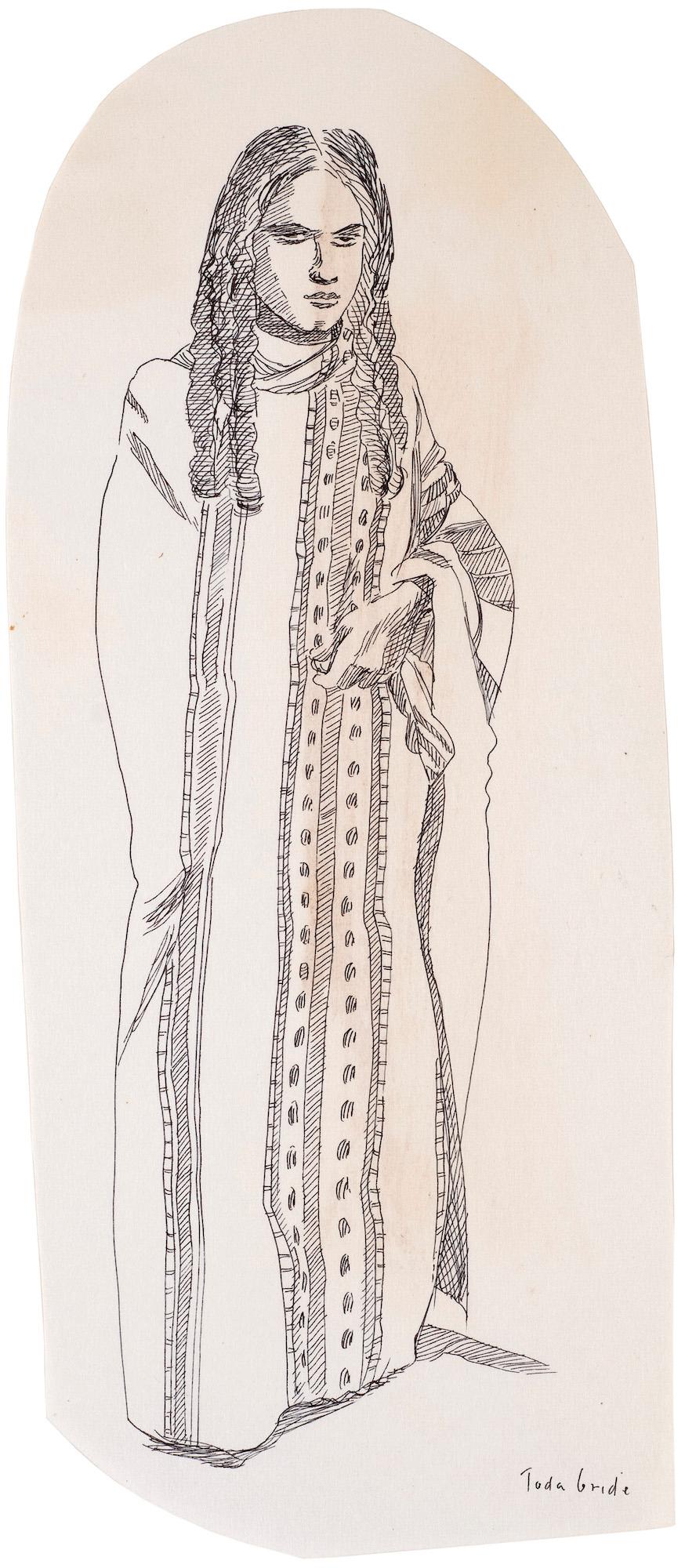
Jacqueline Ayer, Untitled (Toda bride), c. 1973
Jacqueline Ayer (1930–2012) had a career that spanned many creative fields. She began as a fashion illustrator, and later turned her hand to children’s books, textiles and garments, as she worked in New York, Paris, London, Bangkok, Hong Kong and across India. This drawing was used as one of the final illustrations printed in Ayer's publication Oriental* Costume (1974). *The term ‘oriental’ has colonial and racist origins. It was established during a period when European powers took political control of other countries and defined non-European cultures as ‘inferior’ to their own. ‘Oriental’ was commonly used in English-speaking countries until the late 20th century to group together people, culture and places in Northern Africa, East Asia and Southeast Asia, as well as objects thought to have originated in these areas. The term has been widely rejected today as it exoticizes and ‘others’ these diverse cultures. Ayer used the term here to collectively refer to modes of dress from Cambodia, China, Japan, Mongolia, Nepal, Thailand and Tibet.
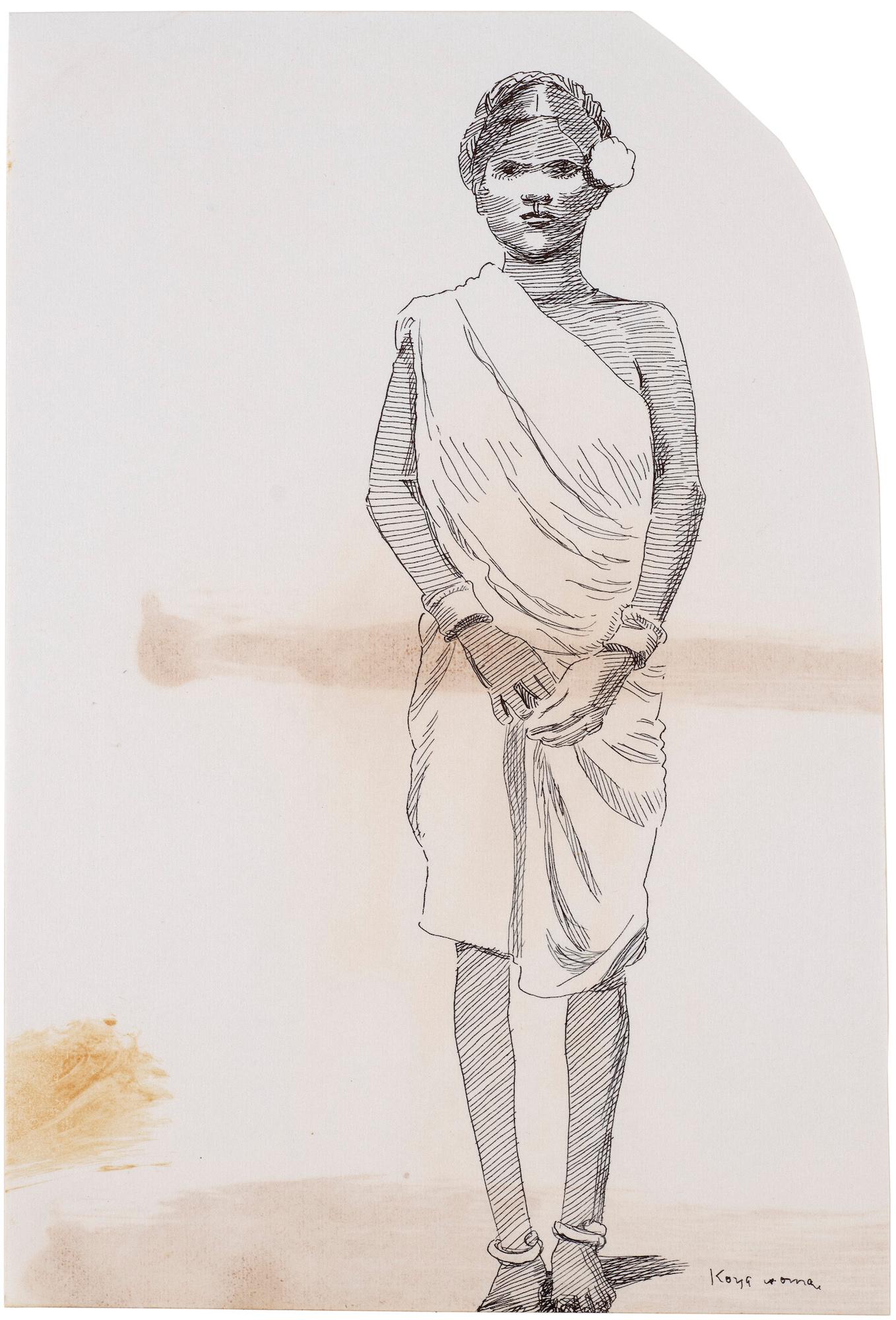
Jacqueline Ayer, Untitled (Koya woman), c. 1973
Jacqueline Ayer (1930–2012) had a career that spanned many creative fields. She began as a fashion illustrator, and later turned her hand to children’s books, textiles and garments, as she worked in New York, Paris, London, Bangkok, Hong Kong and across India. This drawing was used as one of the final illustrations printed in Ayer's publication Oriental* Costume (1974). *The term ‘oriental’ has colonial and racist origins. It was established during a period when European powers took political control of other countries and defined non-European cultures as ‘inferior’ to their own. ‘Oriental’ was commonly used in English-speaking countries until the late 20th century to group together people, culture and places in Northern Africa, East Asia and Southeast Asia, as well as objects thought to have originated in these areas. The term has been widely rejected today as it exoticizes and ‘others’ these diverse cultures. Ayer used the term here to collectively refer to modes of dress from Cambodia, China, Japan, Mongolia, Nepal, Thailand and Tibet.
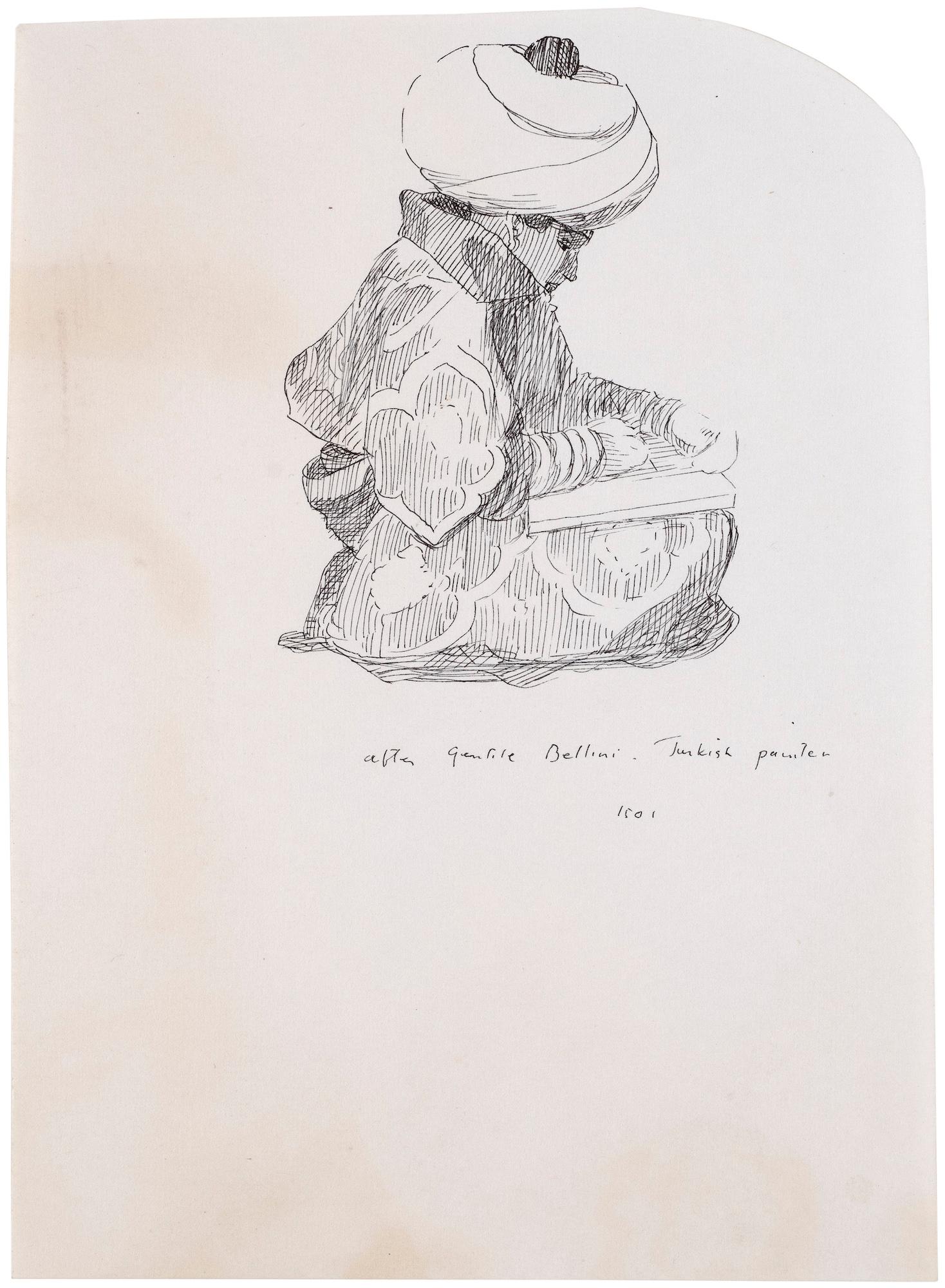
Jacqueline Ayer, Untitled (Turkish caftan, Turkey, 1501), c. 1973
Jacqueline Ayer (1930–2012) had a career that spanned many creative fields. She began as a fashion illustrator, and later turned her hand to children’s books, textiles and garments, as she worked in New York, Paris, London, Bangkok, Hong Kong and across India. This drawing was used as one of the final illustrations printed in Ayer's publication Oriental* Costume (1974). *The term ‘oriental’ has colonial and racist origins. It was established during a period when European powers took political control of other countries and defined non-European cultures as ‘inferior’ to their own. ‘Oriental’ was commonly used in English-speaking countries until the late 20th century to group together people, culture and places in Northern Africa, East Asia and Southeast Asia, as well as objects thought to have originated in these areas. The term has been widely rejected today as it exoticizes and ‘others’ these diverse cultures. Ayer used the term here to collectively refer to modes of dress from Cambodia, China, Japan, Mongolia, Nepal, Thailand and Tibet.
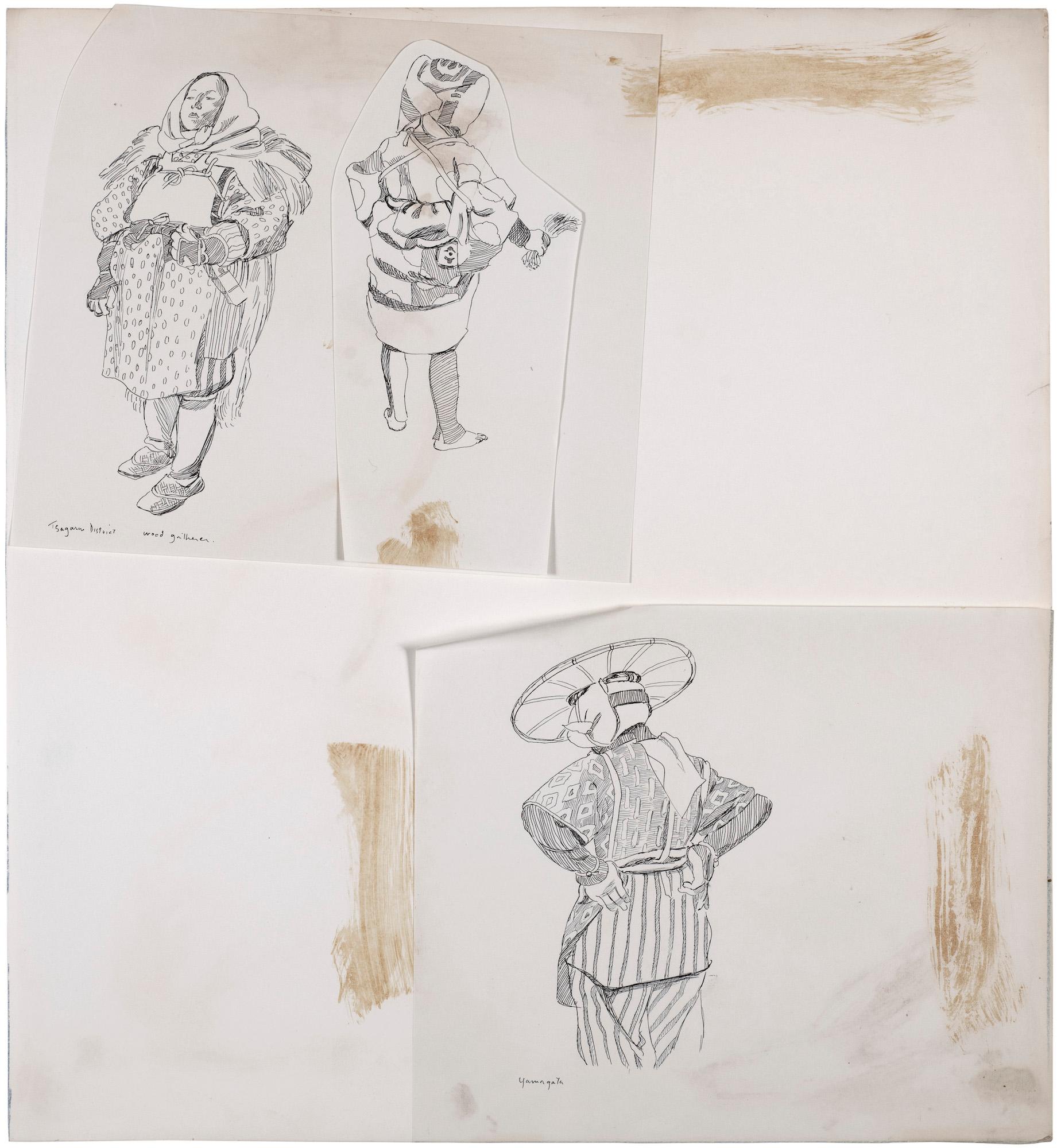
Jacqueline Ayer, Untitled (various Japanese working attire), c. 1973
Jacqueline Ayer (1930–2012) had a career that spanned many creative fields. She began as a fashion illustrator, and later turned her hand to children’s books, textiles and garments, as she worked in New York, Paris, London, Bangkok, Hong Kong and across India. These drawings were used as some of the final illustrations printed in Ayer's publication Oriental* Costume (1974). Descriptions from left: Tsaguru wood gatherer, Japan; Rice planter, Kochi; Yamagata field worker (back view). *The term ‘oriental’ has colonial and racist origins. It was established during a period when European powers took political control of other countries and defined non-European cultures as ‘inferior’ to their own. ‘Oriental’ was commonly used in English-speaking countries until the late 20th century to group together people, culture and places in Northern Africa, East Asia and Southeast Asia, as well as objects thought to have originated in these areas. The term has been widely rejected today as it exoticizes and ‘others’ these diverse cultures. Ayer used the term here to collectively refer to modes of dress from Cambodia, China, Japan, Mongolia, Nepal, Thailand and Tibet.
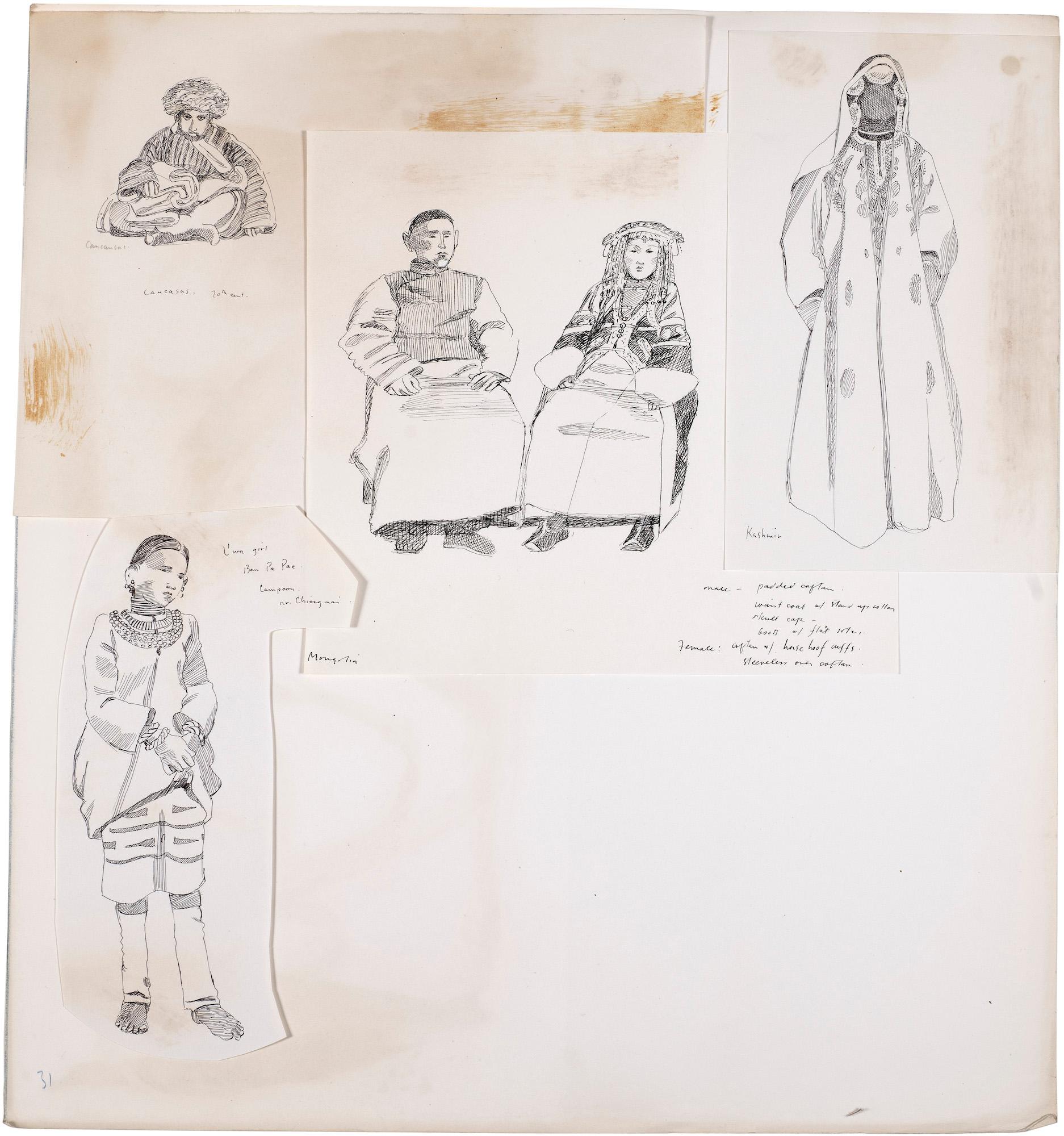
Jacqueline Ayer, Untitled (various clothing featured on page titled 'The Closed Sewn Garment', and Karen woman), c. 1973
Jacqueline Ayer (1930–2012) had a career that spanned many creative fields. She began as a fashion illustrator, and later turned her hand to children’s books, textiles and garments, as she worked in New York, Paris, London, Bangkok, Hong Kong and across India. This drawing was used as one of the final illustrations printed in Ayer's publication Oriental* Costume (1974). Descriptions from left: Padded loose robe, Caucasus, 19th century; Diagonal closed sewn garment, the layered caftan, Mongolia, 19th century; Closed sewn garment, Kashmir, contemporary; Karen woman. *The term ‘oriental’ has colonial and racist origins. It was established during a period when European powers took political control of other countries and defined non-European cultures as ‘inferior’ to their own. ‘Oriental’ was commonly used in English-speaking countries until the late 20th century to group together people, culture and places in Northern Africa, East Asia and Southeast Asia, as well as objects thought to have originated in these areas. The term has been widely rejected today as it exoticizes and ‘others’ these diverse cultures. Ayer used the term here to collectively refer to modes of dress from Cambodia, China, Japan, Mongolia, Nepal, Thailand and Tibet.
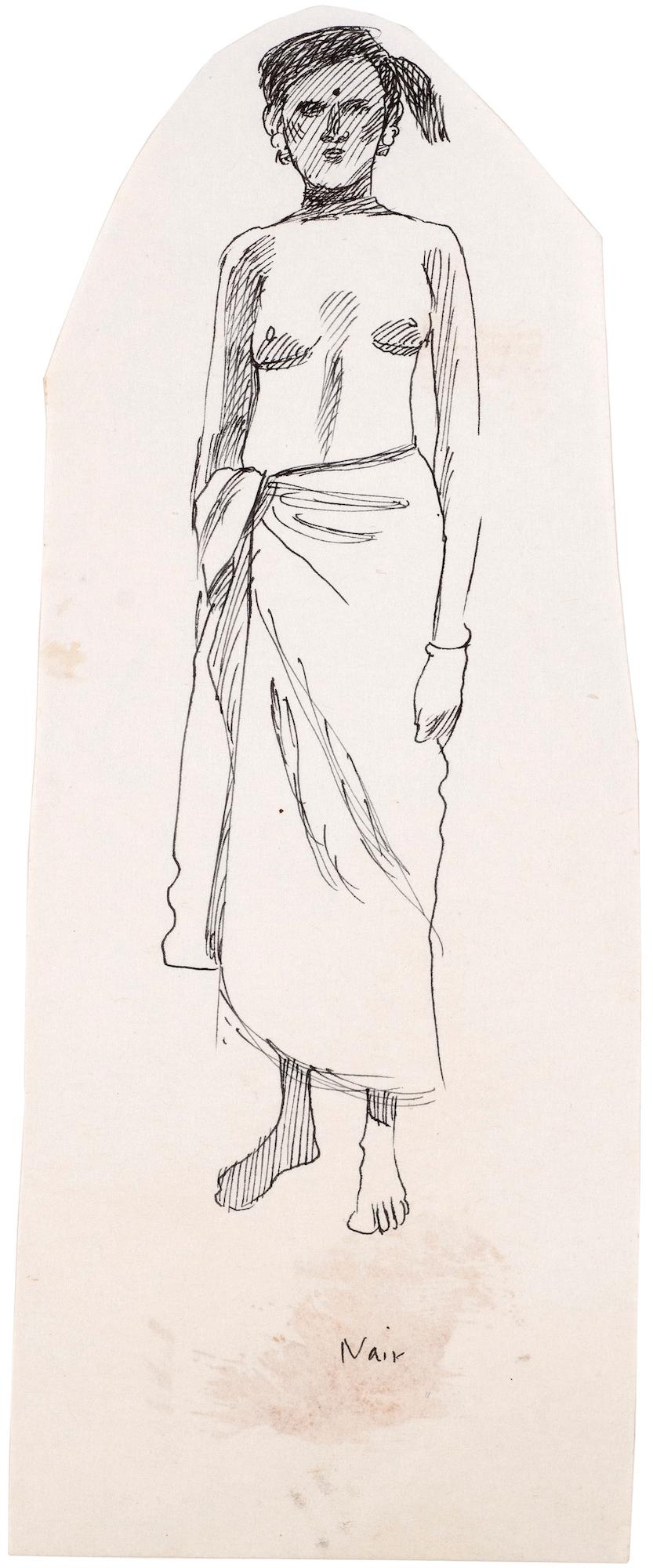
Jacqueline Ayer, Untitled (Nair woman), c. 1973
Jacqueline Ayer (1930–2012) had a career that spanned many creative fields. She began as a fashion illustrator, and later turned her hand to children’s books, textiles and garments, as she worked in New York, Paris, London, Bangkok, Hong Kong and across India. This drawing was used as one of the final illustrations printed in Ayer's publication Oriental* Costume (1974). *The term ‘oriental’ has colonial and racist origins. It was established during a period when European powers took political control of other countries and defined non-European cultures as ‘inferior’ to their own. ‘Oriental’ was commonly used in English-speaking countries until the late 20th century to group together people, culture and places in Northern Africa, East Asia and Southeast Asia, as well as objects thought to have originated in these areas. The term has been widely rejected today as it exoticizes and ‘others’ these diverse cultures. Ayer used the term here to collectively refer to modes of dress from Cambodia, China, Japan, Mongolia, Nepal, Thailand and Tibet.

Jacqueline Ayer, Untitled, Date unknown
Jacqueline Ayer (1930–2012) had a career that spanned many creative fields. She began as a fashion illustrator, and later turned her hand to children’s books, textiles and garments, as she worked in New York, Paris, London, Bangkok, Hong Kong and across India. Ayer often used a sketchbook to record her observations and ideas for book narratives and fashion designs. The context for this drawing is unknown.
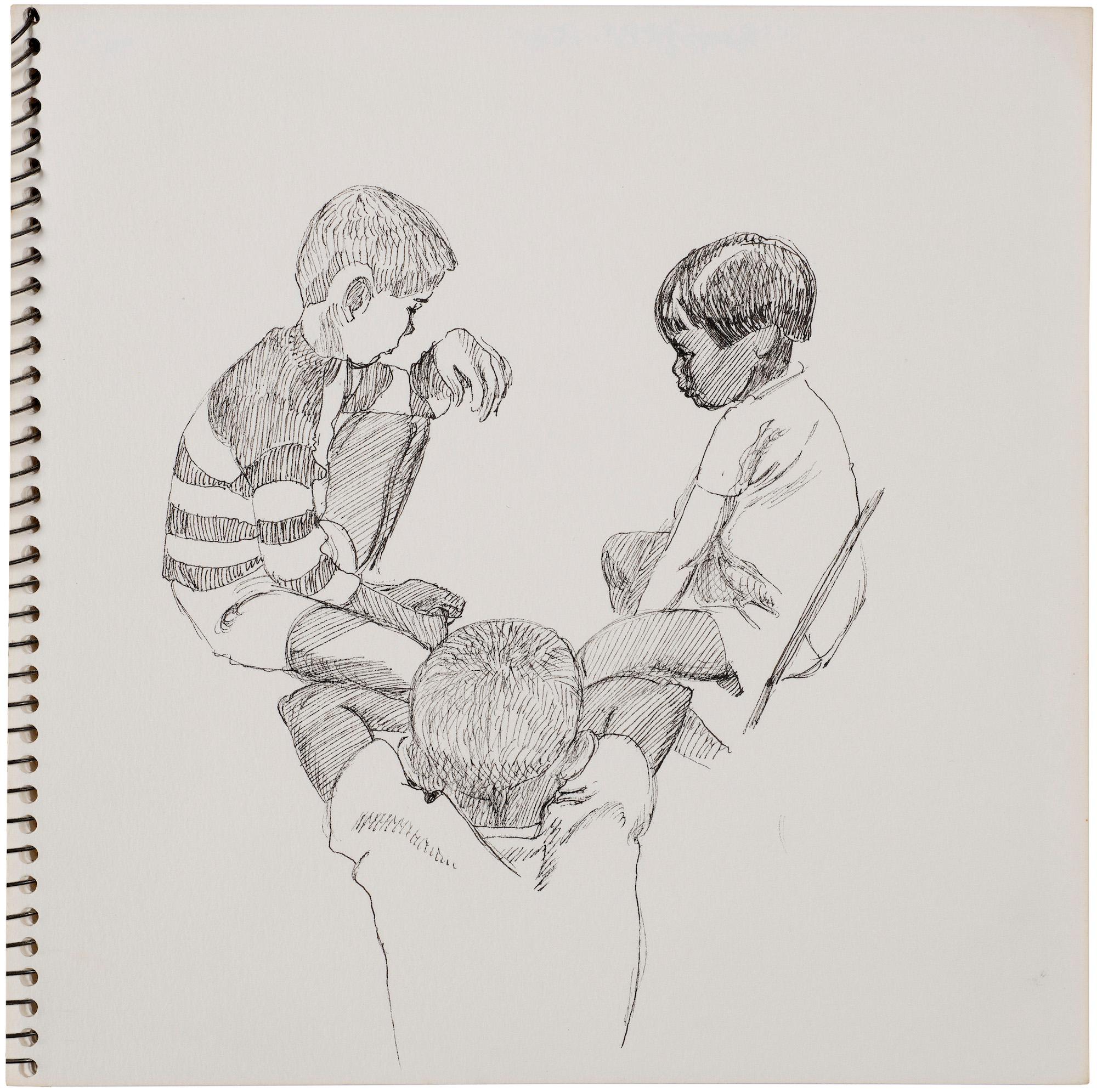
Jacqueline Ayer, Untitled, Date unknown
Jacqueline Ayer (1930–2012) had a career that spanned many creative fields. She began as a fashion illustrator, and later turned her hand to children’s books, textiles and garments, as she worked in New York, Paris, London, Bangkok, Hong Kong and across India. Ayer often used a sketchbook to record her observations and ideas for book narratives and fashion designs. The context for this drawing is unknown.
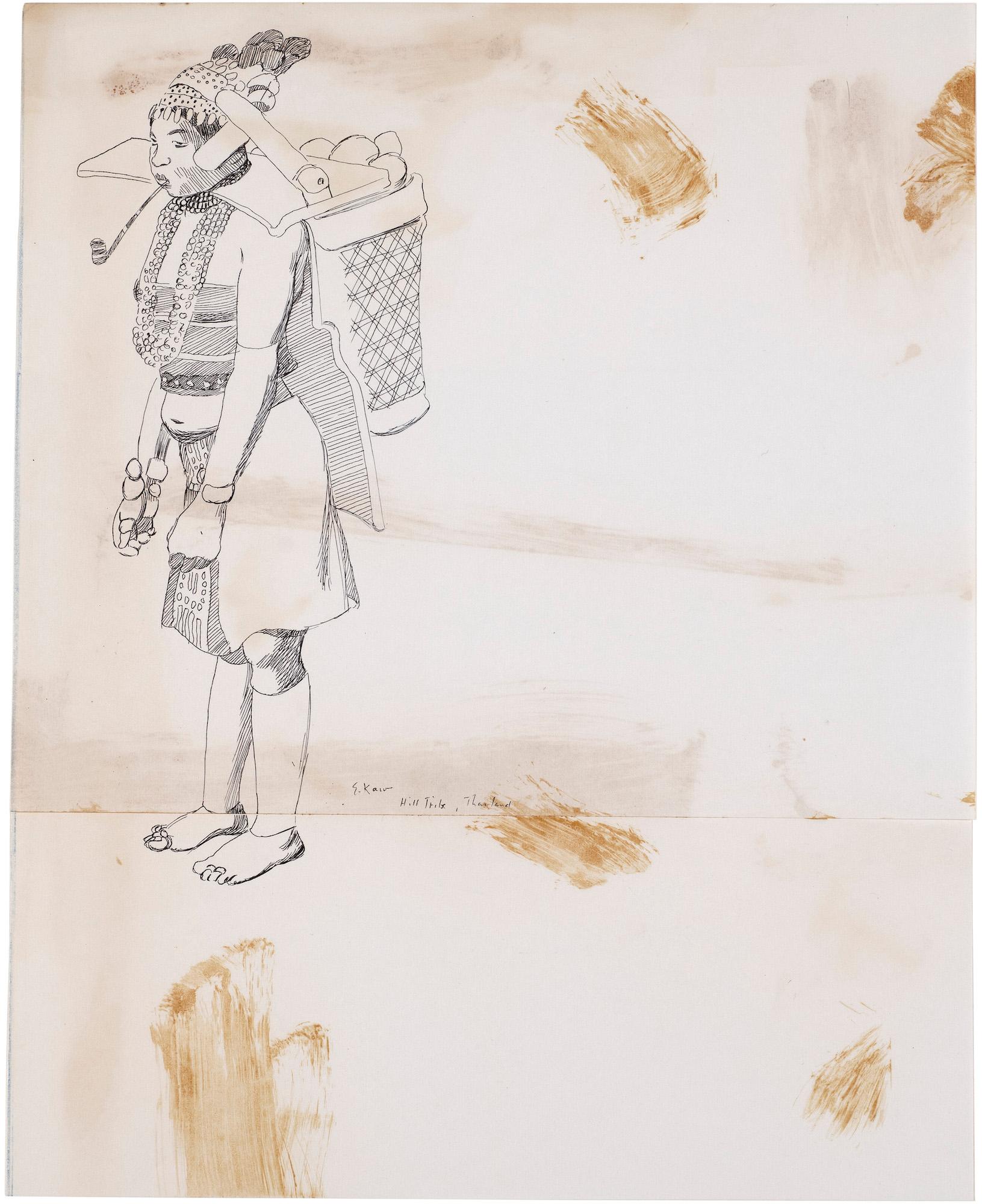
Jacqueline Ayer, Untitled (E Kaw, young girl, northern Thailand), c.1973
Jacqueline Ayer (1930–2012) had a career that spanned many creative fields. She began as a fashion illustrator, and later turned her hand to children’s books, textiles and garments, as she worked in New York, Paris, London, Bangkok, Hong Kong and across India. This drawing was used as one of the final illustrations printed in Ayer's publication Oriental* Costume (1974). *The term ‘oriental’ has colonial and racist origins. It was established during a period when European powers took political control of other countries and defined non-European cultures as ‘inferior’ to their own. ‘Oriental’ was commonly used in English-speaking countries until the late 20th century to group together people, culture and places in Northern Africa, East Asia and Southeast Asia, as well as objects thought to have originated in these areas. The term has been widely rejected today as it exoticizes and ‘others’ these diverse cultures. Ayer used the term here to collectively refer to modes of dress from Cambodia, China, Japan, Mongolia, Nepal, Thailand and Tibet.
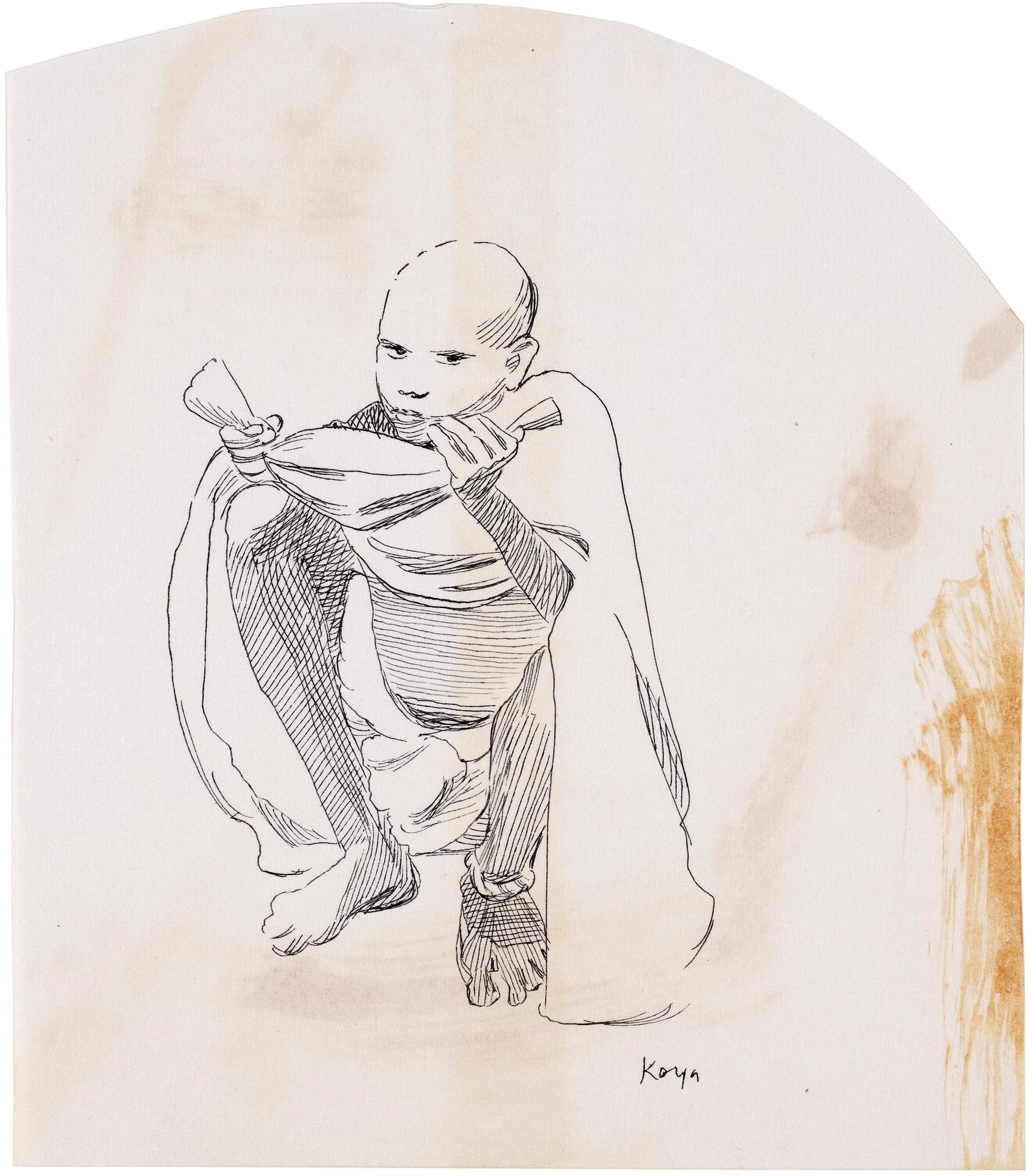
Jacqueline Ayer, Untitled (Koya man), c. 1973
Jacqueline Ayer (1930–2012) had a career that spanned many creative fields. She began as a fashion illustrator, and later turned her hand to children’s books, textiles and garments, as she worked in New York, Paris, London, Bangkok, Hong Kong and across India. This drawing was used as one of the final illustrations printed in Ayer's publication Oriental* Costume (1974). *The term ‘oriental’ has colonial and racist origins. It was established during a period when European powers took political control of other countries and defined non-European cultures as ‘inferior’ to their own. ‘Oriental’ was commonly used in English-speaking countries until the late 20th century to group together people, culture and places in Northern Africa, East Asia and Southeast Asia, as well as objects thought to have originated in these areas. The term has been widely rejected today as it exoticizes and ‘others’ these diverse cultures. Ayer used the term here to collectively refer to modes of dress from Cambodia, China, Japan, Mongolia, Nepal, Thailand and Tibet.
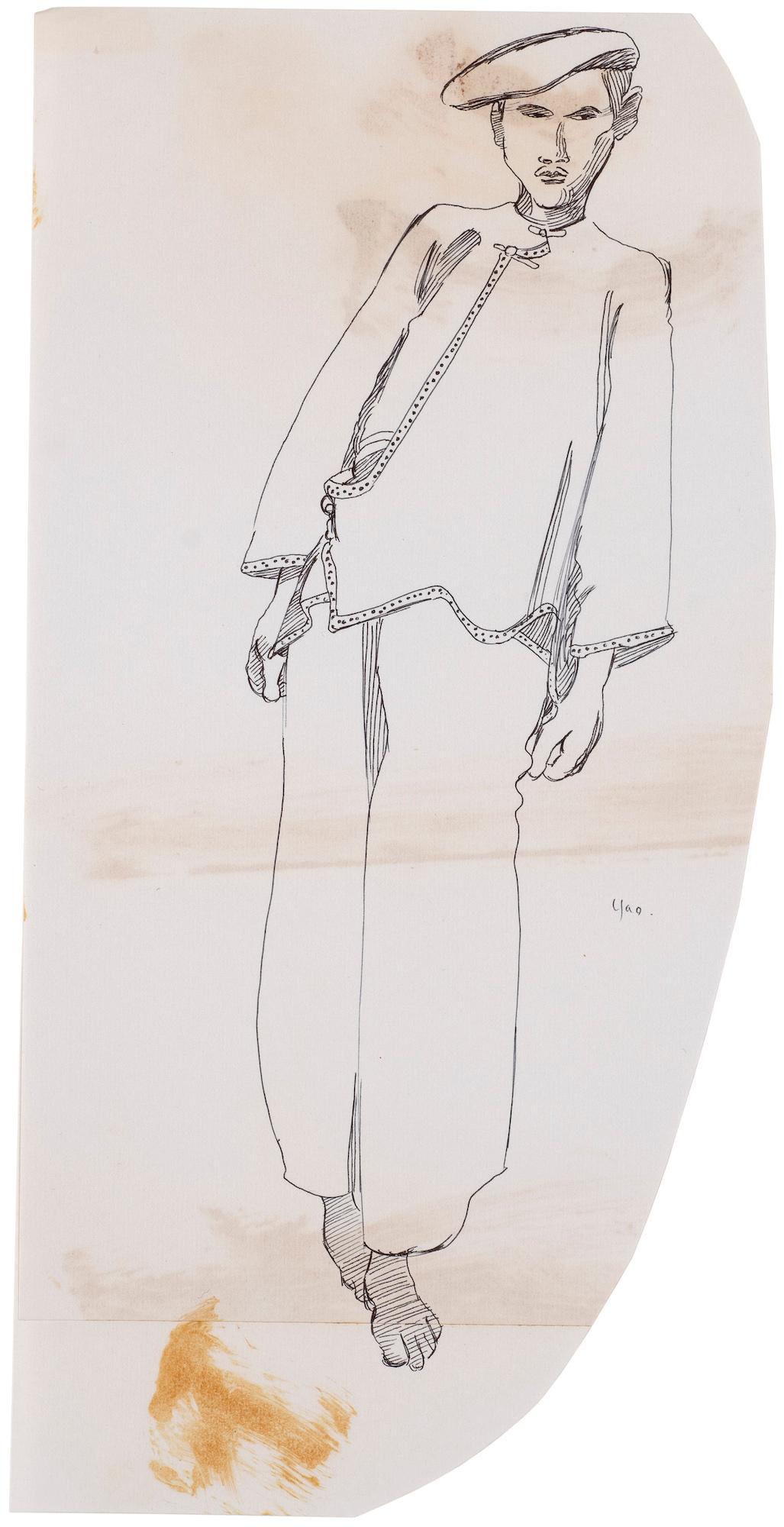
Jacqueline Ayer, Untitled (Yao man, Thailand), c. 1973
Jacqueline Ayer (1930–2012) had a career that spanned many creative fields. She began as a fashion illustrator, and later turned her hand to children’s books, textiles and garments, as she worked in New York, Paris, London, Bangkok, Hong Kong and across India. This drawing was used as one of the final illustrations printed in Ayer's publication Oriental* Costume (1974). *The term ‘oriental’ has colonial and racist origins. It was established during a period when European powers took political control of other countries and defined non-European cultures as ‘inferior’ to their own. ‘Oriental’ was commonly used in English-speaking countries until the late 20th century to group together people, culture and places in Northern Africa, East Asia and Southeast Asia, as well as objects thought to have originated in these areas. The term has been widely rejected today as it exoticizes and ‘others’ these diverse cultures. Ayer used the term here to collectively refer to modes of dress from Cambodia, China, Japan, Mongolia, Nepal, Thailand and Tibet.
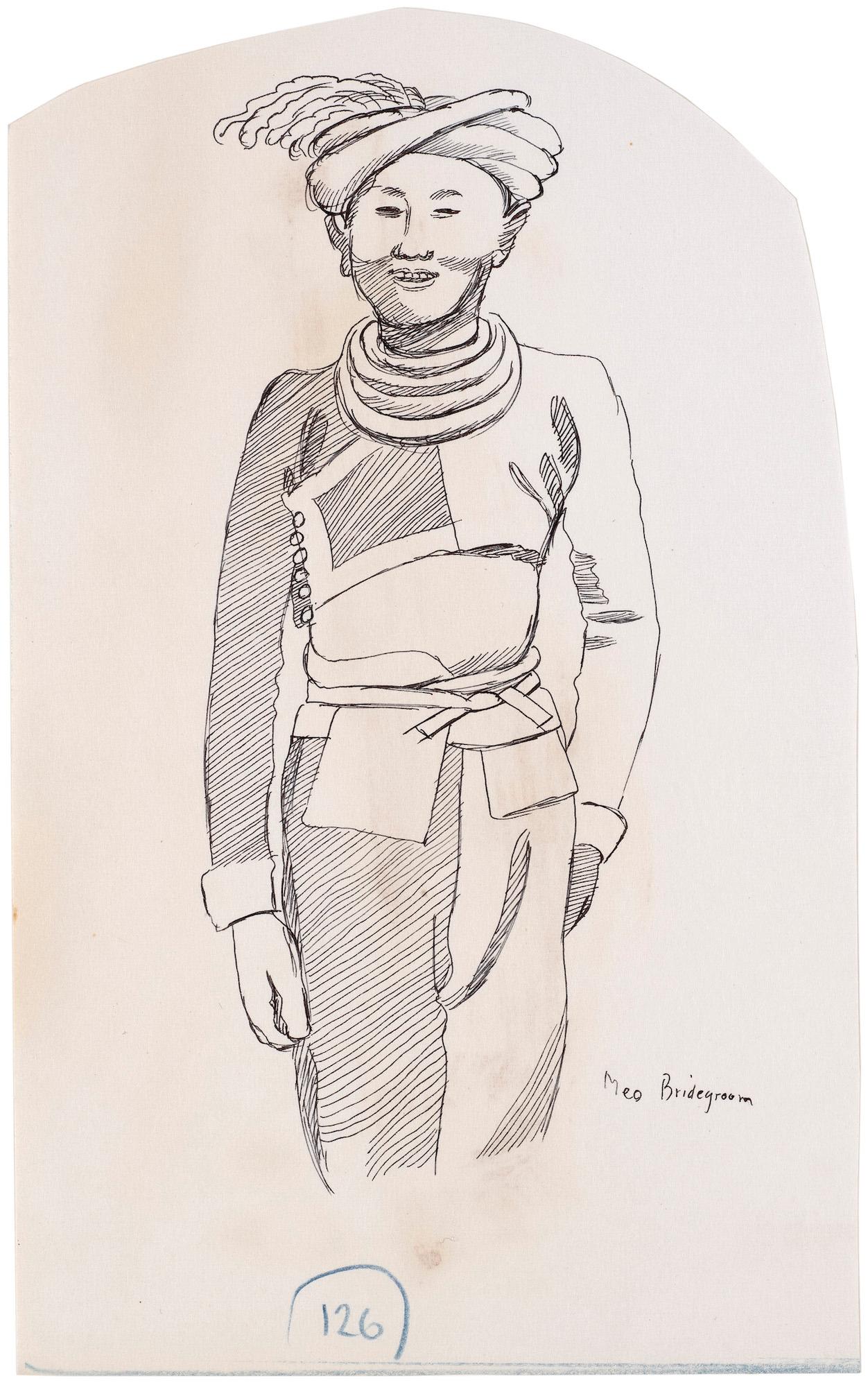
Jacqueline Ayer, Untitled (Meo bridegroom, Thailand), c. 1973
Jacqueline Ayer (1930–2012) had a career that spanned many creative fields. She began as a fashion illustrator, and later turned her hand to children’s books, textiles and garments, as she worked in New York, Paris, London, Bangkok, Hong Kong and across India. This drawing was used as one of the final illustrations printed in Ayer's publication Oriental* Costume (1974). *The term ‘oriental’ has colonial and racist origins. It was established during a period when European powers took political control of other countries and defined non-European cultures as ‘inferior’ to their own. ‘Oriental’ was commonly used in English-speaking countries until the late 20th century to group together people, culture and places in Northern Africa, East Asia and Southeast Asia, as well as objects thought to have originated in these areas. The term has been widely rejected today as it exoticizes and ‘others’ these diverse cultures. Ayer used the term here to collectively refer to modes of dress from Cambodia, China, Japan, Mongolia, Nepal, Thailand and Tibet.
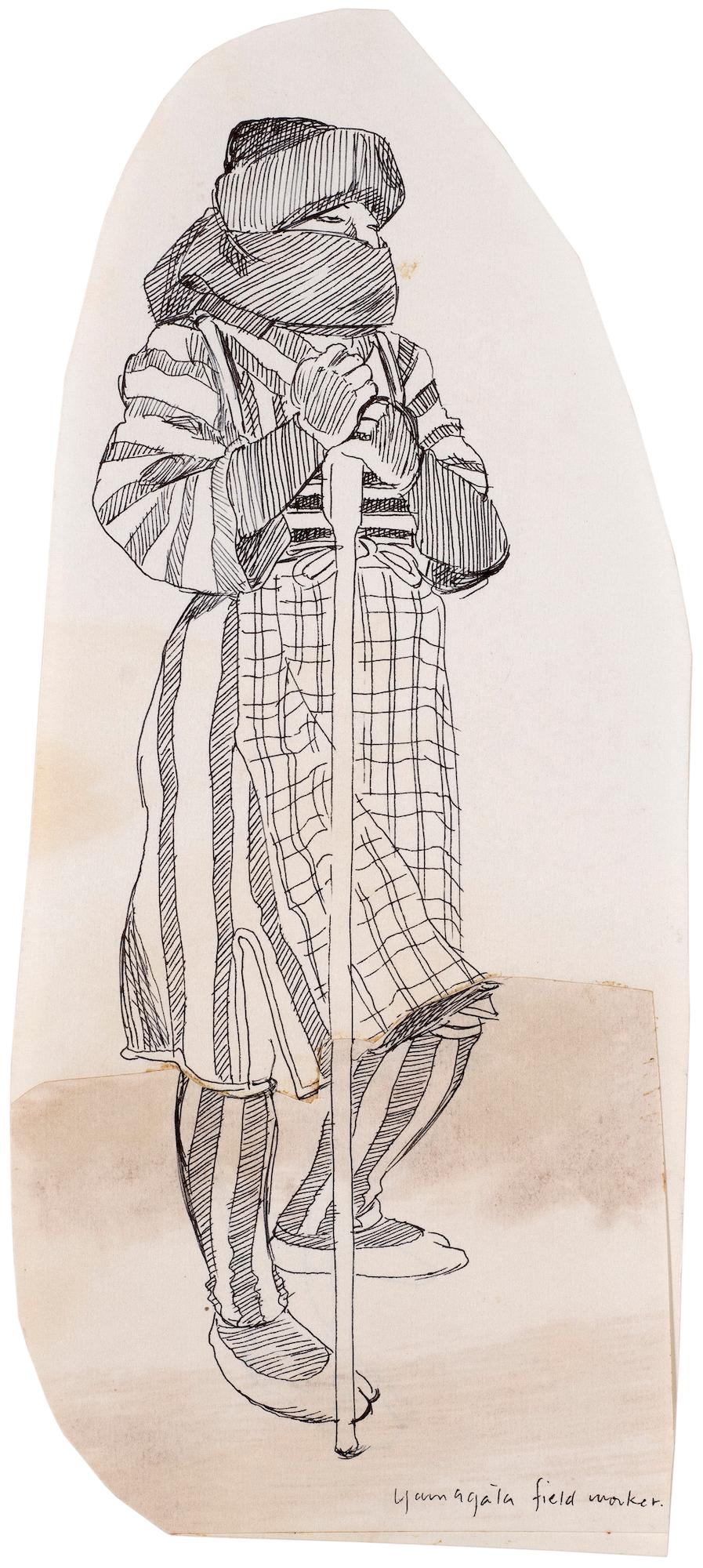
Jacqueline Ayer, Untitled (Yamagata field worker, contemporary), c. 1973
Jacqueline Ayer (1930–2012) had a career that spanned many creative fields. She began as a fashion illustrator, and later turned her hand to children’s books, textiles and garments, as she worked in New York, Paris, London, Bangkok, Hong Kong and across India. This drawing was used as one of the final illustrations printed in Ayer's publication Oriental* Costume (1974). *The term ‘oriental’ has colonial and racist origins. It was established during a period when European powers took political control of other countries and defined non-European cultures as ‘inferior’ to their own. ‘Oriental’ was commonly used in English-speaking countries until the late 20th century to group together people, culture and places in Northern Africa, East Asia and Southeast Asia, as well as objects thought to have originated in these areas. The term has been widely rejected today as it exoticizes and ‘others’ these diverse cultures. Ayer used the term here to collectively refer to modes of dress from Cambodia, China, Japan, Mongolia, Nepal, Thailand and Tibet.
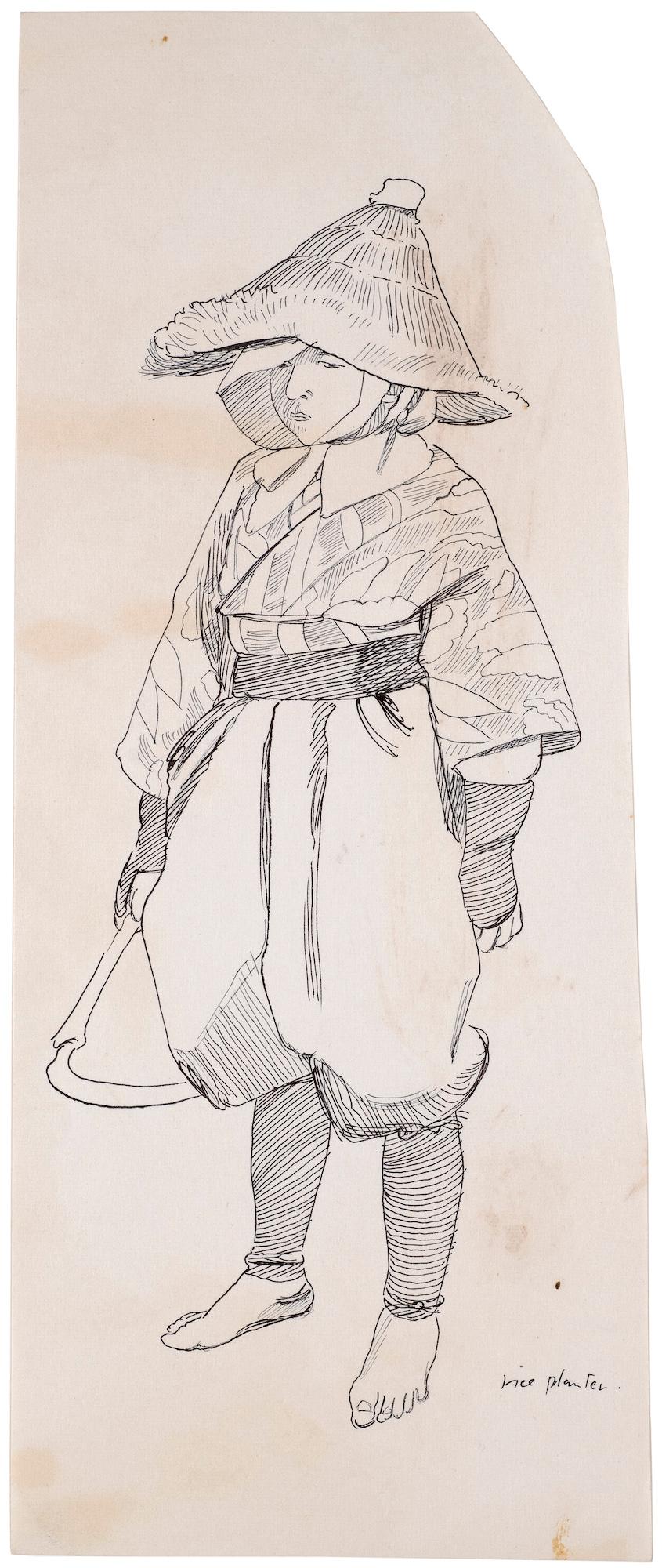
Jacqueline Ayer, Untitled (Rice planter, Himi), c. 1973
Jacqueline Ayer (1930–2012) had a career that spanned many creative fields. She began as a fashion illustrator, and later turned her hand to children’s books, textiles and garments, as she worked in New York, Paris, London, Bangkok, Hong Kong and across India. This drawing was used as one of the final illustrations printed in Ayer's publication Oriental* Costume (1974). *The term ‘oriental’ has colonial and racist origins. It was established during a period when European powers took political control of other countries and defined non-European cultures as ‘inferior’ to their own. ‘Oriental’ was commonly used in English-speaking countries until the late 20th century to group together people, culture and places in Northern Africa, East Asia and Southeast Asia, as well as objects thought to have originated in these areas. The term has been widely rejected today as it exoticizes and ‘others’ these diverse cultures. Ayer used the term here to collectively refer to modes of dress from Cambodia, China, Japan, Mongolia, Nepal, Thailand and Tibet.
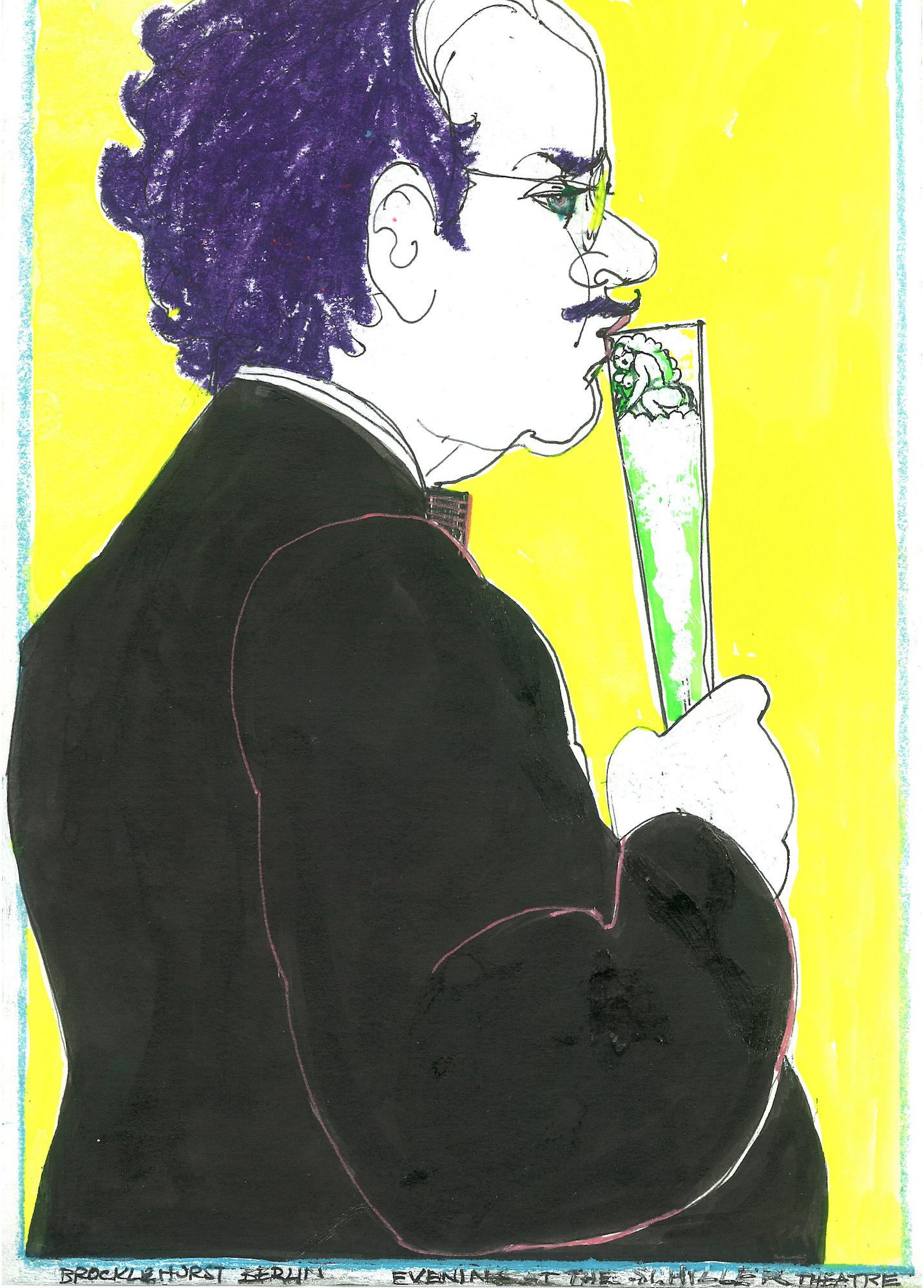
Jo Brocklehurst, Evening at the Schiller Theatre, 1999
Jo (Josephine) Brocklehurst (1935 - 2006) studied at Central Saint Martins and began her career as a fashion illustrator. She later focused on portraiture, drawing directly from models at her studio in West Hampstead and in nightclubs and theatres in Berlin, London and New York. Her work documents the alternative subcultures of the 1970s, 80s and 90s that went on to shape mainstream fashion and performance scenes. In 1999, Brocklehurst was artist in residence at newspaper Berliner Zeitung during Berliner Theatertreffen, a festival of new German theatre. The paper wanted to revive the Weimar tradition of theatre reviews being accompanied by illustrations, rather than using photographs. Brocklehurst drew behind the scenes and from her seat during performances. This drawing may have been made during the interval of a performance of play Die Eingeborene at the Schiller Theatre.
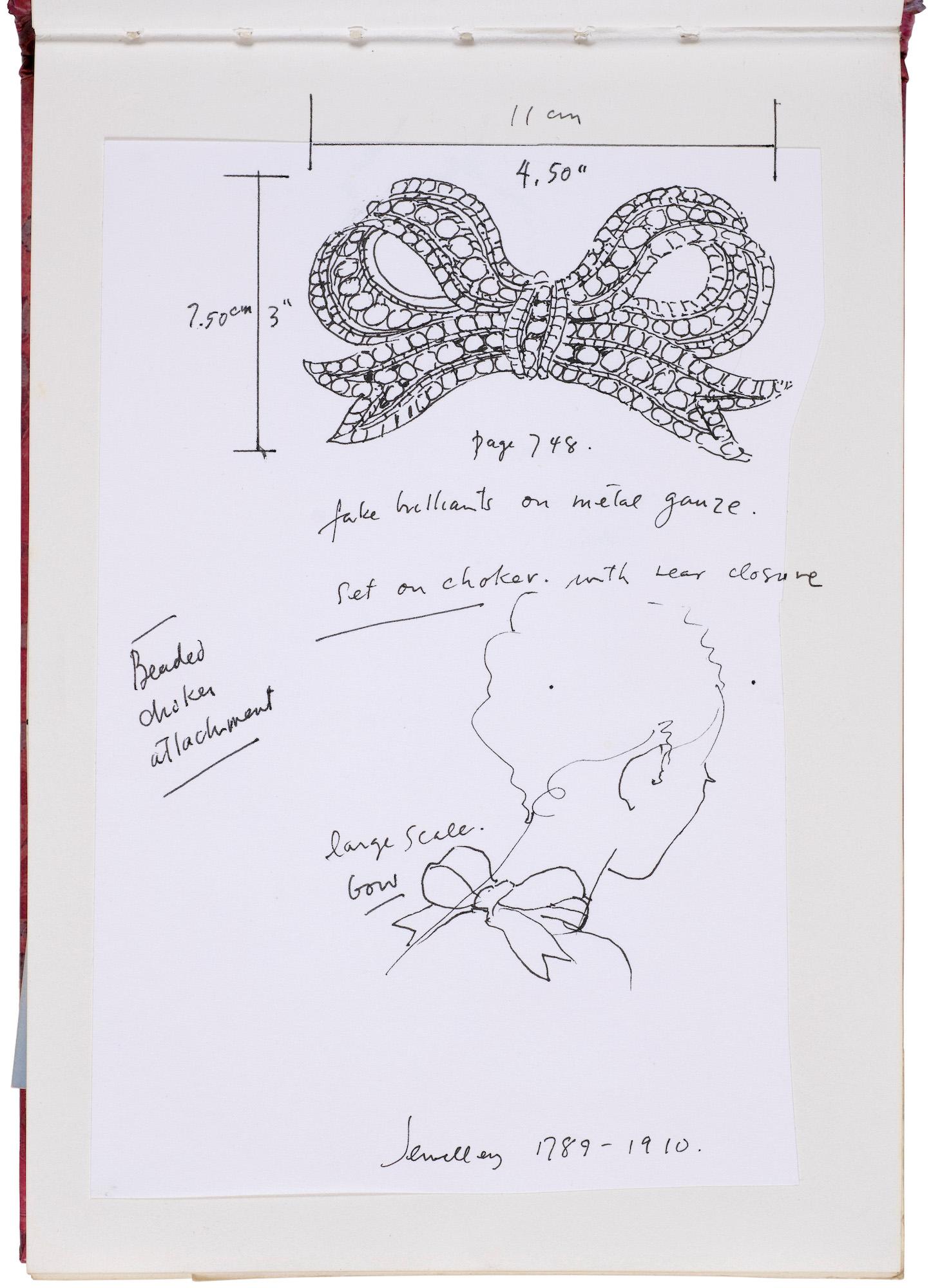
Jacqueline Ayer, Untitled, Date unknown
Jacqueline Ayer (1930–2012) had a career that spanned many creative fields. She began as a fashion illustrator, and later turned her hand to children’s books, textiles and garments, as she worked in New York, Paris, London, Bangkok, Hong Kong and across India. Ayer often used a sketchbook to record her observations and ideas for book narratives and fashion designs. The context for this drawing is unknown.
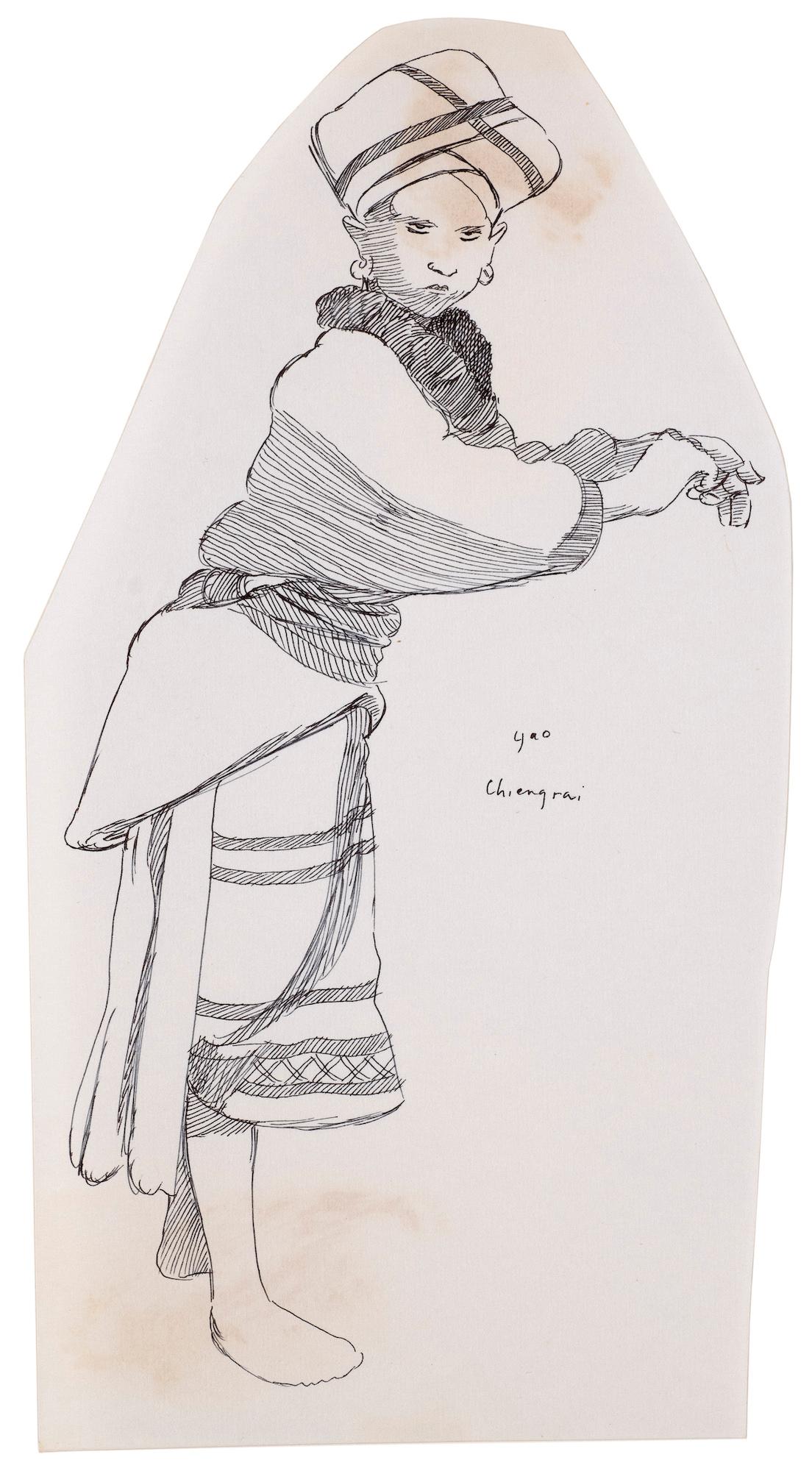
Jacqueline Ayer, Untitled (Yao girl, Thailand), c. 1973
Jacqueline Ayer (1930–2012) had a career that spanned many creative fields. She began as a fashion illustrator, and later turned her hand to children’s books, textiles and garments, as she worked in New York, Paris, London, Bangkok, Hong Kong and across India. This drawing was used as one of the final illustrations printed in Ayer's publication Oriental* Costume (1974). *The term ‘oriental’ has colonial and racist origins. It was established during a period when European powers took political control of other countries and defined non-European cultures as ‘inferior’ to their own. ‘Oriental’ was commonly used in English-speaking countries until the late 20th century to group together people, culture and places in Northern Africa, East Asia and Southeast Asia, as well as objects thought to have originated in these areas. The term has been widely rejected today as it exoticizes and ‘others’ these diverse cultures. Ayer used the term here to collectively refer to modes of dress from Cambodia, China, Japan, Mongolia, Nepal, Thailand and Tibet.